28 Jun Crime and Deinstitutionalization: The Henry Sáenz Case and Guatemala’s National Defense
By,
Jesús Romero. Co-Founder & Senior Fellow, MSI²
Introduction: Guatemala is undergoing a critical phase in terms of institutional integrity and national security.
At the center of the debate is Minister of Defense General Henry Sáenz Ramos, whose continued tenure beyond the constitutional limit, administrative background lacking operational leadership, and alleged involvement in strategic concessions to foreign actors have sparked controversy.
As a former U.S. Department of Defense diplomatic representative in Guatemala for five years, I offer a professional analysis to contribute to the public debate with institutional and defense-oriented insights.
Prolonged Tenure: Violation of Legal Framework?
Legal scholars like Dr. Omar Barrios have warned that Sáenz’s continuation in office beyond June 27 may violate the Guatemalan Penal Code, as he has already served 33 years in the military, surpassing the legal threshold. The Constitutional Court, by denying an injunction on June 24, 2025, left it to the Executive Branch to act in accordance with the law.
Strategic Concessions Under Scrutiny: The Puerto Quetzal Case
An audio clip circulating in media and social networks allegedly implicates Minister Sáenz in the irregular transfer of military land in Puerto Quetzal to the Chinese firm Trans-Shipping World. Although the recording’s authenticity has not been officially verified, its release has raised serious concerns about transparency in the Ministry’s strategic decisions.
DIGECAM: Firearms Licenses and the Black Market
Congress has launched an investigation into the General Directorate of Arms and Ammunition Control (DIGECAM) following allegations of irregular license issuances. Under Sáenz’s leadership, procedures reportedly lacked transparency, contributing to the growth of a black market in weapons, as reported in early 2025. The Ministry only released relevant documents in March after initially withholding them.
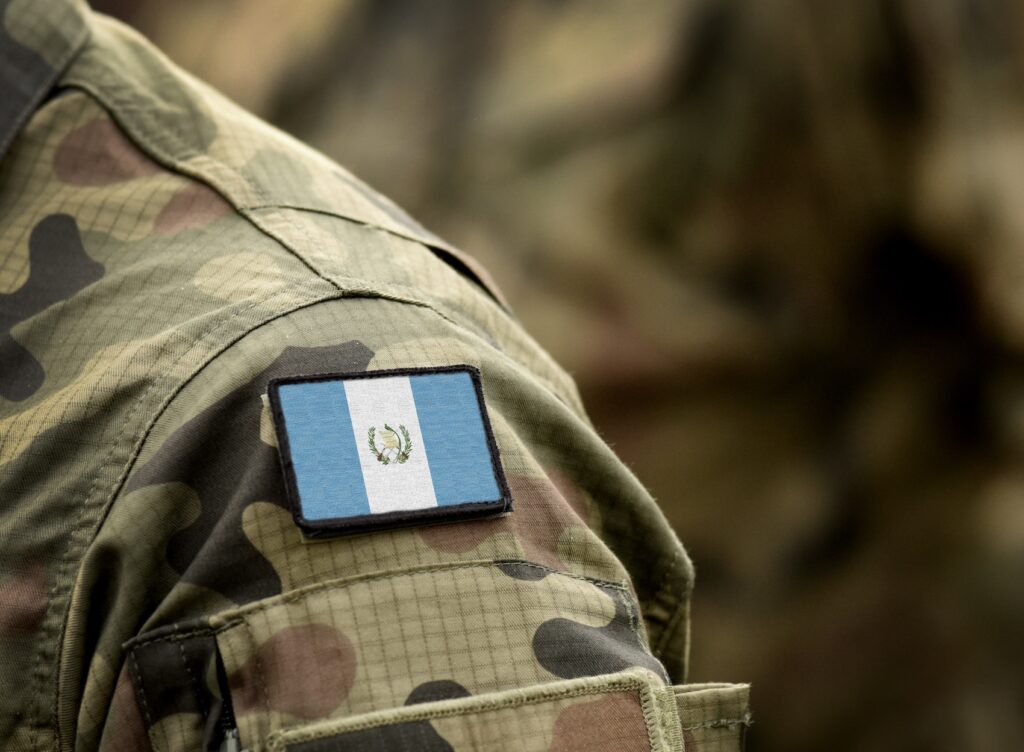
Military Profile: Lack of Operational Leadership?
Unlike several of his predecessors, General Sáenz lacks direct command experience in tactical units. His career has largely focused on logistics, administration, and procurement. There is no record of him having commanded battalions or brigades, or having led units in crisis scenarios.
This contrasts with figures such as:
- General Williams Mansilla (2016–2017), who had combat experience despite later corruption investigations.
- General Juan Henry Yovani Reyes Chigua (2022), who held key roles in intelligence and special forces.
In an institution like the Guatemalan Army, where respect is earned in the field, this difference is significant.
Institutional and Geopolitical Risks
In a region marked by narco-trafficking, extraregional pressures, and transnational corruption networks, national defense requires solid leadership, operational expertise, and internal legitimacy. The perception that the minister is beholden to political or foreign interests undermines military morale and democratic governance.
This concern has been echoed by key international actors. During the 7th U.S.–Guatemala Defense Bilateral Working Group in June 2024, the U.S. Department of Defense — through Deputy Assistant Secretary Rebecca Zimmerman — formally urged the Guatemalan government to “advance anti-corruption initiatives, increase transparency, and strengthen institutional oversight” in the defense sector. These remarks were delivered at a high-level forum co-chaired by Minister Sáenz himself, confirming that governance and transparency issues are central to the bilateral strategic dialogue (U.S. Department of Defense, 2024).
Additionally, U.S. Secretary of State Marco Rubio, during his official visit to Guatemala in February 2025, warned that “narcotrafficking generates a culture of corruption” and stated that the U.S. would support efforts to counter this threat, including the expansion of strategic ports in collaboration with U.S. Army engineers — with the explicit goal of curbing Chinese penetration into the country’s critical infrastructure.
Recommendations for Action
In light of this situation, President Arévalo must act decisively and within constitutional bounds. The following three measures are proposed:
- An independent external audit of Sáenz’s decisions regarding land transfers, procurement, and firearms licenses.
- Formal review of the minister’s legal status by the Attorney General’s Office and the Office of the Comptroller General.
- Appointment of an interim replacement with operational experience to restore internal confidence and the military’s public image.
Conclusion
The Henry Sáenz case is not just a legal dilemma, but an institutional one: Who truly leads Guatemala’s national defense?
Keeping a weakened and questioned minister in office undermines the legitimacy of the defense apparatus at a time when the country needs strength, clarity, and strategic vision.
The time to act is now — for the integrity of the state, the security of the nation, and the future of the Armed Forces.
References
Congress of the Republic of Guatemala. (2024, April 24). The National Defense Commission audits budget execution and DIGECAM operations. Congressional News. https://www.congreso.gob.gt/noticias_congreso/11319/2024/3
Prensa Libre. (2025, June 24). Constitutional Court rejects injunction from colonel questioning continuity of senior military officers with 33 years of service. https://www.prensalibre.com/ahora/guatemala/justicia/cc-rechaza-amparo-de-coronel-que-cuestiono-continuidad-de-altos-mandos-militares-con-33-anos-de-servicio/
U.S. Department of Defense. (2024, June 5). Readout of the 7th U.S.–Guatemala Defense Bilateral Working Group [Press release]. https://www.defense.gov/News/Releases/Release/Article/3804343/readout-of-the-7th-us-guatemala-defense-bilateral-working-group/
The opinions expressed in this article are those of the author and do not necessarily reflect the views of the Miami Strategic Intelligence Institute (MSI²).