
29 Jun From Ceasefires to Kinetic Force: Inside Colombia’s Bold Security Overhaul
By,
Jaime (Jim) González, Senior Fellow, Analytical Tradecraft SME
In my March 2025 article, “Colombia at a Crossroads: New Leadership, New Strategy, Uncertain Future,” I argued that Minister of Defense (MoD) Pedro Arnulfo Sánchez Suárez could pursue three courses of action to improve civil‑military relations while conducting selective counterinsurgency operations alongside peacebuilding efforts.
I named one of these courses of action “A Hybrid Approach.” After four months as defense minister, I remain confident that MoD Sánchez chose this approach based on his new operational policies. However, this hybrid is no gentle blend. It is a tension-filled balancing act between the necessity of combat and civil accountability. Moreover, Sánchez is a tightrope walker.
Defense Minister Sánchez assumed office as Colombia’s Minister of Defense in March 2025, following the issuance of Decree 0249, making him the first retired military officer to lead the Ministry since 1991. During February’s Cumbre de Gobernadores, Colombian President Gustavo announced his appointment, which immediately drew national attention due to his military background and public recognition following the successful 2023 rescue of the Mucutuy children (Infobae, 2025; El Heraldo, 2025). According to Colombia One (2025), Sánchez has championed a nonpartisan approach to defense policy, and many view him as an advocate for pragmatic, homegrown solutions to Colombia’s worsening security landscape. He inherited an overstretched and demoralized security apparatus amid one of Colombia’s gravest crises since the 2016 peace accord.
The country faces a proliferation of insurgent and criminal organizations that compete for control of cocaine production zones, narcotics trafficking corridors, illegal mining operations, and other illicit economies. Furthermore, deteriorating military equipment compounds this challenge. Aging Israeli-built Kfir fighter jets (Times of Israel, 2025) and Russian-made Mi‑17 transport helicopters (El Estratégico, 2025) continue to be essential for counterinsurgency operations and troop mobility.
The Catatumbo offensive by the ELN in January left over one hundred civilians dead and sent thousands fleeing through rain-choked trails with only what they could carry. This event marked the first significant security crisis of the year, caught the armed forces off guard, and further discredited President Gustavo Petro’s “Total Peace” plan—a comprehensive strategy aimed at negotiating with all armed groups simultaneously.
In response, on January 17, President Petro suspended peace talks with the ELN after officials met in November 2024 (AP News, 2025). Seven days later, on January 24, he declared a 90‑day state of exception for the Catatumbo region, which allowed the government to adopt extraordinary measures, including issuing decrees that carry the force of law under the Constitution (Bogota Post, 2025).
Since taking office, Defense Minister Sánchez has operated in a volatile political environment that enjoys strong executive support. Although President Petro appointed him, Petro’s credibility has suffered significantly because he failed to address Colombia’s deteriorating security situation. In many respects, Sánchez inherited both the burden and the consequences of a national security strategy that many consider incoherent and unviable. By June, the violence had metastasized. In Guaviare, dissidents loyal to “Iván Mordisco” launched an armed strike, while across the nation, security forces pursued those responsible for a failed assassination attempt against a presidential candidate. El Tiempo, 2025). As of June 1, dire conditions persist in many parts of the country (Daily Mail, 2025).
Intensified military and police operations now characterize the post–March 2025 security landscape in Colombia, signaling a qualitative shift in kinetic capabilities. These operations take place against a backdrop of persistent threats from criminal dissident networks and increasingly complex transnational narcotics flows. At the center of this recalibration, Defense Minister Sanchez is demonstrating effective leadership through robust policies and the state’s capacity to execute high‑risk, high‑impact kinetic actions.
Against this complex backdrop, this analysis examines how Minister Sánchez’s tenure reshapes Colombia’s public security doctrine, how the fight against the drug trade underscores his operational priorities, and how his approach achieves a geopolitical balance.
Public Security Doctrine: The Total War Approach
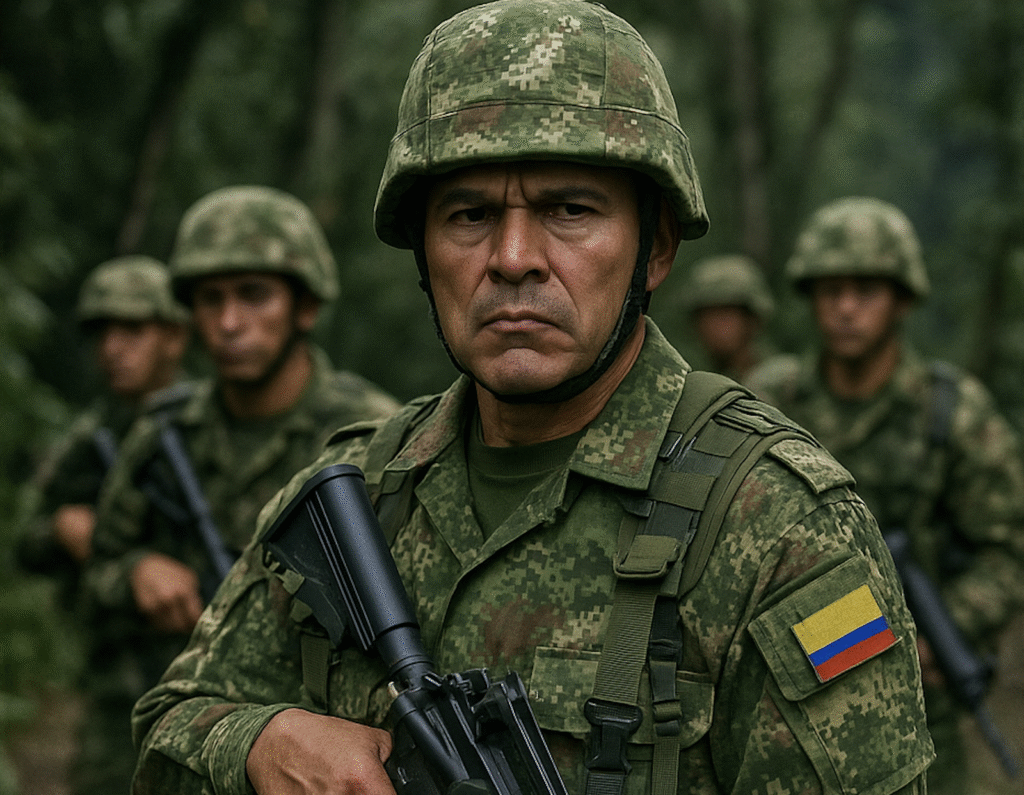
For Defense Minister Sánchez, the path was never neutral. A former general turned civilian leader, he entered office with one question hanging over every decision: strike swiftly to deter further bloodshed or risk delay in hopes of political resolution? He chose the former. Under his leadership, Sánchez abandoned ceasefire policies in favor of a full-spectrum offensive, ordering military units to operate continuously and targeting all threats without discrimination. It was a gamble on deterrence through dominance—a choice that would bring results but also risk moral erosion and potential escalation of violence (Defense Post, 2025).
In practice, Sánchez’s model favored decisive kinetic action over strategic synchrony, as shown by the publicized June 2025 arrest of alias “Cholinga,” a high-ranking drug trafficker and mining racketeer in northern Colombia (Semana, 2025). The takedown of “Cholinga,” a key operator in the FARC dissident network, was more than a headline; it was a template. Although removing Cholinga as the lead narcotrafficker marked a success, it does not prove that officials dismantled the entire criminal network, sustaining regional dominance. As seen in Mexico, arresting or killing a kingpin can create a leadership vacuum that may spawn more vicious splinter groups.
Minister Sánchez’s actions mark a definitive doctrinal shift, prioritizing military interventions over negotiated peace processes as of March 2025. The imperative to counteract rising criminality and pervasive insecurity throughout Colombia drove this pivot from the established “Total Peace” strategy. According to Radio Caracol (2025), Sánchez actively listens to constituents and government leaders who have long called for a shift in focus from peace initiatives to robust enforcement.
Andrés Julián Rendón, governor of Antioquia, has vocally criticized the ceasefire policy, contending that it inadvertently strengthens criminal organizations rather than mitigating violence. Sánchez deployed forces immediately in critical zones during March as a deliberate signal—a demonstration of state authority through force projection rather than gradual integration of civil and institutional frameworks, as Colombia One noted (2025). Following terrorist attacks on military personnel in Guaviare, once again, he ordered security forces to mobilize “all capacities” for an immediate response while deliberately avoiding inquiries into the perpetrators’ affiliations. This resolute policy stance may have unsettled civilian observers by prioritizing swift, decisive action over the careful application of legal and human rights principles (Colombia One, 2025).
In response to criticisms of Operation Fortaleza, Sánchez publicly repudiated claims that the mission failed and affirmed that he aimed to protect civilians rather than meet external expectations, as El Colombiano highlighted (2025). However, the operation exposed significant operational vulnerabilities and planning deficiencies, thereby revealing a disconnect between the new doctrinal emphasis and the practical capacities of the institution—a shortfall that Infobae also underscored (2025).
Reflecting on the early 2000s, this renewed strategic orientation signals that Colombia reverts to security paradigms centered on enemy decapitation and battlefield efficiency—a stark contrast to the negotiated, multilateral frameworks that have defined Colombia’s post-2016 peace efforts. This re-adoption of counterinsurgency models may conflict with principles of democratic accountability and human security. Moreover, human rights organizations, along with the UN Verification Mission, have expressed concerns that automatic retaliatory tactics, combined with limited legal oversight, could jeopardize Colombia’s adherence to its international law commitments (United Nations, 2025). Sanchez is well aware that the country fights against enemies who disregard human rights, the laws of war, and other legal norms.
Neutralizing the Pillars of Drug Trafficking
Since March 2025, Colombia has experienced an unprecedented intensification of kinetic operations targeting cocaine-processing facilities and high-value targets linked to Segunda Marquetalia, ELN, Revolutionary Armed Forces of Colombia, Clan del Golfo (AGC), and any criminal actor that operates in Colombia (Infobae, 2025). This strategic pivot underscores how dismantling clandestine labs, bolstering interagency coordination, and executing precision targeting have not only achieved tangible tactical victories but also generated considerable political capital for the minister. In doing so, these measures have reasserted the military’s pivotal role within Colombia’s security framework, thereby enhancing the strategic legitimacy and institutional prominence of the Ministry of Defense.
Tactical Landscape: The Colombian security forces’ actions since March 2025 have notably focused on the departments of Nariño and Chocó, areas long dominated by drug trafficking infrastructure and insurgent activity. Between March and May, the Colombian Army dismantled over 50 cocaine-processing laboratories, seizing large volumes of both finished products and precursor chemicals (Colombian Ministry of Defense, 2025). Each seizure disrupted revenue streams for factions like Segunda Marquetalia, Clan del Golfo, and others who have used the drug trade to fund terror, recruit foot soldiers, and terrorize civilians. The Navy, too, made headlines seizing more than 380 tonnes of chemical precursors—enough to halt entire seasons of cocaine production (Infobae, 2025). The sheer scale and scope of these interdictions showcased Colombia’s growing interagency synchronization, with military, police, and intelligence forces working in sync.
High-Value Target Neutralizations and Strategic Decapitation: The National Police Anti-Narcotics Directorate intensified its operations by dismantling 56 clandestine labs, including facilities directly tied to the Oliver Sinisterra Front and Clan del Golfo, and seizing over 8,000 gallons of precursor chemicals (Infobae, 2025). These actions, supported by cross-border cooperation with Ecuadorian forces, underscore a doctrine of surgical intervention focused on leadership decapitation and disrupting the supply chain. These HVT actions are strategic for two reasons: (1) they demonstrate a shift from static defense to dynamic interdiction, and (2) the defense ministry’s strategic vision drives high-visibility successes.
Interagency Coordination and Kinetic Synergy: The scale and coordination of these operations indicate a paradigm shift in civil-military synchronization. In one joint operation in Cumbal, Colombian and Ecuadorian troops raided a cross-border drug compound and confiscated 2.5 tonnes of hydrochloride cocaine—a move that signaled not just sovereignty but regional unity (Colombian Ministry of Defense, 2025). This cross-border initiative suggests a recalibrated defense posture that combines intelligence, mobility, and diplomacy. Such kinetic synergy underlines the defense minister’s commitment to operational integration—breaking down bureaucratic silos between institutions to deliver tactical wins that align with strategic policy goals.
Shifting Geopolitics: Between Autonomy and Strategic Alignment
Under Sánchez, Colombia has strengthened its ties with the United States at a pace not seen in over a decade. (US Department of State, 2025 The March 2025 Strategic Security Compact marked a new era—an agreement that included military training, cyber defense collaboration, border monitoring, and the transfer of critical equipment. (US Department of State, 2025).
In March 2025, Colombia deepened its strategic partnership with the United States during high-level meetings—most notably when General Carlos Triana and Gloria Miranda visited Washington—to address counter-narcotics, crop substitution, and interdiction efforts. These talks signaled a robust renewal of joint operations (US Embassy Colombia, 2025). Over the last two months, Sánchez and SOUTHCOM Commander Admiral Alvin Holsey exchanged high-profile visits. Colombia also received invitations to strategic NATO dialogues, placing it more firmly within Western security frameworks. Admiral Cubides’s meetings at NATO headquarters signaled that Colombia is not just a partner—it is a player. (USSOUTHCOM, 2025).
With U.S. support, Colombia’s invitation to NATO’s Southern Flank Strategic Dialogue marks a qualitative shift in its international security profile, positioning the country as a privileged interlocutor within transatlantic security frameworks (NATO, 2025). In May 2025, Admiral Francisco Hernando Cubides Granados, Colombia’s Chief of Defence, visited NATO Headquarters and met with NATO military leadership in a series of high-level meetings to advance NATO-Colombia cooperation (NATO, 2025).
Colombia’s pivot toward the United States has significantly boosted its intelligence and military interoperability. SOUTHCOM visits, NATO engagements, and the defense minister’s bilateral statements further illustrate these improvements. However, Colombia risks becoming strategically dependent on the United States, a situation that could narrow its foreign policy options. However, within the Petro administration, a tug of war exists between strategic alignment and autonomy. Petro’s parallel move to procure Swedish Gripen jets—rejecting US and Israeli offers—suggests an effort to diversify dependencies. The goal? To avoid becoming a geopolitical pawn. (Jaime Gonzalez, 2025).
Colombia’s deeper integration into U.S.-led defense structures now situates the country within a hemispheric security framework that faces increasing contestation. According to the Council on Foreign Relations, China and Russia continue to expand their strategic influence in Latin America through military, intelligence, and infrastructural investments, transforming the region into a new front of multipolar competition (CFR, 2025; National Media Week, 2025). While alignment with the United States enhances Colombia’s operational capability and intelligence access, it also compels the country to navigate a complex geopolitical landscape that may constrain its diplomatic flexibility in a fluid multipolar order. In a multipolar world where Russia and China are also courting Latin America, Colombia’s diplomacy is walking a fine line: deepening its partnership with the US while not closing other doors.
These developments indicate that Minister Sánchez has prioritized pragmatic engagement over political posturing by actively preserving strong defense ties with the United States and remaining open to dialogue with other global actors. His approach likely reflects a tacit understanding with President Petro that securing US relations while diversifying partnerships remains critical for advancing Colombia’s tactical and strategic interests.
Strategic Implications and Outlook
The results of Sánchez’s early tenure are tactically impressive, institutionally significant, and politically polarizing. His leadership has marked a turning point—away from rhetorical peacebuilding and toward aggressive enforcement. From the ground in Guaviare to the corridors of NATO, the defense minister has shifted the narrative: Colombia is not just asking for peace—it is imposing control. However, even his strongest supporters acknowledge that operational success is not equivalent to sustainable peace.
From the outset, Sánchez’s hardline messaging and dismissal of ceasefires broke with the “Total Peace” framework and propelled the state toward coercive deterrence. He has repositioned Colombia as an agile, combat-capable, and globally connected security actor. His doctrine combines technology, speed, and targeted force to tackle Colombia’s enduring internal conflicts.
Since March 2025, security forces have systematically dismantled the cocaine infrastructure. They neutralized insurgent leadership figures—actions that reflect more than tactical acumen, as they transformed Colombia’s security apparatus under the current Minister of Defense. These operations have re-legitimized state authority in contested zones, bolstered the military’s operational capacity, and reshaped the strategic profile of the Ministry of Defense. Looking ahead, government leaders must implement institutional reforms, deepen interagency integration, and secure continued political support at the highest levels to sustain these gains.
These kinetic successes have boosted the Minister of Defense’s political legitimacy. In a security environment where insurgent attacks have risen—illustrated by the 24 coordinated incidents detailed in several Ministry of Defense press releases (Ministry of Defense, 2025)—the ability to execute decisive kinetic responses reinforces institutional credibility. Moreover, these operations cast the minister as a guardian of territorial sovereignty and an architect of operational modernization, especially amid public skepticism about the “Total Peace” agenda. His emphasis on “results-driven security” stands in sharp contrast to previous approaches that relied more on rhetoric than on real capability.
The Ministry’s tactical achievements, institutional innovations, and improved international standing demonstrate genuine progress that has strengthened the Colombian state’s capacities and global legitimacy. In this context, the Minister of Defense emerges not only as a policy actor but also as a strategic operator who fuses field-level execution with national defense policy. This shift reshapes Colombia’s defense diplomacy and may revitalize bilateral engagements with NATO-aligned partners and US institutions.
The cost of this doctrine is steep. Civilian fears linger. Human rights organizations remain watchful. Within elite units, fatigue is on the rise. Moreover, if these operations do not translate into long-term reform—such as judicial independence, corruption control, and political stability—the victories of today may only postpone the crises of tomorrow.
Ultimately, Sánchez’s tenure will be judged not just by arrests made or cocaine seized but by the legacy he leaves behind. In a country scarred by protracted violence and a fragile peace process, the question looms: Can Colombia fight its enemies without losing sight of its democratic soul? If Sánchez succeeds, people will remember him as the architect of Colombia’s security revival.
If not, his victories could become just another chapter in a cycle of violence disguised as progress.
References
AP News. (2023). The oldest of 4 siblings who survived a Colombian plane crash told the family their mother lived for the day. https://apnews.com/article/colombia-plane-crash-jungle-children-survivors-b522276c1af57aa15c836efadc287b46
AP News. (2025). Colombia suspends peace talks with ELN rebel group after a deadly attack on the military. https://apnews.com/article/colombia-eln-rebels-ceasefire-petro-387caf06b740869e2087eb3b90934393
Bogota Post. (2025). Colombia’s President Petro declares a state of emergency in the northeastern Catatumbo region. https://thebogotapost.com/colombias-president-petro-declares-state-of-emergency-in-northeastern-catatumbo-region/53350/
CBS News. (2025). Colombian presidential candidate recovering from surgery after assassination attempt. https://www.cbsnews.com/news/miguel-uribe-turbay-colombian-presidential-hopeful-shot-assassination-attempt/
Colombia One. (2025a). Colombia to launch military intervention in conflict-torn Cauca region. https://colombiaone.com/2025/03/11/colombia-cauca-military-social-intervention/
Colombia One. (2025b). Guerrilla attack kills seven soldiers in Colombia. https://colombiaone.com/2025/04/28/colombia-attack-kills-seven-soldiers/
Colombia One. (2025c). Petro appointed General Pedro Sanchez as the new Defense Minister of Colombia. https://colombiaone.com/2025/02/20/colombia-new-defense-minister-general-pedro-sanchez/
Colombia One. (2025d). US Southern Command Chief visits Colombia, avoids meeting with Petro. https://colombiaone.com/2025/04/17/colombia-us-southern-command-visits/
Council on Foreign Relations. (2025). China’s growing influence in Latin America. https://www.cfr.org/backgrounder/china-influence-latin-america-argentina-brazil-venezuela-security-energy-bri
Daily Mail. (2025). Colombian presidential hopeful in critical condition after being shot during an assassination attempt. https://www.dailymail.co.uk/news/article-14791053/miguel-uribe-turbay-assassination-attempt-colombia-president-senator.html
Defense Post. (2025). Colombia Defense Minister vows ‘full force’ against guerrillas. https://thedefensepost.com/2025/03/17/colombia-defense-guerrillas/
El Colombiano. (2025a). Denuncian al MinDefensa por fallas en la “Operación fortaleza” en la que murieron cinco soldados. https://www.elcolombiano.com/colombia/denuncian-al-ministro-de-defensa-por-la-fallida-operacion-fortaleza-antioquia-AF26891717
El Colombiano. (2025b). Denuncian al MinDefensa por fallas en la “Operación fortaleza” en la que murieron cinco soldados. https://www.elcolombiano.com/colombia/denuncian-al-ministro-de-defensa-por-la-fallida-operacion-fortaleza-antioquia-AF26891717#google_vignette
El Estratégico. (2025). El Ejército de Colombia avanza en la recuperación de su flota de helicópteros Mil Mi-17 de origen ruso. https://www.elestrategico.com/2025/05/21/el-ejercito-de-colombia-avanza-en-la-recuperacion-de-su-flota-de-helicopteros-mil-mi-17-de-origen-ruso/
El Heraldo. (2025). ¿Quién es Pedro Sánchez, el militar que asumirá el Ministerio de Defensa? https://www.elheraldo.co/colombia/2025/02/20/quien-es-pedro-sanchez-el-militar-que-asumira-el-ministerio-de-defensa/
El País. (2025). Neutralizan en combate a alias Cholinga, máximo líder de las disidencias de las Farc en el Cauca, Valle y Nariño. https://www.elpais.com.co/judicial/neutralizan-en-combate-a-alias-cholinga-maximo-lider-de-las-disidencias-de-las-farc-en-el-cauca-valle-y-narino-1035.html
El Tiempo. (2025). Paro armado en Guaviare: Ejército despliega fuerzas especiales para frenar accionar de ‘Iván Mordisco’ y ‘Calarcá’. https://www.eltiempo.com/justicia/conflicto-y-narcotrafico/paro-armado-en-guaviare-ejercito-despliega-fuerzas-especiales-para-frenar-accionar-de-ivan-mordisco-y-calarca-3463733
Independent. (2025). Colombia’s new defense minister vows to reclaim territory lost to rebel groups. https://www.independent.co.uk/news/pedro-sanchez-colombia-farc-bogota-president-b2713312.html
Infobae. (2025a). Cumbre de gobernadores en Villa de Leyva: cuál es el tema de la reunión de al menos 30 mandatarios en Boyacá. https://www.infobae.com/colombia/2025/02/19/hoy-inicia-la-cumbre-de-gobernadores-en-villa-de-leyva-con-la-participacion-de-30-mandatarios/
Infobae. (2025b). Denuncian al ministro de Defensa Pedro Sánchez por fallas estratégicas en la “Operación fortaleza”: cinco soldados resultaron muertos. https://www.infobae.com/colombia/2025/03/19/denuncian-al-ministro-de-defensa-pedro-sanchez-por-fallas-estrategicas-en-la-operacion-fortaleza-en-la-que-fallecieron-cinco-soldados/
Infobae. (2025c). Desmantelan 56 laboratorios de cocaína en Nariño y Chocó: 40 de estos pertenecían al Frente Oliver Sinisterra de las disidencias. https://www.infobae.com/colombia/2025/04/02/desmantelan-56-laboratorios-de-cocaina-en-narino-y-choco-40-de-estos-pertenecian-al-frente-oliver-sinisterra-de-las-disidencias/
Infobae. (2025d). Incautadas más de 380 toneladas de insumos químicos en los primeros meses de 2025. https://www.infobae.com/colombia/2025/04/06/incautadas-mas-de-380-toneladas-de-insumos-quimicos-en-los-primeros-meses-de-2025/
Infobae. (2025e). Polémica por posibilidad de que nuevo ministro de Defensa ejerza como civil o como militar activo: es decisión del presidente Petro. https://www.infobae.com/colombia/2025/02/20/es-decision-de-petro-si-el-nuevo-ministro-de-defensa-ejercera-como-civil-o-como-militar-activo/
Jaime Gonzalez. (2025). Losing altitude: US lost fighter jet contracts to Sweden in Brazil, Colombia. https://msi2.substack.com/p/losing-altitude-us-lost-fighter-jet
Kienyke. (2025). Señalan al general Raúl Vargas por falsos positivos y sigue activo en el Ejército. https://www.kienyke.com/politica/senalan-general-raul-vargas-por-falsos-positivos-y-sigue-activo-en-el-ejercito
La Semana. (2025). Operación desastre: SEMANA revela informe secreto que evidencia graves fallas en un operativo militar que comandó el hoy ministro de Defensa, Pedro Sánchez. https://www.semana.com/nacion/justicia/articulo/operacion-desastre-semana-revela-informe-secreto-que-evidencia-graves-fallas-en-un-operativo-militar-que-comando-el-hoy-ministro-de-defensa-pedro-sanchez/202524/
Merco Press. (2025). Colombian authorities gun down guerrilla leader Cholinga. https://en.mercopress.com/2025/06/11/colombian-authorities-gun-down-guerrilla-leader-cholinga
National Media. (2025). Moscow highlights deepening Russia-Latin America ties and vision for multipolar world. https://www.nationalmedia.uk/2025/06/moscow-highlights-deepening-russia.html
NATO. (2025a). NATO hosts Colombian Chief of Defence. https://www.nato.int/cps/en/natohq/news_235122.htm?selectedLocale=en
NATO. (2025b). Senior officials from NATO Allies and partners gather for NATO’s first Southern Neighbourhood Security Dialogue. https://www.nato.int/cps/en/natohq/news_235664.htm
Radio Caracol. (2025). Secretario de Seguridad de Antioquia: “Por acá la Paz Total no ha llegado”. https://caracol.com.co/2024/05/24/secretario-de-seguridad-de-antioquia-por-aca-la-paz-total-no-ha-llegado/
Times of Israel. (2025). Colombia cut ties with Israel to replace aging Israeli fighter jets with Swedish. https://www.timesofisrael.com/colombia-which-cut-ties-with-israel-to-replace-aging-israeli-fighter-jets-with-swedish/
United Nations. (2025). United Nations Verification Mission in Colombia. https://digitallibrary.un.org/record/4080173/files/S_2025_188-EN.pdf
US Colombia Embassy. (2025a). Colombia and the United States deepen cooperation on counter-narcotics and regional security. https://www.colombiaemb.org/post/colombia-and-the-united-states-deepen-cooperation-on-counter-narcotics-and-regional-security
US Colombia Embassy. (2025b). US–Colombia Strategic Security Compact. https://www.colombiaemb.org/post/colombia-and-the-united-states-strengthen-security-and-defence-cooperation
US State Department. (2025). US security cooperation with Colombia: Fact sheet. https://www.state.gov/u-s-security-cooperation-with-colombia/
USSOUTHCOM. (2025). Colombian Minister of Defense visits SOUTHCOM. https://www.southcom.mil/News/PressReleases/Article/4174473/colombian-minister-of-defense-visits-southcom/
The views expressed by Jaime González, a current US government contractor, are solely their own and do not necessarily reflect the views of the Defense Intelligence, Defense Homeland Security, the Office of Director of National intelligence Government Agency, or the United States Government.
The opinions expressed in this article are those of the author and do not necessarily reflect the views of the Miami Strategic Intelligence Institute (MSI²).