
03 Jul Another major Trump victory: Congress approves his mega-budget bill
By,
Leonardo Morales, Senior Fellow MSI²
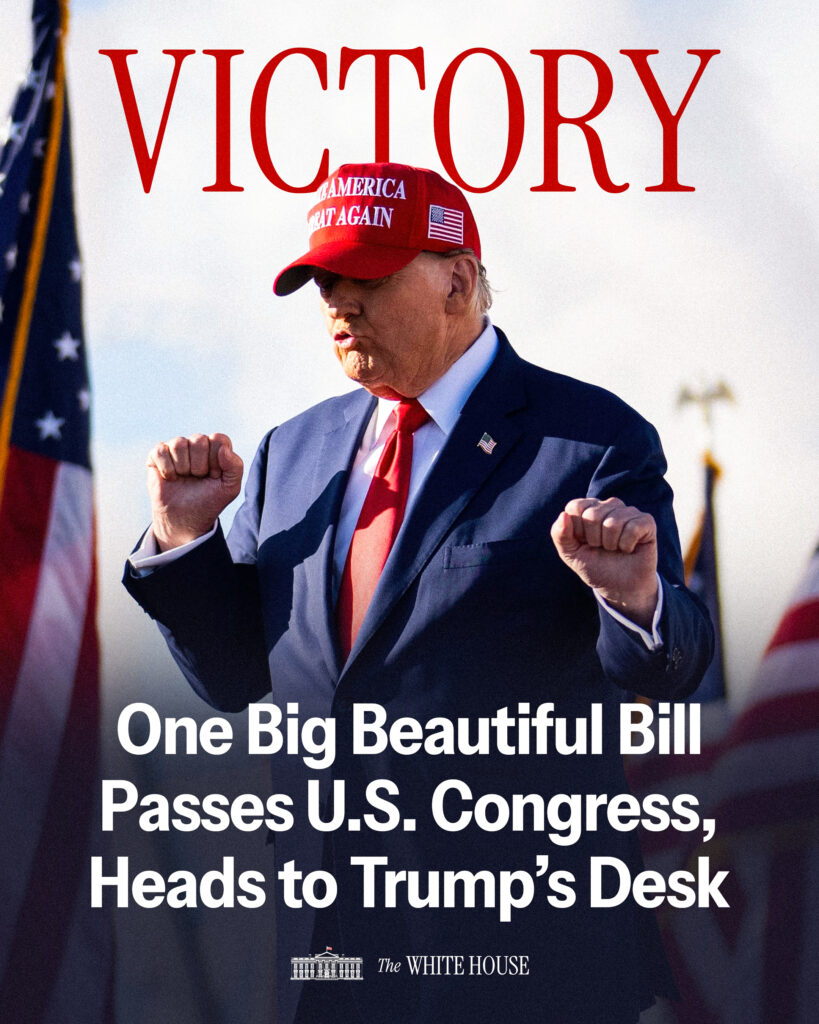
First, the Senate gave the green light, then it had to return to the House again for several changes and amendments for final approval by 218 votes to 214.
The Republican-led US Congress delivered another major victory to President Donald J. Trump by passing his mega-budget bill in both chambers.
The bill, with some changes, was approved by the House of Representatives by 218 votes to 214, after the Senate had done the same earlier.
Some Republicans finally understood the importance of this major bill and put aside their differences to deliver another major victory for President Trump, conservatism, and the American people. This was not the case in the Senate, where three Republican senators joined the Democrats in voting.
Trump was waiting in his Oval Office for the decisive document to sign it into law, either hours before or on Independence Day, July 4, as he had requested.
In the Senate, the more than 940-page text was amended several times, and therefore had to be sent back to the House, where it had previously been approved, but without the current changes.
In a close 50-50 vote, Vice President J.D. Vance cast the deciding vote in the Senate, with three Republicans dissenting.
“I think it would be very wise for them [Republicans] to get on board. It’s an excellent bill,” Trump told reporters on July 1 during his visit to the new immigration detention center in South Florida.
Republican Senator John Hoeven of North Dakota indicated that Vice President J.D. Vance was called upon to cast decisive votes on several final changes to the legislation, including the massive package of changes negotiated by Senate Republican leaders, known as the “substitute” amendment.
“We’ll need him on the actual substitute bill,” Hoeven said of Vance.
The internal opposition
The GOP’s push in the Senate came after 24 hours of intense negotiations between Senate Majority Leader John Thune, Vance, and holdout Republicans, including Senator Lisa Murkowski of Alaska and Thom Tillis of North Carolina, who announced his withdrawal ahead of the upcoming primary elections.
Senators Susan Collins of Maine, Rand Paul of Kentucky, and Thom Tillis of North Carolina ultimately joined the 47 Democrats in voting against it.
Trump defended his budget plan in his Truth Social platform, where he stated that the bill is “perhaps the greatest and most important of its kind in history,” and asserted that if it were not passed, it would mean “a 68% tax increase, the largest in history.”
Among the benefits of this bill, which will now become law, are: exemption from taxes on tips and overtime, which frees tens of millions of Americans from paying taxes.
Another proposal is to increase the SALT deduction limit, which allows those living in areas with high state and property taxes to deduct more expenses up to $40,000, rather than the current $10,000. This proposal also increases the child tax credit to $2,500 for each child under 17 through 2028 and eliminates tax credits for loans in the automotive sector for electric vehicles and the possibility of deductions for U.S.-made vehicles with combustion engines.
After more than a month of deliberations, the Senate amended the House version to expand corporate tax cuts, deepen the fraud measures found in Medicaid, mobilize $4.5 trillion to lower taxes, and eliminate the moratorium on state restrictions against artificial intelligence, among other measures.
Trump has just solidified his agenda for a second term.
“This bill is President Trump’s agenda, and we’re signing it into law,” House Speaker Mike Johnson declared. “Republicans are prepared to finish the job,” he said hours before its final passage.
Keep promises
With the approval of the budget in Congress, Trump begins to fulfill his promises to cut taxes on tips and overtime, expand immigration control and national security measures, enhance the nation’s overall defense, curb programs created by the Woke movement, reduce federal bureaucratic and partisan spending, make his 2017 tax cuts permanent, develop the country’s infrastructure, eliminate subsidies for so-called green energy, and strengthen the extraction and export of oil and other fossil fuels to make the US 100% energy independent, among other goals.
The White House resident called on Republicans to unite and pass his mega-project for signature before or on July 4th, Independence Day.
The final approval of the budget represents the Trump administration’s major stepping stone to its “America First” platform, which encompasses all of its government policies.
The Republican leader will combine the funds raised by tariffs to finance his economic, social, and foreign policy programs.
In recent days, Secretary of State Marco Rubio announced the official closure of the international aid agency (USAID), which operated with federal taxpayer funds.
The closure of this and other agencies, created in previous decades, is part of President Trump’s strategy to minimize financial waste, misappropriation of American funds, fraud, corruption, and spending on political interests far removed from national interests and national security.
The text extends the tax credits adopted during Trump’s first term (2017-2021), eliminates the tax on tips and overtime, and includes hundreds of billions of additional dollars for defense and immigration control.
Some analysts aligned with the Democrats and the liberal press suggest that this budget plan will increase the nation’s debt by more than $3 trillion by 2034; and the fiscal deficit, based on a report by the Congressional Budget Office (CBO), which has repeatedly issued erroneous reports under both Republican and Democratic administrations.
The denials
Treasury Secretary Scott Bessent has reiterated in various interviews that he has crafted a large part of this budget and considers it the best economic plan in US history, and that neither tariffs “nor actions to balance spending in Washington will increase the country’s debt, much less inflation.”
As another part of the financing to prevent this, the White House will dismantle tax incentives for so-called renewable energy, adopted by the Joe Biden administration, and which have angered billionaire Elon Musk.
Musk, a key player in Trump’s 2024 presidential campaign, has harshly criticized the president and Republicans’ bill because it directly impacts his financial interests in his electric vehicle company, Tesla.
Musk has attacked the “porky” bill, arguing that the trillions of dollars in additional federal debt would bankrupt the US.
Since his first term, Trump has openly defended his push for the oil and other fossil fuel industries, as he did in his first term, a path opposite to that of Musk and his companies. But Trump’s former special presidential adviser, who headed the Department of Government Efficiency (DOGE) until a few weeks ago, went further, saying he would form a new party that would seek a balanced federal budget and threatening to intervene in the primaries of congressional Republicans who support spending cuts but voted for the bill to remove them.
Regarding criticism of the “One, Big, Beautiful Bill” by the owner of SpaceX, Neuralink, and the social network X, Bessent responded forcefully: “I admire Elon Musk’s leadership on rockets. I take care of the country’s finances,” Bessent told Fox News.
Fraud and cost-cutting
As part of the federal government’s spending cuts and fraud efforts that have worsened over the past 20 years, the new Department of Justice in Washington made a significant announcement.
The Trump administration judicial authorities announced they have prevented the embezzlement of more than $14 billion in healthcare fraud so far this year.
This current crackdown on health insurance fraud has resulted in criminal prosecutions against 324 individuals, stated Matthew Galeotti, head of the Justice Department’s criminal division.
Among the 324 defendants are “96 licensed healthcare professionals, including 25 physicians,” stated Christopher Delzotto, head of the FBI unit, the federal law enforcement agency charged with combating health insurance fraud.
The attempted fraud is estimated at $14.6 billion. Of this total, “the actual loss is $2.9 billion,” he stated.
The most significant case, made public last week, reveals a Russia-based network that defrauded Medicare, the health insurance program for people over 65, by using stolen personal data from more than one million Americans.
This network submitted reimbursement claims worth $10.6 billion for various medical devices in the names of these patients and without their knowledge.
This demonstrates that, both in Social Security and in the federal government’s Medicaid and Medicare health programs, the Trump administration is steadfast in its stated stance to combat corruption, fraud, and massive government spending. And its actions extend to every department in Washington.
The last four years represented the largest waste of taxpayer money in the nation’s history.
In recent days, the Supreme Court lifted a lower court order and granted the Department of Government Efficiency (DOGE) access to the Social Security (SSA) records of millions of Americans.
“The SSA may grant members of the SSA DOGE team access to the records of the agency in question so they can perform their work,” the Supreme Court declared.
The White House claims that DOGE needed access to carry out its mission of eliminating waste in the federal government.
Musk, who until recently headed DOGE, had targeted Social Security, considering it a major source of fraud. The entrepreneur described it as a “Ponzi scheme” and insisted that reducing waste in the program is a way to reduce massive government spending.
The opinions expressed in this article are those of the author and do not necessarily reflect the views of the Miami Strategic Intelligence Institute (MSI²).