
25 Jul Federal Agents Under Fire: The Reality Behind the Shield
By,
Jesús Romero. Co-Founder & Senior Fellow, MSI²
Among the lesser-reported injuries were dozens of cases of agents suffering eye lacerations, embedded glass shards, and torn corneas caused by shattered bottles and broken projectiles hurled at close range
In the chaos of summer 2025, federal agents deployed to Los Angeles faced what many described as “Gladiator School”—a term used internally by officers to describe the intensity and unpredictability of violent protest zones. But amid the turmoil, these agents upheld a level of discipline and restraint rarely acknowledged in mainstream coverage.
The agents deployed were not typical riot-control forces. Many came from the Department of Homeland Security (DHS), Immigration and Customs Enforcement (ICE), Customs and Border Protection (CBP), and various federal task forces. They were trained for border interdictions, federal warrant operations, and national-security missions—not crowd control in hostile urban terrain. Yet between June and August 2025, they found themselves under siege in downtown Los Angeles.
There were real injuries. Agents suffered concussions, burns, and blunt-force trauma from improvised weapons. According to DHS, on June 7, 2025, over 1,000 rioters surrounded an ICE facility in Los Angeles, slashing tires, defacing buildings, and assaulting officers—marking a 413% spike in assaults against ICE personnel compared to earlier periods (Department of Homeland Security, 2025a). Agents were struck by bricks, Molotov cocktails, lasers, and frozen water bottles—causing multiple hospitalizations.
Among the lesser-reported injuries were dozens of cases of agents suffering eye lacerations, embedded glass shards, and torn corneas caused by shattered bottles and broken projectiles hurled at close range. At least four agents required emergency ophthalmic surgery, according to medical logs reviewed internally. Despite this, federal teams continued to operate under strict rules of engagement, refraining from lethal force even as assaults intensified. This level of restraint—amid sustained targeting—underscores the professionalism and discipline federal agents maintained during prolonged urban confrontations.
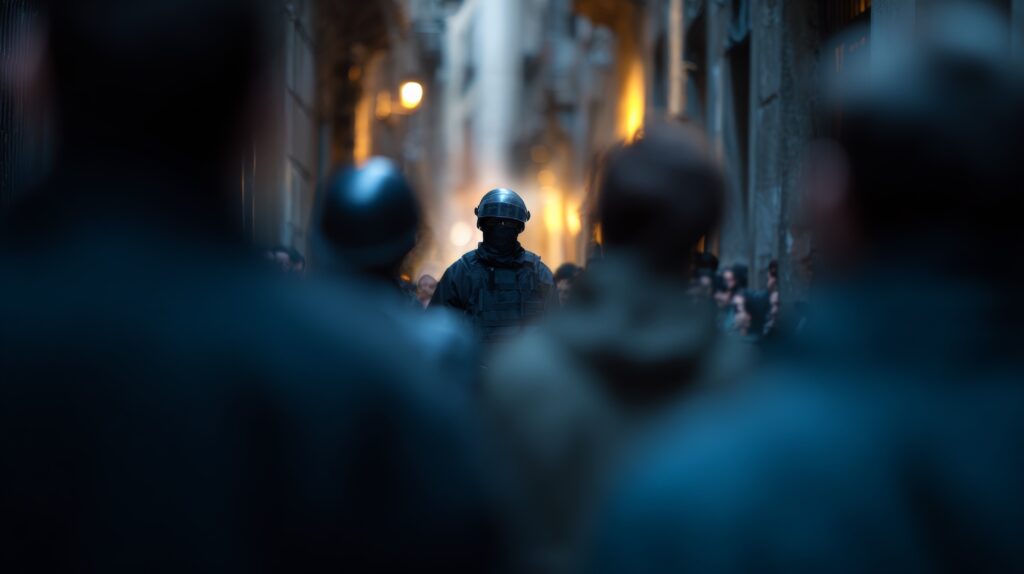
Fortunately, the federal government has made it clear that there will be severe consequences for those who harm federal agents in the line of duty. But like modern-day gladiators, many of these officers were thrust into a chaotic urban arena not of their choosing—carrying out lawful orders under conditions for which they were never specifically trained. These agents, primarily skilled in border interdictions, counter-narcotics, and national-security missions, were not riot-control specialists. Yet they found themselves directly targeted by protesters whose intent was not peaceful dissent but physical harm and mayhem. The disconnect between their training and the environment they encountered underscores both the volatility of these confrontations and the exceptional restraint exercised in response. In some cases, leftist agitators even went so far as to attempt to identify federal agents by name and residence, disseminating that personal information across encrypted platforms. The intent was chillingly clear: to enable operatives to target agents and their families beyond the protest zones. This level of doxxing and intimidation reflects a shift from spontaneous civil unrest to deliberate, asymmetric harassment campaigns—aimed not just at federal operations, but at the very people who carry them out.
At least 17 federally owned vehicles, including ICE and Border Patrol SUVs, were damaged or destroyed in targeted attacks. DHS internal logs from June and July confirm these numbers, corroborated in oversight briefings (Department of Homeland Security, 2025a). Despite the intensity of these confrontations, federal agents did not respond with lethal force.
That fact matters.
Not a single protester was killed by federal return fire throughout the Los Angeles unrest. The use of force remained non-lethal—focused on dispersal and de-escalation. Agents deployed tear gas, pepper spray, and flash-bang devices. The legal thresholds for escalation were met repeatedly, but lethal options were withheld.
A senior DHS official, who requested anonymity, told us:
“This wasn’t Portland in 2020. The threats were real, and our agents were bleeding. But the restraint we showed wasn’t just discipline. It was a choice and a duty to protect lives on both sides.”
Some of the imagery captured during the events evoked the dystopian tone of Escape from L.A., but this was no fiction. These were real streets, real lives, and real threats. Protest is a constitutional right. Violence is not. Yet when several detained rioters were interviewed, many admitted they didn’t know federal agents have constitutionally protected authority to defend federal facilities and personnel—regardless of local sentiment.
The destruction of federal property, the targeting of law enforcement, and the use of encrypted communication have become consistent tactics of extremist cells operating from within otherwise peaceful protests. Federal agents are not beyond scrutiny, but when they enforce the law with discipline and restraint under intense pressure, that should be acknowledged.
What occurred in Los Angeles was not civil unrest. It was a deliberate attempt to confront and undermine law enforcement. The agents on the ground responded with professionalism and resolve. Federalized military forces deployed in support roles also maintained a disciplined and professional posture throughout the crisis.
This was not an act of protest. It was an organized campaign to cause destruction and provoke violence.
Reports circulated during the summer of 2025 indicating that recruitment ads had appeared on platforms like Craigslist, offering significant compensation to individuals with prior military experience—explicitly excluding former Marines—to join organized demonstrations. Although the most widely circulated ad was later confirmed to be a prank, the traction it gained reflects how easily such tactics can spread and influence real-world events (MSN, 2023). Beyond this, open-source investigations and political observers have raised concerns about the Party for Socialism and Liberation (PSL) and its ideological alignment with foreign actors, including anti-U.S. regimes (Party for Socialism and Liberation, n.d.). These protest movements increasingly resemble asymmetric operations, recruiting skilled operatives and coordinating via encrypted platforms. This strategy mirrors tactics used by criminal organizations such as the Los Zetas cartel, which famously recruited former elite soldiers to strengthen its enforcement wing (ICE, 2021). Historically, radical groups like the Black Panther Party and the Black Liberation Army pursued similar paths in the 1960s and 70s, although without the promise of financial reward (Burrough, 2015, p. 15). Today, a new version of that formula has emerged—fueled by digital reach, financial incentives, and underexplored patterns of foreign influence (Chang et al., 2023).
Throughout history, urban guerrilla tactics have not only been used by foreign enemies or criminal cartels but also by ideological factions aligned with domestic political agendas. In recent years, elements of the radical left have functioned as de facto militant pressure arms of major political coalitions. These groups often resurface in times of electoral stress, policy rollbacks, or political scandal. Their mobilization is not coincidental—it is strategic. The pardon of Oscar López Rivera in 2017, a convicted member of the FALN terrorist group responsible for over 130 bombings in the United States, is a striking example. His release, approved by President Obama just days before leaving office, was interpreted by many as a political gesture aimed at energizing a specific voter bloc (Meese & Kirsanow, 2017). The precedent set is troubling: individuals linked to violent extremist movements can be reframed as activists if the timing and political gain justify it.
The ideological roots of today’s urban agitation often trace back to revolutionary movements of the Cold War era. These were not fringe student experiments but structured alliances with regimes hostile to the United States. Karen Bass, now Mayor of Los Angeles, has acknowledged her past participation in the Venceremos Brigade—a pro-Castro program that brought young Americans to Cuba during the 1970s—and has stated she visited the island at least eight times in her youth (Dovere, 2020). According to reporting by The Atlantic, the FBI tracked the Brigade’s connections to Cuban intelligence and noted limited military training among participants. While Bass insists she was never trained militarily and did not carry weapons, she admitted to joining the program out of solidarity despite being aware that Cubans did not enjoy the same freedoms as Americans (Dovere, 2020). That experience, and the ideological grounding it provided, is relevant when evaluating the cautious response to orchestrated anti-government violence.
Conclusion
The events of summer 2025 challenged the role and resolve of federal law enforcement in a volatile urban environment. Faced with organized violence, political ambiguity, and personal targeting, federal agents responded with discipline, restraint, and commitment to their mission. Their actions reflected a clear understanding of the distinction between lawful protest and coordinated attempts to disrupt public order. As protest movements continue to evolve in complexity and organization, that distinction must remain central to how we evaluate both policy and public response. The responsibility to defend lawful institutions cannot fall solely on those in uniform. It requires recognition, clarity, and consistency at every level of government and society.
References
Burrough, B. (2015). Days of rage: America’s radical underground, the FBI, and the forgotten age of revolutionary violence (p. 15). Penguin. https://books.google.com/books?id=QPUVBAAAQBAJ&pg=PT15
Chang, J., Burke, M., & Awan, I. (2023). Coordinated digital protest destabilization and foreign actor influence. Journal of Global Security Studies, 9(1). https://pmc.ncbi.nlm.nih.gov/articles/PMC10106894
Department of Homeland Security. (2025a, June 7). Statement on violent rioters assaulting ICE officers in Los Angeles, CA. https://www.dhs.gov/news/2025/06/07/dhs-releases-statement-violent-rioters-assaulting-ice-officers-los-angeles-ca-and
Dovere, E.-I. (2020, July 31). When Karen Bass went to work in Castro’s Cuba. The Atlantic. https://www.theatlantic.com/politics/archive/2020/07/karen-bass-cuba-venceremos-brigade/614662/
ICE. (2021, May 27). Los Zetas cartel assassin who became northern Mexico plaza boss sentenced in San Antonio. https://www.ice.gov/news/releases/los-zetas-cartel-assassin-who-became-northern-mexico-plaza-boss-sentenced-san-antonio
Meese, E., & Kirsanow, P. (2017, January 18). President Obama’s pardon of Oscar López Rivera trades terrorist for votes. The Heritage Foundation. https://www.heritage.org/crime-and-justice/commentary/president-obamas-pardon-oscar-lopez-rivera-trades-terrorist-votes
MSN. (2023, September 20). Fact Focus: A Craigslist ad is not proof of paid protesters in LA. It was posted as a prank. https://www.msn.com/en-us/news/us/fact-focus-a-craigslist-ad-is-not-proof-of-paid-protesters-in-la-it-was-posted-as-a-prank/ar-AA1Gsxox
Party for Socialism and Liberation. (n.d.). Official website. https://pslweb.org
The opinions expressed in this article are those of the author and do not necessarily reflect the views of the Miami Strategic Intelligence Institute (MSI²).