
07 Aug Op-Ed: Why is the US-EU trade deal relevant?
By,
Leonardo Morales, Senior Fellow, MSI²
In addition to the historic agreement with the Old Continent, the pacts with Japan, the United Kingdom, and other nations represent extraordinary advantages for Americans, contrary to negative predictions.
A great uproar arose in left-wing media outlets around the world following the announcement of new tariffs on countries negotiating with the United States that failed to reach an agreement by August 1.
Many complied without protest with Washington’s tax rate, especially those who will pay between 10% and 15%.
In several cases, such as Mexico, which trades 80% of its production with the US, Trump has been patient and has extended the negotiation period in search of bilateral agreements that are beneficial to both parties. Because the White House resident doesn’t want abuses, but rather fairness, which truly should have been achieved decades ago, he has also extended deadlines and allowed talks to take place on a pragmatic basis with China, in search of a common understanding.
The tariffs go into effect on August 7. Many thought Trump was merely warning or threatening (the watchword of his political adversaries) and that he would ultimately have to give in to so much international pressure. A serious mistake!
As millions of Americans already know, Trump doesn’t gamble to lose, much less to change course. Not even death on the horizon could make him back down. On the contrary, he doesn’t have much time to play, so in due time he tightens the noose and, seeing no answers, makes decisions or accelerates strategies. This is what happened with Europe.
Some criticize the president of the European Union, especially French President Emmanuel Macron, who has insisted on building prominence by contradicting Trump, especially after his partner’s famous slap on the wrist. Macron wants to demonstrate determination and independence, and immediately lamented Ursula Von Der Leyen’s supposed weakness in the face of Trump.
Historic agreement
The formula was simple. Von Der Leyen perfectly captured the American president’s message, because at the current moment, Europe is not in a position to assert itself and attack like a lion. Too much is at stake, and the president—with few options—used the balance.
In the history of the United States, after the pact with China in 2020, no trade agreement of such magnitude and relevance had been reached as the one obtained by President Donald J. Trump with the European Union and its 27 member countries.
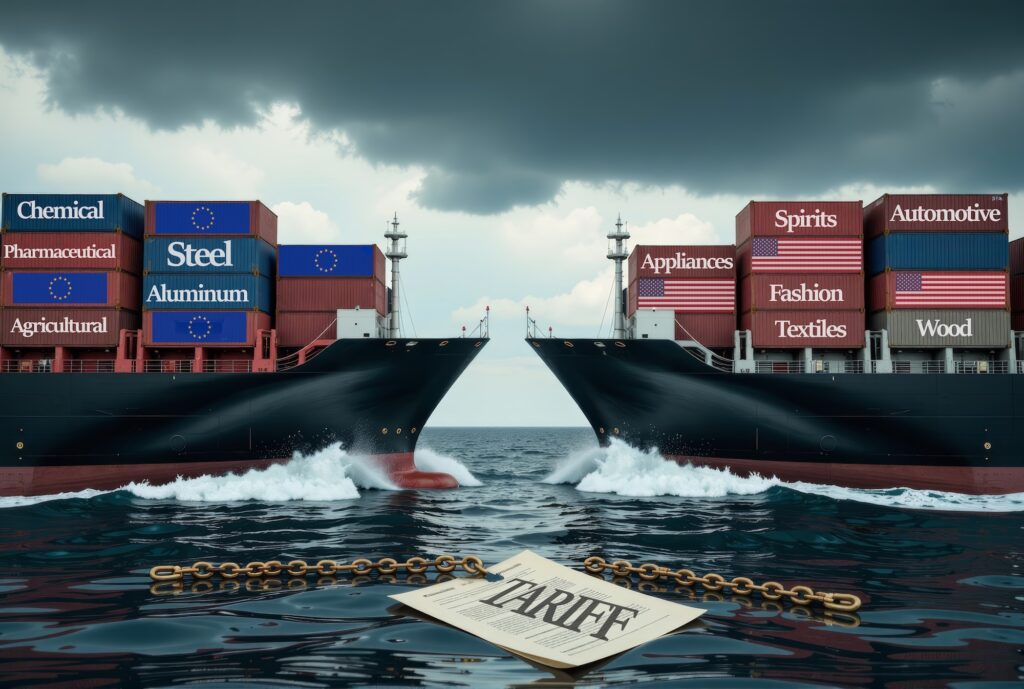
The agreement includes a 15% tariff on European products entering the US and a commitment to invest more than $600 billion in addition to those previously agreed upon in different sectors of the US economy through 2029.
This strengthens the consolidation of the US dollar as the global reserve currency, in the face of the BRICS (socialist bloc) member countries’ intentions to destroy Washington’s financial hegemony.
While some economists aligned with the economic policies of the previous Joe Biden administration make negative predictions, reality dictates otherwise.
The US economy grew by 3% between April and June (second quarter), as predicted by Treasury Secretary Scott Bessent and White House economic advisors.
However, the liberal media continues to pursue their agenda to foster uncertainty about the tariffs and the US’s strategic shift in global trade. So does Federal Reserve Chairman Jerome Powell, who has become a thorn in the President’s side.
Powell proposed—for the fifth consecutive time—leaving the country’s benchmark interest rate unchanged in the range of 4.25% to 4.50%, in an open challenge to Republicans and the head of the Oval Office, who are calling for a significant reduction in interest rates to accelerate the economy while providing Americans and businesses with better access to loans and credit.
Despite the Central Bank’s decision, Trump is not deterred by his plans.
A blow to Russia and escalating tensions with Putin
The economic treaty with the EU also entails the purchase of $750 billion or more in energy (oil, gas, coal, etc.) from North America, replacing Russian oil and hydrocarbons.
As chess goes, Russian President Vladimir Putin turned to India – a historic ally – but Trump has already set his sights on them and is looking for another checkmate move against the one who has wasted too much of his time by ordering multiple attacks against Ukraine from the Kremlin in the last two months, far from the expectations of the head of the Oval Office in Washington.
Russia launched more drone attacks against Ukraine in July than in any other month since the invasion.
Following ill-advised comments, which Trump found unsympathetic, by former Russian President Dmitry Anatolievich Medvedev (2008-2012) and Prime Minister (2012-2020), there was an immediate backlash.
“I have ordered two nuclear submarines to be positioned in the appropriate regions, in case these reckless and incendiary statements become more than that,” Trump wrote on his Truth Social platform.
The White House’s response comes because Medvedev is not a retired politician. He now serves as Deputy Chairman of the Russian Security Council, and his remarks pose a very serious threat.
And the Kremlin felt the blow from Washington. The pact with the EU, and especially the energy section, is the biggest economic and financial blow that President Vladimir Putin has received, by far compared to all the ineffective sanctions imposed by Joe Biden’s predecessor administration.
The Kremlin’s reactions were immediate. And the level of tension has escalated.
Russian Diplomacy
Hours after the announcement, Russian Foreign Minister Sergei Lavrov estimated that the agreement between the United States and the European Union represents a “very hard blow to European industry.” But in reality, it represents a blow to Moscow, which had already seen it coming, and that is partly why Putin reacted by continuing his offensive in Ukraine in retaliation for Trump’s actions on global trade, and specifically with Europe; with a resounding impact on Moscow.
“This approach will lead to further deindustrialization of Europe, to an outflow of investment from Europe to the United States, and of course, it will be a very hard blow,” said a frustrated Foreign Minister Lavrov.
President Trump has always struck a conciliatory note—even with America’s enemies—but without falling into the ploys of false friends. Nor did he do so in his first term when the Russian leader walked hand in hand with his American counterpart. Now, Putin seems emboldened by the war and is acting drunk with power, something Trump hadn’t counted on.
What Putin has implied is that he wants to continue the war until all his objectives are met (as he has reiterated before) or that he has been left reeling from the weakness of the previous administration and its inability to stop him. Nor does the Russian leader have much choice, given the situation he has reached with Ukraine.
Russia has spent its old reserve arsenal in Kyiv and has almost completely renewed it, according to experts. This has been one of the Kremlin’s strategies with the war.
Trump has felt cheated and disappointed by the Russian leader, who promised to end the war. On the contrary, Putin has intensified attacks against Ukraine and civilians over the past three months.
“I really felt it was going to end. But every time I think it’s going to end, it comes back again. I’m not that interested in talking to him again,” said the White House resident.
Unlike the 50 days he had given Moscow to end the war, Trump gave a 10- or 12-day ultimatum. If he doesn’t comply, he will take direct action against Moscow and countries that trade with it, which would have a significant additional impact on the former Soviet economy.
That lies at the heart of the relevance of this trade agreement with the EU and its impact on ending the war in Ukraine, which Trump has been unable to conclude through negotiations with those involved.
The trade agreement with the EU forces Putin, like never before, to give in to his position with Kyiv or face real and immediate consequences. This is precisely what has made the Russian leader extremely uncomfortable. Like a Trumpian magic trick, he now finds himself in a bind.
New tariffs and “America First”
On August 1, Trump signed the presidential order on the new tariffs imposed by Washington on nations that have not reached an agreement with the world’s largest economy, amid a new international trade order and under the White House’s new economic policies. Countries will begin paying on August 7.
Before that date, Trump warned India of 25% tariffs if it did not reach an agreement with Washington and signed an executive order raising tariffs on Brazilian imports to 50%.
The White House considers the actions of the government of Brazilian far-leftist Luiz Inácio Lula da Silva “an unusual and extraordinary threat to the national security, foreign policy, and economy of the United States.”
“The Brazilian government’s politically motivated persecution, intimidation, harassment, censorship, and prosecution of former Brazilian President Jair Bolsonaro and thousands of his supporters are serious human rights violations that have undermined the rule of law in Brazil,” the government statement said.
Washington asserts that members of the Brazilian government “have taken unprecedented measures to tyrannically and arbitrarily coerce US companies to censor political speech, remove users from their platforms, hand over sensitive US user data, or modify their content moderation policies.”
The highest tariff rates will apply to Syria (41%), Laos and Myanmar (40%), Switzerland (39%), and Iraq and Serbia (35%).
“President Trump has begun to recalibrate decades of failed trade policy for the United States,” a White House statement said.
Recently, the U.S. Congress approved the budget to finance the Republicans’ and Trump’s mega-economic plan, which is based on the “America First” platform.
Tariffs, a centerpiece of Trump’s economic project, have completely reversed the [false global free trade], which was not truly free, much less equitable.
In these two scenarios, the U.S. has been on the losing side for more than six decades. On the one hand, paying high taxes on the export of its products amid numerous markets closed to North America; on the other, dozens of nations with tariffs below 10% and others at near-zero under the category of “favored nations members of the World Trade Organization.”
Among this broad group were the 27 countries that make up the European bloc, on which Washington levied a symbolic 4.8% tariff on average, compared to the more than 30% and 70% levied on most US exports. Some products were even taxed at over 80% and 100% in several countries that held the status of “important and strategic” trading partners with Washington.
The European Community imposed significantly higher tariffs than the US on the chemical, automotive, technology, manufacturing, agricultural, and livestock industries.
Even before his return to the White House, Trump promised a radical change in international trade, and above all, with fair benefits for the United States.
“The long era of abuse and the United States’ disadvantage in global trade is over. It will never return,” the American president has said on several occasions, having so far fulfilled more than 90% of his major campaign promises.
His administration’s approval rating among Republicans averages 88%, according to recent polls.
This is the highest level of support among conservatives for a Republican president, surpassing even the successful President Ronald Reagan. Overall, support stands at 63% in the latest poll published by the left-wing CNN network, a level never seen before just six months into his term.
Trade with the European Union
The trade agreements signed with Japan, Indonesia, the Philippines, Vietnam, the United Kingdom (four countries), and the European Union (27) bring the total to 35 nations that decided to negotiate with Washington before paying the fee set by the White House.
Many, with levies between 10% and 15%, are willing to pay and have avoided the negotiation process.
The members of the European Council still need to meet and approve Ursula von der Leyen’s agreement with Trump in Scotland.
Trade in goods and services between the EU and the US has doubled in the last decade, reaching around $2 trillion. This figure represents more than $4.28 billion a day in bilateral trade across the Atlantic and represents 45% of global trade, according to the World Trade Organization (WTO) and the International Monetary Fund (IMF).
Trump had complained that Europe was not opening its market to many American products and not opening it enough to others, such as US-made vehicles. Currently, 30% of European imports come from American companies, according to statistics from the European Central Bank (ECB).
The deal Trump reached is so remarkable that Hungarian conservative President Viktor Orbán declared, “We suspected it would happen, because the US president is a negotiating heavyweight, while Ursula von der Leyen is a lightweight.”
He added that Von der Leyen’s pact with Trump “falls far short of the one achieved by the United Kingdom.”
“It wasn’t Trump who reached an agreement with Ursula Von der Leyen, but rather Trump had Von der Leyen for breakfast,” the right-wing Hungarian leader told international media with a smile.
Most members of the European Union defended the agreement reached with the United States to avoid an escalating trade war, which would have had serious consequences for the European Union at a time of extreme economic weakness in its main driving force, Germany, and other internal problems despite its $198 billion trade surplus.
The pact provoked divided reactions among its members, ranging from praise for the agreement to criticism that characterized it as a capitulation to Washington’s power.
The false fears about the impossibility of trade agreements, spread by left-wing and far-left media, have once again collapsed, and each agreement reached by Trump and his negotiating team, led by Treasury Secretary Scott Bessent, has achieved victory after victory and shattered all the predictions of “catastrophe” from the White House’s adversaries.
This is the case with the agreement with Japan, the world’s fourth-largest economy, and with the United Kingdom. Both agreements directly pressured Von der Leyen to extend her hand to the Republican leader in less than an hour of talks.
Trump, Bessent, and US Trade Representative Jamieson Greer have been weaving a geopolitical strategy that is difficult to break, always backed by economic, military, and technological power.
Some of the specifics
The European Union knew, as did Trump and his advisors, that European bloc companies would face a serious working capital problem due to an imminent production overcapacity if the agreement was not signed. It also knew that—if the pact with the US was not signed—Japan and the United Kingdom would absorb a large share of the European market from Washington. This is the opinion of leading economists, including Daniel Lacalle.
As part of the deal, Tokyo fully opened its market to the US for the first time, Vietnam did the same, and now the European Union has joined in with respect to US products from the fishing industry, including Alaska pollock, Pacific salmon, and shrimp.
The US will also have greater access to Europe for its agricultural exports worth over $8 billion, and products such as soybean oil, plantation seeds, grains and nuts, as well as cocoa, tomato sauces, and other processed foods will be introduced.
One of the key points of the agreement reached between the EU and the US is zero tariffs on a number of strategic goods, such as the aeronautical industry and its spare parts, some essential chemical products for factories, semiconductor equipment, crucial raw materials, and high-value agricultural products for export and consumption.
The 50% tariff on imported EU steel is not included in the current agreement, nor are pharmaceuticals, which will be subject to new negotiations between the two parties in the coming weeks.
Among trading partners, the bloc had the best chances of a quick agreement, given the complexity of its trade, as it only had to lift its trade barriers and accept reciprocal tariffs.
The US trade deficit and the decline in manufacturing had worsened over the past two decades—among other causes—due to these tariff and non-tariff barriers imposed by dozens of countries, including the 27 members of the European Union.
“President Trump is once again right about the injustices of world trade. Countries, for the first time, are recognizing their unequal barriers to international trade in the face of the US. Those who have refused to do so will receive slightly higher taxes, while those who have taken a step toward equity will receive lower taxes and differences compared to others,” says renowned economist Lacalle.
The best example is “the United Kingdom with 10% tariffs due to its bilateral agreement with the United States. The European Union refused to lift its environmental barriers and will therefore pay 15% taxes,” the expert explains.
Other benefits
But the direct advantages are not only for US coffers and companies, but also for consumers, who in the coming months will see a wide range of new international products in the retail and wholesale sectors.
The balance Trump sought in global trade will be readjusted as more agreements are signed or large-scale tariff collection is boosted starting in August.
In just four months, Washington has collected more than $115 billion in tariff taxes, and it’s just the beginning.
From now on, American companies will compete without barriers in new and established markets, which will lead to the introduction of more attractive and higher-quality products in a healthier and more legitimate competition.
With the elimination of these tax barriers in Europe and other international markets, products will become cheaper instead of more expensive, as analysts linked to liberal tendencies and left-wing and far-left media outlets have been claiming for months.
These barriers cost the European Union more than a trillion dollars annually. For the services and manufacturing sectors, they represent a price increase of 110% and 45% respectively, according to a report by the European Chamber of Commerce, endorsed by the International Monetary Fund (IMF).
The facilitation of truly free trade benefits consumers on both sides of the Atlantic. Exporting companies know they can absorb the 15% tariff, which means that prices, far from increasing, would fall in the face of broader competition.
The same is true for companies from Japan, the United Kingdom, Indonesia, the Philippines, Vietnam, and others.
There is still a long way to go for the White House’s plans, but the first six months of its administration have been extremely intense and fruitful so far. They have seen accelerated progress against all odds, but above all because the current administration has been able to establish the central pillars of the “America First” platform day after day.
Sources: AFP, Reuters, International Monetary Fund, economic analysis by Daniel Lacalle, WTO, and White House documents.
The opinions expressed in this article are those of the author and do not necessarily reflect the views of the Miami Strategic Intelligence Institute (MSI²).