
21 Aug Borders, bases, and balance: Chile’s strategic concerns regarding US support for Ushuaia
By,
Jose Adan Gutiérrez, Senior Fellow, MSI²
Enzo Ibaceta, businessman
Abstract
Chile is closely monitoring Argentina’s plan—backed by the U.S. Southern Command—to develop an “integrated” naval logistics center in Ushuaia, with an investment of approximately $300 to $360 million.
Although not perceived as a direct military threat, this project is part of a broader scenario: the global strategic competition between the United States and China. For Chilean analysts and authorities, U.S. funding for Ushuaia appears, in part, to be a response to China’s space base in Neuquén, Argentina (personal communication, August 7, 2025). Ushuaia’s proximity to Antarctica, coupled with the 5,000 km shared border between Chile and Argentina, heightens Santiago’s caution. This article integrates historical background, diplomatic perceptions, geopolitical implications, and firsthand accounts to analyze how the Argentina/China/U.S. and Argentina/Chile/U.S. equations interact in the new South Atlantic scenario.
1. Introduction and Context
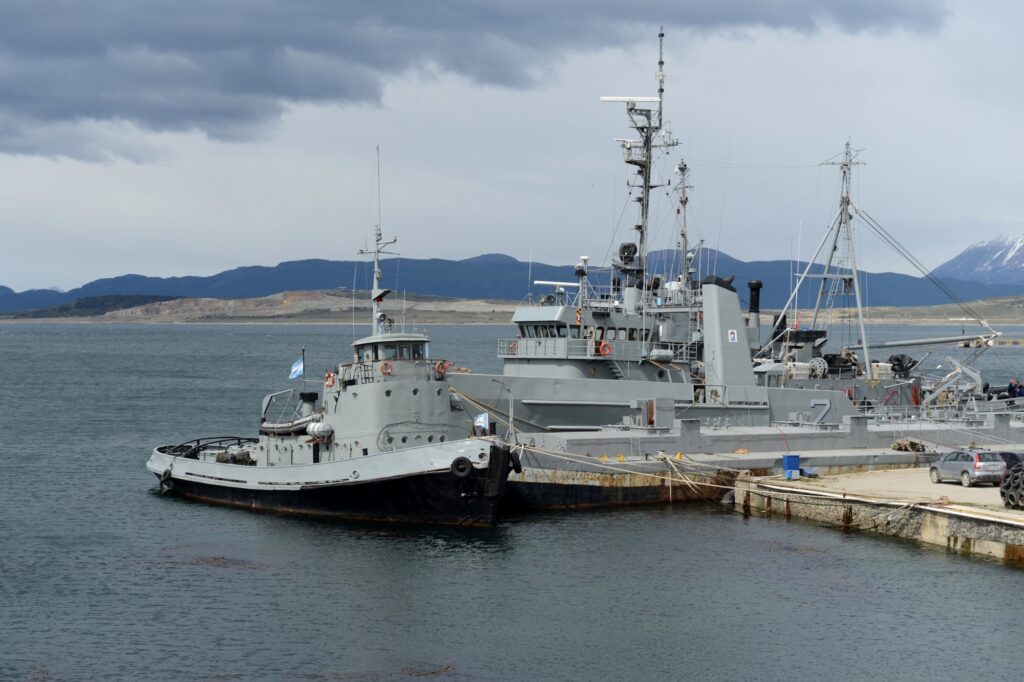
The expansion of the Ushuaia naval center—announced by President Javier Milei together with the Southern Command—has an estimated cost of $300 to $360 million and seeks to enhance Antarctic logistics, maritime search and rescue, and scientific support operations (SOUTHCOM Public Affairs, 2025; Orinoco Tribune, 2025). However, the initiative transcends the technical: it emerges at a time when Washington and Beijing are competing for influence in Latin America, and Argentina and Chile have become key arenas for this dispute.
The Chinese presence in southern Argentina is tangible: the Neuquén space station, operated by an agency subordinate to the People’s Liberation Army, operates with restricted access even for Argentine authorities (Riotimes Online, 2025). Washington sees the modernization of Ushuaia as an opportunity not only to counter this footprint but also to strengthen its logistical reach in Antarctica, support maritime security operations, and ensure compliance with the Antarctic Treaty (El País, 2025).
For Chile—a historic ally of the United States and Argentina’s immediate neighbor—the dilemma is clear: how to balance friendly relations with Buenos Aires and Washington without jeopardizing Chilean sovereignty, its Antarctic reach, and its strategic position in the region?
2. Background to the Ushuaia Naval Base Project
The Ushuaia naval base has traditionally been Argentine, but its modernization with US support marks a qualitative change. For specialized media and analysts, the initiative is part of a strategy to counterbalance the growing Chinese footprint, which includes not only Neuquén but also port investments in the South Atlantic (Polar Journal, 2021; Americas Quarterly, 2025).
Construction began in 2022 and is progressing slowly. As of December 31, 2023, physical progress reached 9.13%, with a financial execution of nearly 2.5 billion pesos; groundworks and the platform for one of the two sheds were completed. In April 2025, Report No. 142 of the Chief of Staff’s Office confirmed that physical progress remained at 9.13%, with no additional substantive progress. However, the presence of senior US commanders such as retired General Laura Richardson and Admiral Alvin Holsey reflects Washington’s view of Ushuaia as a geopolitical asset (Mercopress, 2025; SOUTHCOM Public Affairs, 2025). The logistical dimension—submarines, SAR operations, scientific research—complements the strategic dimension.
3. Chile’s Strategic Concerns
3.1 Antarctic Logistics and Maritime Access
Punta Arenas has historically been the gateway to Antarctica and is seeking to consolidate its presence with the International Antarctic Center (INACH, n.d.). The eventual strengthening of Ushuaia could partially displace that role (El País, 2025). Chilean authorities have warned in parliamentary committees that losing prominence in Antarctic logistics would be equivalent to reducing the country’s ability to project its sovereignty on the “white continent” (Agenda Malvinas, 2024).
3.2 Strategic Rivalry and Military Presence
The entry of the US to strengthen Argentine capabilities creates, in Chile’s view, a potential imbalance. This is amplified by the purchase of 24 F-16s by Buenos Aires and the absence of compensatory measures or transparency towards Chile. There is debate in Chilean military circles about whether Ushuaia constitutes a “change in the status quo” that warrants strengthening deterrence (Agenda Malvinas, 2025a).
3.3 Sovereignty Issues
The history of tensions over the Beagle Channel and the continental shelf shapes Chilean perceptions. Even minor gestures, such as the installation of Argentine solar panels in disputed territory, have prompted diplomatic protests (Agenda Malvinas, 2025a).
4. Historical Patterns and New Geopolitical Equations
4.1 Timeline: Chile-Argentina Relations (1978–2025)
1977–1978: Beagle Channel Conflict (brings both countries to the brink of war).
1979–1984: Papal mediation and final peace.
1990–2010: Opening and rapprochement.
2009:
- Argentina submits to the UN Commission on the Limits of the Continental Shelf (CLCS) its request to extend the outer limit of the continental shelf beyond 200 miles, including the area above the “crescent” in the Southern Zone Sea south of Point F.
- Chile submits a preliminary submission to the CLCS regarding its extended continental shelf in the area near the Taitao Peninsula.
2016–2017: The CLCS officially approves Argentina’s submission, originating in 2009, excluding areas disputed with the United Kingdom or subject to the Antarctic Treaty.
2020–2021: Chile updates Nautical Chart No. 8 and incorporates a continental shelf projection (not extended) from the Diego Ramírez Islands into its maritime maps, which partially overlaps with Argentina’s claim; Argentina formally protests.
2021–2023: New border and diplomatic disputes.
2021: Argentina issues a controversial decree regarding shared areas in the Strait of Magellan; Chile questions it.
December 2023: With Milei in power, Argentine officials raise diplomatic tensions with Chile, creating a bilateral impasse.
2024–2025: Growing tensions.
2024: Controversy over the installation of solar panels next to Hito 1 on Chilean territory. Chile demands their withdrawal; Argentina classifies it as a technical error (Agenda Malvinas, 2025a).
April 2024: President Javier Milei announces the construction of an “integrated naval base” in Ushuaia with US participation. He emphasizes that it would be a major logistics center, “the closest development port to Antarctica,” and would make Argentina the “gateway to the white continent.”
April 2024: General Laura Richardson, then head of the Southern Command, visits Ushuaia, strengthens strategic ties, and supports the project.
2024: Tense relations between Presidents Gabriel Boric and Javier Milei, marked by public statements, although no formal ruptures have occurred.
November 2024: Milei decides not to send an Argentine representative to the commemoration of the 40th anniversary of the agreement that averted the Beagle War, rekindling diplomatic tensions.
April 2025: Admiral Alvin Holsey (Southern Command) makes another three-day visit, including to Ushuaia, to consolidate the project’s progress. An investment of nearly $360 million is estimated (SOUTHCOM Public Affairs, 2025; Mercopress, 2025).
4.2 The Argentina-China-United States Triangle
The Ushuaia base cannot be analyzed in isolation from the Chinese presence in Neuquén. However, limiting the explanation to a “mirror effect” would be insufficient. For Washington, Ushuaia serves multiple functions: reinforcing operations in the South Atlantic, projecting rescue and observation capabilities in Antarctica, and guaranteeing free bioceanic routes (El País, 2025).
Beijing, for its part, frames the discussion within its broader strategy of cognitive warfare against the United States and its global influence. Rather than responding to the underlying questions, its spokespersons resort to a predictable discursive pattern: dismissing the US vision as a “Cold War mentality” and presenting its projects as strictly scientific initiatives and peaceful cooperation (Andrés Bello Foundation, 2025; South China Morning Post, 2025). China’s official press reinforces this narrative, projecting the image of a reliable partner and accusing Washington of “militarizing” southern Argentina, yet another example of how Beijing seeks to shape strategic perceptions and weaken the legitimacy of the US presence without directly addressing the merits of the criticisms (Wall Street Journal, 2024).
4.3 The Argentina-Chile-United States Triangle
For Chile, Washington’s support for Buenos Aires poses a diplomatic challenge: without balanced and transparent measures, it could be interpreted as a strategic bias toward Argentina. This risk requires exploring trilateral cooperation mechanisms.
5. Chile’s Strategic Responses
Chile has already responded with parliamentary action, investment in southern ports, and legal oversight (Agenda Malvinas, 2024; AInvest, 2025). However, Chilean military experts suggest that the country should promote mutual trust-building measures:
• Trilateral Chile-Argentina-US naval exercises in Antarctic rescue and security tasks.
• Transparency agreements on the use of Ushuaia and Punta Arenas, including reciprocal visits by military delegations.
• Joint scientific cooperation within the framework of the Antarctic Treaty, allowing for shared facilities and projects.
These initiatives would reduce threat perceptions, transforming Ushuaia from a potential source of friction into an opportunity for regional collaboration.
6. Conclusion and Policy Implications
The construction of the Ushuaia base is part of a larger agenda: the China-US global competition. For Santiago, the key is not only to avoid imbalances today, but also to project future scenarios. If China’s presence in the region intensifies, Chile could see the Ushuaia base as a useful counterweight—provided it actively participates within its framework of use.
In this sense, Ushuaia should not be viewed as an exclusive bilateral initiative, but rather as part of a trilateral arrangement that incorporates Chile as a partner in logistical, scientific, and security planning. Only in this way will Washington ensure that the base strengthens regional stability rather than generating insecurity.
A crisis averted is a crisis prevented, but a shared opportunity can become a pillar of regional confidence.
References
Agenda Malvinas. (2024, May 24). The Chilean Defense Commission met in Antarctica amid disputes with Argentina. https://agendamalvinas.com.ar/en/noticia/la-comision-de-defensa-chilena-sesiono-en-la-antartida-en-medio-de-controversias-con-argentina
Agenda Malvinas. (2025). Chile complains to Argentina about military construction within its territory. https://agendamalvinas.com.ar/en/noticia/chile-reclama-a-la-argentina-por-construccion-militar-dentro-de-su-territorio
AInvest. (2025). Chile’s earthquake sparks opportunities in Antarctic resilience. https://www.ainvest.com/news/chile-earthquake-sparks-opportunities-antarctic-resilience-tourism-recovery-2505
Americas Quarterly. (2025, April 22). A new stage in the race to develop Latin America’s ports. https://americasquarterly.org/article/a-new-stage-in-the-race-to-develop-latin-americas-ports
Arancibia Clavel, F. (2025, August 7). Interview via Zoom with JoseAdan Gutiérrez and Enzo Ibaceta. Personal communication.
Business & Human Rights Resource Centre. (2025). Chile: New port in Magallanes that will facilitate green energy projects. https://www.business-humanrights.org/en/latest-news/chile-new-port-in-magallanes
El País. (2025, May 1). The U.S. sets its sights on Antarctica in pushback against China. https://english.elpais.com/international/2025-05-01/the-us-sets-its-sights-on-antarctica-in-pushback-against-china.html
Fundación Andrés Bello. (2025, February 10). China rebuts U.S. ambassador designate’s remarks on Argentina. https://fundacionandresbello.org/en/news/argentina-%F0%9F%87%A6%F0%9F%87%B7-news/china-rebuts-u-s-ambassador-designates-remarks-on-argentina
Instituto Antártico Chileno (INACH). (n.d.). Centro Antártico Internacional. https://www.inach.cl/iniciativas-de-divulgacion/centro-antartico-internacional
Mercopress. (2025, May 5). Argentina-US SouthCom chief passes through. https://en.mercopress.com/2025/05/05/argentina-us-southcom-chief-passes-through-consequences-to-be-seen-shortly
Orinoco Tribune. (2025). We are at serious risk: US pushes for naval base in southern Argentina. https://orinocotribune.com/we-are-at-serious-risk-us-pushes-for-naval-base-in-southern-argentina
Polar Journal. (2021, July 27). Argentina plans Antarctic logistics center in Ushuaia. https://polarjournal.net/argentina-plans-antarctic-logistics-center-in-ushuaia
Riotimes Online. (2025). South Atlantic stakes: U.S. counters China at Argentina’s Ushuaia naval hub. https://www.riotimesonline.com/south-atlantic-stakes-u-s-counters-china-at-argentinas-ushuaia-naval-hub
South China Morning Post. (2025, February 11). China slams U.S. envoy nominee for framing Argentina as ‘great power battlefield’. https://www.scmp.com/news/china/diplomacy/article/3319506/china-slams-us-envoy-nominee-framing-argentina-great-power-battlefield
Southcom Public Affairs. (2025, May 1). Adm. Holsey meets with President Milei and defense leaders in Argentina. https://www.southcom.mil/MEDIA/NEWS-ARTICLES/Article/4171706/adm-holsey-meets-with-president-milei-and-defense-leaders-in-argentina
Wall Street Journal. (2024, April 10). Argentina’s Milei finds it hard to decouple from China. https://www.wsj.com/world/americas/argentinas-milei-finds-it-hard-to-decouple-from-china-6faae47f
Wikipedia. (2025a). Treaty of Peace and Friendship of 1984 between Chile and Argentina. https://es.wikipedia.org/wiki/Tratado_de_Paz_y_Amistad_de_1984_entre_Chile_y_Argentina
Wikipedia. (2025b). Beagle conflict. https://es.wikipedia.org/wiki/Conflicto_del_Beagle
The opinions expressed in this article are those of the author and do not necessarily reflect the views of the Miami Strategic Intelligence Institute (MSI²).