
22 Aug China and India Today: What’s Happening and Why We Care
By,
René F. Bolio, President of the Mexican Commission on Human Rights
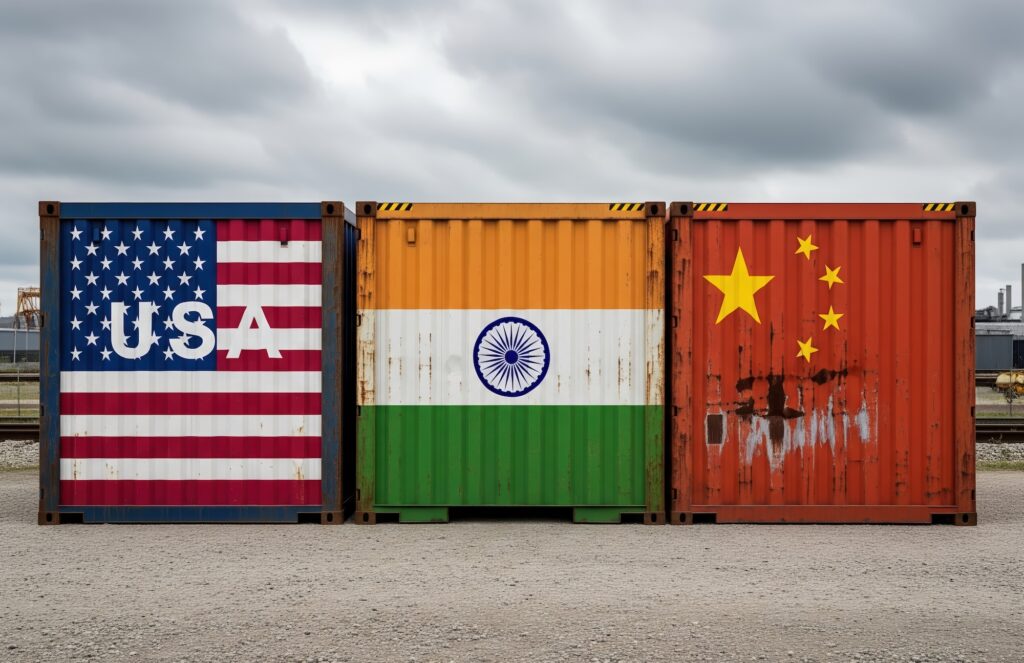
China and India are the two giants of Asia, but today they are moving in different directions. India, a democracy with a young population, is gaining momentum and attracting investment. China, a one-party communist regime (a dictatorship), is showing signs of slowing: real estate problems, an aging population, and trade clashes with the West. This divergence is reshaping global trade, supply chains, and international politics—and is closely affecting the United States and Latin America.
The trajectories of both countries are divergent, and today we can clearly see the direction:
India on the rise (democracy): It is growing solidly, supporting infrastructure, digitalization, and manufacturing, and taking advantage of the interest of companies seeking to “not put all their eggs in the Chinese basket.” Its great advantage is demographic: more young people entering the labor market and an expanding middle class. India is the world’s largest democracy, with many challenges ahead, but its free elections and multiparty system are an example that democracy works, despite the enormous population, linguistic, religious, and racial challenges.
China on the decline (dictatorship): It maintains its industrial strength, but is grappling with a prolonged adjustment in the real estate sector, lower consumer confidence, and a declining population. Tensions with the US and Europe (tariffs and technological controls) add to the friction. The severe repression of the Chinese population, espionage, and lack of freedom greatly complicate the situation, which depends on a fragile economic well-being.
Using various indicators, we observe how each country maintains its path:
- Growth: India remains among the fastest-growing major economies. China is still growing, but at a slower pace than a decade ago.
- Employment and wages: India needs to transform informal jobs into formal ones and create more industrial positions; even so, the arrival of new investment helps. In China, young people are finding it harder than before.
- Demographics: India is gaining workers; China has already begun to lose its population and is aging rapidly.
- Technology and manufacturing: China remains strong in advanced chains (batteries, solar energy, electronics), although facing more barriers in the West. India is making progress in digital services, pharmaceuticals, and, little by little, in electronics and auto factories.
Meanwhile, the relationship between the two giants, rival neighbors and partners, is not straightforward. Trade does flow: India buys many Chinese inputs (electronics, chemicals, equipment). But strategic trust is limited by border clashes and competition for regional leadership. The result: economic interdependence with political prudence.
Recently, the United States and, to some extent, Europe have raised tariffs on Chinese products (electric cars, semiconductors, solar energy, metals). This makes the entry of these goods more expensive to the West, accelerates the “diversion” of production to third parties (Southeast Asia, Mexico, India), and pushes China to seek more customers in Asia, Africa, and Latin America.
For India, the effect is mixed: it gains investment and export opportunities, but it depends on Chinese inputs, which may also become more expensive.
Relations with the United States have changed and are not yet definitive; they are constantly evolving. Let’s see:
China: Open rivalry in trade and technology. Washington seeks to reduce risks: Less dependence on critical sectors and controls over chips and advanced equipment.
India: Growing ties: more dialogue on Indo-Pacific security, defense, and technology cooperation, and US companies installing part of their production in India. There are occasional clashes (tariffs, regulations), but the general trend is toward rapprochement. The rapprochement with Russia over the purchase of cheap oil has resulted in tariff sanctions, but these have not been sufficient to define a realignment.
In the case of Latin America, let’s see what it will be like in these new times.
With China:
The region has relied on China as a major buyer of raw materials (soybeans, minerals, oil) and as a financier/builder of infrastructure. New barriers in the West could lead to a greater Chinese presence in Latin America, seeking markets and political alliances. There is also growing interest in installing parts of the chain (for example, electric cars or batteries) where there are agreements with the US. Mexico is a clear case in point due to the USMCA. This also promotes the constant colonization of nations in the region.
With India:
It is still a minor partner for the region, but is gaining ground in the pharmaceutical, digital services, and auto parts sectors. Several Latin American countries are exploring agreements to attract Indian investment and diversify exports (not just commodities).
Politically:
China cultivates relations with governments of different persuasions and uses state-owned banks to generate debt, and public companies with dumping as leverage. India prioritizes technical cooperation (health, IT, education) and trade forums, with fewer visible political conditions. For Latin America, diversification between the two can translate into better prices and more investment, if the quality of projects and the rules of the game are maintained.
The BRICS group (initiated by Brazil, Russia, India, China, and South Africa) has expanded to gain influence in the “Global South.” China is promoting a more active BRICS (finance and infrastructure). India participates, but cautiously, because it also values its closeness to the West. For Latin America, Brazil plays a bridge, and other countries are watching to see if the bloc offers credit, markets, or specific projects.
What can be expected in the near future in that region of the world will have global significance, and we will closely observe the development of each one in the economic, political, and social spheres.
Indian democracy is in a phase of economic and geopolitical ascent, bringing it closer to the United States and sparking interest in Latin America. The Chinese dictatorship retains enormous industrial capabilities but is undergoing a period of adjustment with more barriers in the West and internal doubts. The relationship between the two—made up of intense trade and strategic distrust—will be one of the forces that define how global trade and politics are reorganized… and where the jobs of the future are created in our region, which will choose between alliances and complicity.
The opinions expressed in this article are those of the author and do not necessarily reflect the views of the Miami Strategic Intelligence Institute (MSI²).