19 Sep Chinese 80th Anniversary Victory Parade: An Afterthought
By,
Octavio Pérez, Co-Founder & Senior Fellow, MSI²
As we hinted on August 22 in our previous article on the parade, there was much to observe—and even more to analyze.
The world, and particularly the United States, closely monitored the initial gathering of the Shanghai Cooperation Summit on the Sunday before the parade. The mere fact that Xi Jinping, Putin, and Modi—who coincidentally are part of BRICS (Brazil, Russia, India, China, and South Africa)—were present is significant. This group represents nations whose anti-Western, anti-American agenda ultimately challenges existing banking, lending, and longstanding institutions such as the G7.
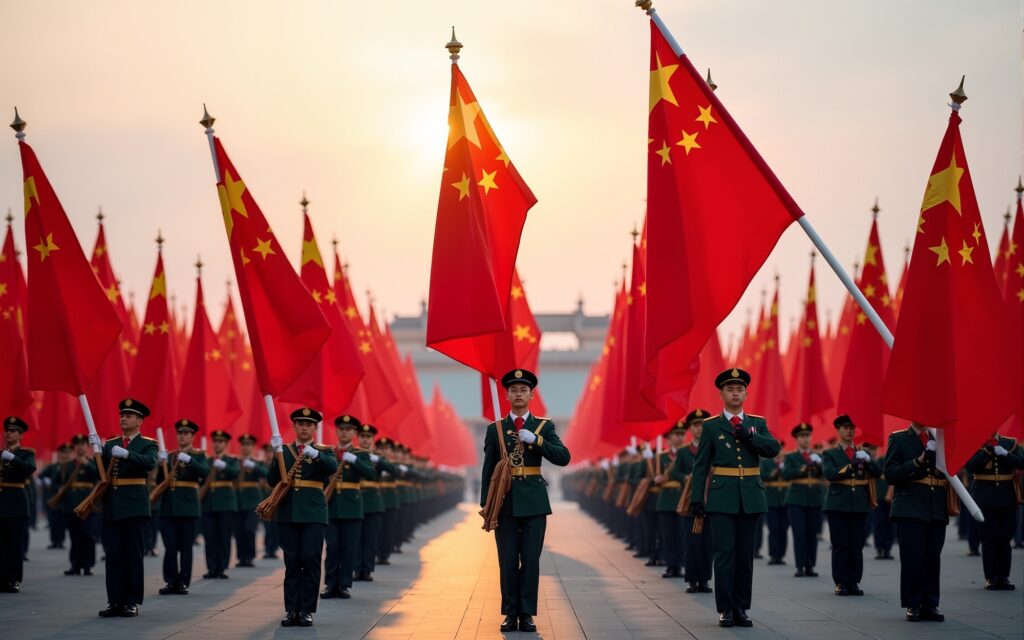
The summit allowed Xi Jinping to present himself as a global leader with the power of convocation. Geopolitics was on full display as he met with Modi and Putin during the summit. During the parade itself, Modi did not attend, but Kim Jong Un made his appearance after a six-year hiatus—sending two powerful messages: Xi reaffirmed economic ties with Modi and other leaders, while the parade highlighted a unified military posture between Putin and Kim Jong Un.
Xi did not mention the U.S. contribution to China’s liberation from Japanese occupation. President Trump had sent him a message reminding him of the 3,727 American lives lost in the China-Burma-India (CBI) theater of operations while sustaining supply efforts. The actual number of casualties was 6,925, with 3,727 resulting in deaths.
Xi’s main message upon arriving at Tiananmen Square, flanked by Putin and Kim Jong Un, was to show the world—and President Trump—that he is a man capable of convening key global issues, including the Ukraine War and North Korea’s nuclear threat. All this posturing preceded the parade itself, emphasizing that the messages were as important as the hardware on display.
Putin took advantage of the moment to announce that his contacts supported his upcoming meeting with Trump in Alaska, hinting at potential progress toward ending the war in Ukraine. As host, Xi reviewed the troops and explicitly reminded them to defend the nation and unify all territories, including Taiwan.
The parade showcased new weapons systems, including first appearances and upgrades. Key highlights of China’s nuclear triad included the SL-1, an air-launched nuclear missile derived from the submarine-launched JL-3 ICBM. Land-based versions of the DF-31 and DF-61 were also displayed.
New aircraft included twin-seat J-20 variants, J-20A with improved engines, and the land-based J-35A, previously unveiled at the November 2024 Zhuhai Air Show. The DF-5C made its official debut, showing three different launch vehicles with two-phase boosters and MIRV (Multiple Independently Targetable Reentry Vehicle) cones, carrying ten warheads.
The hypersonic CJ-1000 cruise missile, an improved version of the DF-100 capable of reaching Guam, also appeared. Air defense systems included the HQ-20 SAM, HQ-22A, HQ-10 with 18 pods, and LY-1 naval laser weapons on an amphibious transport dock. Anti-ship missiles such as the YJ-15, YJ-17, YJ-19, and YJ-20 were displayed, along with torpedoes and submersible drones, including the AMB012, AJC015, and AQA10. Heavyweight nuclear-capable torpedoes, surveillance drones like the HSU100, and mine-laying drones like the AJX002 were also present. Naval drones included mine-laying boats and the GJ-11/21 “noble wingman,” plus unmanned helicopter drones.
Chinese aircraft such as the Y-9 ASW, J-15, and J-35 were escorted by tankers like the KJ-600. New Chinese S-300 variants included the HQ-9C, with semi-active radar homing and a 155-mile range, and the HQ-19 ABM system, comparable to the U.S. THAAD system.
The parade demonstrated China’s technological advancements across all military domains. From disbanding horse cavalry divisions in 1969 to a state-of-the-art armed force in 56 years, most modernization occurred during Xi Jinping’s 13-year tenure. Despite internal challenges—such as stock market declines, employment issues, and tariffs—the parade emphasized Xi’s military power and strategic influence.
References
AP News. (2025, September 3). China displays its military strength in a parade on the 80th anniversary of the end of WWII. https://apnews.com/article/china-military-parade-world-war-xi-jinping-ed1f7b3e245882dd91b597df24eafbea
China Economic Review. (2025, September 5). Parade fallout. https://chinaeconomicreview.substack.com/p/parade-fallout?utm_campaign=email-half-post&r=5qpmj4&utm_source=substack&utm_medium=email
SCMP. (2025, September 3). China parades new weapons in show of ‘strategic ace’ deterrence – as it happened. https://www.scmp.com/news/china/article/3324119/victory-day-military-parade-china-puts-weapons-progress-and-troops-show
Wong, T. (2025). What new weapons on show at huge parade say about China’s military strength. BBC News. https://www.bbc.com/news/articles/cjr1reyr059o
The opinions expressed in this article are those of the author and do not necessarily reflect the views of the Miami Strategic Intelligence Institute (MSI²).