
16 Dec Opinion: The Junta Is Still There
By,
Andrés Alburquerque, Senior Fellow, MSI²
Necessary Foreword
Spurred by the crushing defeat we suffered in the New York mayoral elections, I have resolved to expose, through a series of three articles, the true face of communism in Cuba. I will examine how, with scarcely five percent of the popular vote, the communists succeeded in seizing the island and holding it in what appears to be an eternal bear hug. My analysis draws heavily on the indispensable “Soviet Cuba” by my friend César Reynel Aguilera, as well as on my own childhood memories of growing up within a communist household. In approaching this task, I have endeavored to be as meticulous and unsparing as possible.
The persistence of the Cuban regime is often framed as an anachronism, an ideological fossil kept alive by nostalgia, inertia, or the brute mechanics of repression. But this explanation is insufficient. The junta is still there, not merely because it controls the island, but because it has never lacked accomplices abroad. Its longevity is not just a Cuban phenomenon; it is an international one, sustained by cultural laundering, diplomatic cowardice, and a steady stream of moral exemptions granted by Hollywood, Brussels, Washington, and even some in Wall Street.
From its earliest days, the Cuban Revolution learned a lesson that many authoritarian regimes have since perfected: survival depends as much on narrative as on force. Prisons, firing squads, and informants maintain internal order, but it is the story told to the outside world that keeps sanctions porous, criticism muted, and sympathy alive. The regime’s genius, if such a word can be used in this context, was to brand its dictatorship as a romance.
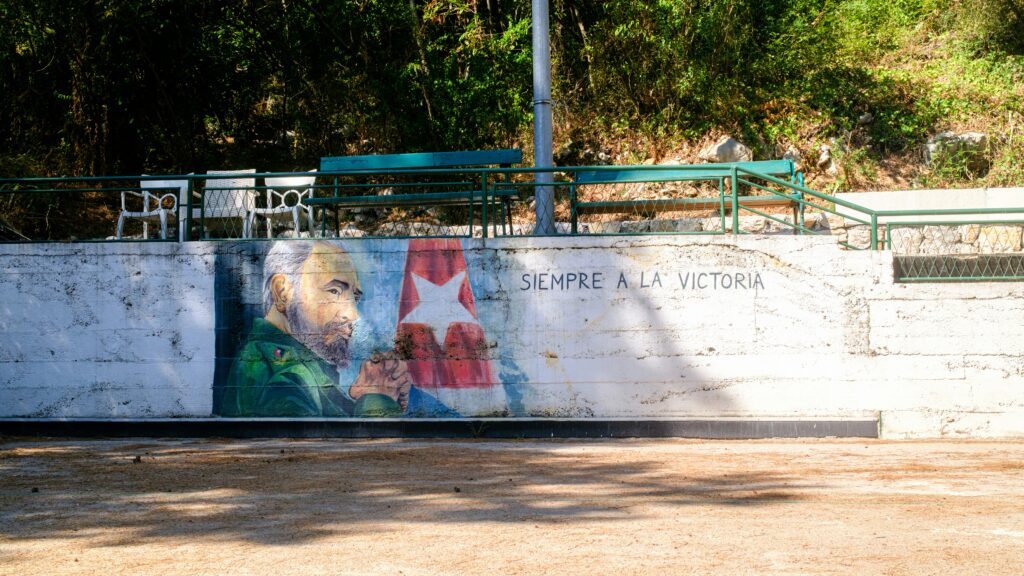
Hollywood played a central role in this myth-making. For decades, the Cuban regime benefited from a cultural industry predisposed to view anti-Americanism as sophistication and revolutionary aesthetics as moral seriousness. Biased films and documentaries, as well as celebrity visits, transformed a police state into a backdrop for expensive cigars, vintage cars, and poetic resistance. The suffering of political prisoners, the absence of free unions, the criminalization of dissent, these were inconvenient details, eclipsed by sunlit images of defiant artists and benevolent strongmen. The result was not ignorance but selective vision: a willingness to see Cuba not as it was, but as it flattered Western fantasies about rebellion and purity.
The European Union, meanwhile, perfected a different form of complicity: bureaucratic indulgence. Brussels spoke the language of human rights while practicing the politics of accommodation. “Dialogue”, usually a tool to achieve political objectives, became an end in itself, detached from measurable outcomes. Trade agreements and cooperation frameworks were signed, renewed, and expanded with only ritualistic nods to political reform. The regime learned that it could jail dissidents on Monday and host EU delegations on Friday, confident that moral condemnation would never translate into meaningful consequences. In this sense, Europe did not merely tolerate the junta; it did, and still does, normalize it.
The United States, for its part, oscillated between fake pressure and indulgence, often undermining its own stated principles. While Washington officially condemned the regime, influential sectors within academia, media, and the foreign policy establishment, the infamous 4th Floor of the State Department, worked tirelessly to reframe Cuba as a misunderstood underdog rather than a durable tyranny. I still remember the late Bob McNamara painstakingly juggling with semantics to avoid admitting that Castro violated his people’s human rights. Every gesture of repression was met with an explanation, every protest with a contextualization, every failure with a reminder of the embargo, as if economic sanctions, rather than absolute political control, explained the absence of free elections after more than six decades.
This reflex to excuse is the regime’s greatest external asset. The Cuban government has outlived generations of US leaders not because it delivers prosperity or justice, but because it has been shielded from the full moral accounting that other dictatorships face. Its crimes are relativized, its victims rendered literally invisible, its ideology treated as a charming eccentricity rather than a mechanism of domination and extermination.
The junta is still there because too many powerful actors prefer the comfort of myth to the inconvenience of truth. Hollywood prefers a good story. European elites prefer stability and dialogue without confrontation. American institutions remain divided between principle and guilt. Together, they have created an ecosystem in which the Cuban regime can fail indefinitely without ever being allowed to fully lose legitimacy.
To say that the junta is still there is not merely to describe a political reality on an island ninety miles from Florida. It is to indict a transnational culture of complicity, one that proves that dictatorships do not survive on repression alone. They survive because, somewhere far from the prisons and the empty-shelved bodegas, there are influential people willing to look away, applaud the symbolism, and insist that this time, uniquely, tyranny deserves understanding. All this happens while the Cuban people is taken to the very verge of lunacy; oblivious to the rest of the world; barely surviving; those lucky enough, the genocide that their government has launched on them.
The opinions expressed in this article are those of the author and do not necessarily reflect the views of the Miami Strategic Intelligence Institute (MSI²).