11 Jan Opinion – The despot is imprisoned, does the dictatorship still rule?
By,
Pedro Corzo, Senior Fellow, MSI²
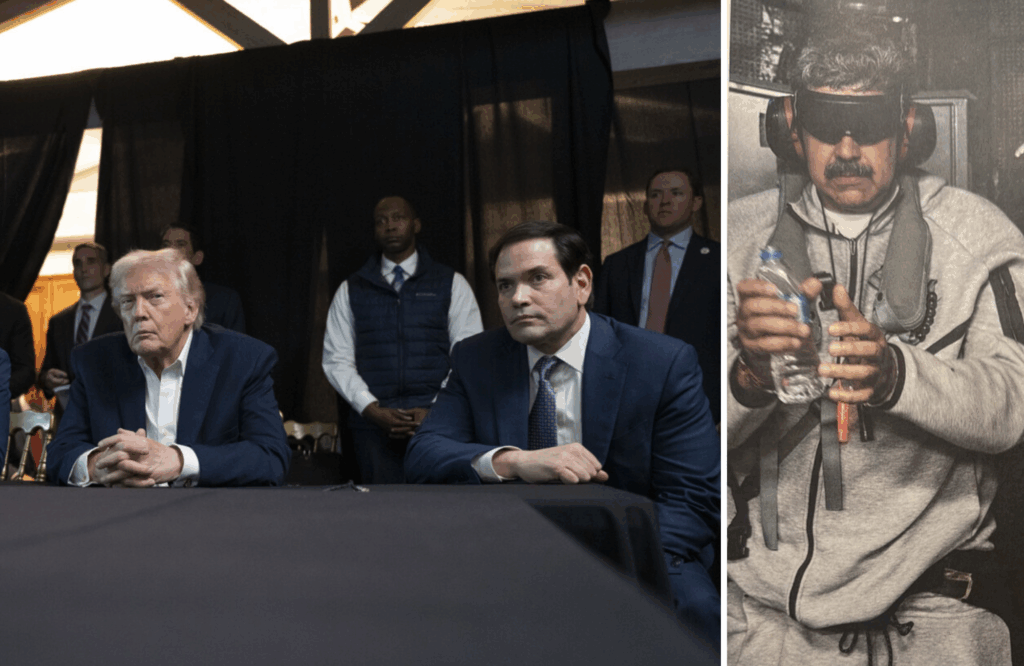
I received with great satisfaction the capture of Nicolás Maduro and his complicit wife, Cilia Flores, and deeply regretted that many of his associates, including Diosdado Cabello and General Vladimir Padrino López, were not arrested, although it is to be expected that all those associated with the dictator in the Cartel de los Soles and the government will eventually end up in prison.
Moreover, I find it highly appropriate that this humanitarian intervention, without military occupation, helps to purge the Latin American doctrine of “non-intervention,” which has been useful in allowing tyrants to perpetuate themselves in power, as has occurred in Cuba (67 years), Venezuela (26 years), and Nicaragua (30 years over two periods).
The principle of “non-intervention” is valid when citizens have the capacity to remove their rulers through plural and secret elections, with an independent judiciary and electoral tribunals, as well as verification by reputable international organizations, which is not possible in the countries mentioned.
“Non-intervention and self-determination of peoples” should be a sacred principle when democracy and popular will prevail in a country, just as electoral practice should be the means to change a government that respects democratic norms. However, when there is no democracy, the oppressed have the right to rebellion and to fight oppression, just as neighboring states have the duty to cross the border to protect the defenseless who suffer in its shadow.
It is true that every people has the prerogative to choose its rulers and the system of government it prefers, a natural right linked to regime change when it no longer satisfies them; therefore, when the tyrant Fidel Castro said “the Cuban people voted in 1959,” he committed one of the many aberrations of his malevolent existence.
It is not prudent to respect doctrines that allow predators to feed on the blood of their victims. What has been happening in Cuba for decades demands active solidarity with a people who have demonstrated their desire to be free; nor is it moral to accept the debacle suffered by Venezuelans in the name of contracts that only serve criminals.
The dire situation in Cuba, Venezuela, and Nicaragua demands the participation of the hemisphere’s democracies. It is not prudent to allow the proliferation of evil when the possibility of freedom exists. The continent should respond to wrongdoing in a multilateral manner, acting in common agreement and condemning governments that do not respect their citizens.
On the other hand, the leadership of the United States in this judicial operation, without which Maduro and Flores would continue oppressing Venezuelans, raises questions with complex answers for all parties.
In my view, Washington learned the lesson of Iraq. That country’s government was completely dismantled, generating a power vacuum partially filled by terrorist groups, a situation that would apparently be avoided if the current president and accomplice of the imprisoned drug trafficker, Delcy Rodríguez, were to lead a political transition that should have been carried out by Nicolás Maduro when he lost the elections of July 28, 2024.
Other questions arise. Will there be a call for new elections, or simply what many of us consider just: the transfer of government to Edmundo González and María Corina Machado, although we do not doubt that, if new elections are held, that pair would repeat their victory.
On the other hand, when will all political prisoners be released? As a former prisoner, I believe that this should be the first action taken by the criminals in power, who are also responsible for all the abuses and outrages committed under Hugo Chávez and Maduro. When will the rights of the opposition and of those politically disqualified be restored? When will those who chose exile to safeguard their freedom and their lives be able to return to Venezuela? When will the confiscated assets and the radio and television broadcasting licenses that Chávez and Nicolás Maduro stripped away be returned to their rightful owners?
Finally, Maduro’s alliance with Cuban totalitarianism far exceeds his relationship with China, Russia, and Iran, a reality made evident by the deaths of dozens of Castroite agents who fell defending the dictator. The repressive assistance and Cuban control over Venezuelan public institutions are more than evident, so it is reasonable to assume that Havana is aware of the drug trafficking carried out by the Cartel de los Soles led by the imprisoned dictator.
The opinions expressed in this article are those of the author and do not necessarily reflect the views of the Miami Strategic Intelligence Institute (MSI²).