
11 Jan Opinion – The Phantom Force That Never Existed but Died Recognized
By,
LTC Octavio Pérez, US Army (Ret.), Co-Founder and Senior Fellow, MSI²
Much more will be said about the Cubans in Venezuela as we peel back the layers of this onion. Isis Unveiled, the book by H. P. Blavatsky, which I keep in my library and read many years ago, and which deals with esoteric philosophy, offers a comparable level of mystery to that surrounding Cuban operations worldwide.
The Phantom Force had its existence publicly denied for as long as Chávez remained in power. Its presence was so evident that even his own army generals rebelled against him. Yet he survived it all, and the Phantom Force remained in place. As late as 2019, news interviews conducted by María Elvira Salazar, now Congresswoman from Florida, then a prominent TV reporter, confronted Nicolás Maduro directly about its existence. Maduro claimed it was a fabricated Yankee fantasy and insisted that his Praetorian Guard was entirely Venezuelan. So, fast-forward to 2026.
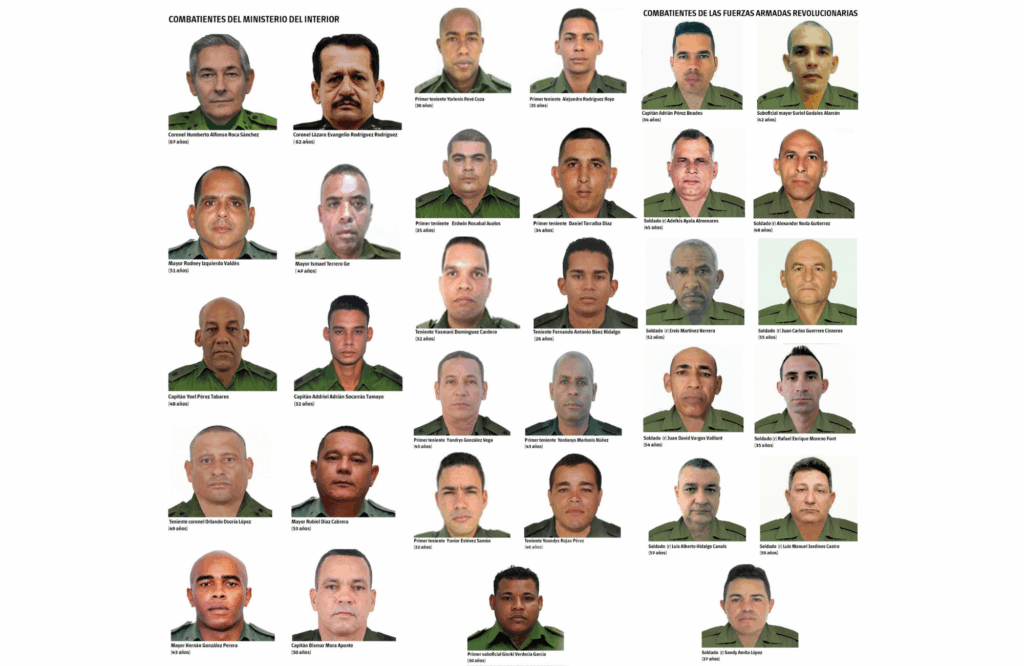
Many questions remain unanswered, and what we know so far is mind-boggling. When reviewing the list published by the Cuban government, it becomes evident that all of the deceased enlisted personnel, except for the Sergeant Major, were either retired soldiers recalled to active duty or volunteers. Were they there because of meritocracy or due to specific experience?
Even within the group of 32 killed, more than half were over 40 years old. Only three were under the age of 32. Compare this to the average age of a Delta Force team, generally in the early to mid-30s or even late 20s. Age was clearly a factor. Within U.S. forces, only a few individuals over 40 would be part of an assault or rescue team; most older personnel serve in higher command and control positions. The core “door kickers” are younger.
If the deceased represent a representative sample of the broader security force, that in itself is problematic. Consider the requirements for a Secret Service presidential detail: beyond exceptional physical fitness, sharp observational skills, and marksmanship, service on the detail typically lasts no more than three years and 120 days before reassignment. This means one would almost certainly not remain on the detail beyond their mid-30s.
Let us return to what is known as Capa Cero, the first ring of security composed of the so-called Avispas Negras (Black Wasps).
They failed to protect Maduro and his wife during a two-hour and twenty-minute operation, within a potential assault that lasted less than 30 minutes. The targets were extracted directly from their bedroom. There was a total failure to react from the moment the bombing began until the ground operation reached their residence.
The American success can be attributed to several factors.
The U.S. conducted extensive research on Maduro’s habits and daily routines, documenting every hour to establish behavioral patterns, which were corroborated through on-site human intelligence. They obtained access codes to the bunkers, knew what he ate and when, and developed a comprehensive daily life profile. In addition, a mole within his inner circle provided real-time data, confirming routines and identifying his rotation among six to eight safe houses.
Returning to the Phantom Force, the aftermath revealed significant failures in Cuban military protection and intelligence capabilities.
There was no detection of an internal mole within the first security ring, an essential counterintelligence failure that allowed near-real-time tracking of the target.
Predictable movement routines were allowed to persist, establishing exploitable patterns critical to the assault.
Cuban intelligence failed to detect CIA infiltration teams operating in Caracas since August 2025. Cuban services typically monitor all foreigners in the country; the fact that no one was detected over a five-month period is unacceptable.
The defense of Maduro’s residence at Fuerte Tiuna was compromised within seconds. The operation was so well planned that the equipment used to breach reinforced steel doors (blowtorches) was highly effective and rapid, leaving Maduro no time to reach the safe room.
Military assistance also failed to prepare for or counter electronic warfare. U.S. SEAD (Suppression of Enemy Air Defenses) operations rendered Russian and Chinese radar systems inoperative, while jamming neutralized other air defense assets. This was instrumental in enabling the assault and extraction.
Videos clearly show a massive MH-47G Special Operations helicopter hovering for several minutes over a high-rise building during insertion and extraction operations.
Persistent aerial surveillance over Caracas using the RQ-170 Sentinel stealth drone was, and remains, a critical asset. It corroborated intelligence findings, target identification, and movement tracking, and continues to do so.
Returning to the Phantom Force for the conclusion:
The fact that approximately 23% of the Cuban contingent, estimated at 140 personnel, was killed in the assault is deeply troubling. According to Cuban listings, nine of the deceased were designated as “retired.” Of these, five were between 52 and 59 years old, two between 45 and 48, and two between 35 and 37. Only the Sergeant Major (48) was an active FAR personnel.
Even more striking is that 21 officers, 66% of the total fatalities, were among the dead. These included two colonels aged 62–67, one lieutenant colonel (49), four majors (43–53), four captains (32–50), six first lieutenants (32–45), and three second lieutenants (26–32).
Comparing rank and age structures with U.S. forces, the picture is stark: young men were fighting older men.
Thus, the mythical power of Cuban counterintelligence, its elite force (the Avispas Negras), and more than 25 years of intervention on Venezuelan soil failed to protect the narco-leader usurping power in Venezuela.
The force appears to have been composed largely through meritocratic selection. The disproportionate ratio of officers to enlisted personnel, combined with age distribution, suggests volunteers who passed additional vetting, only to end up dead.
But the key point remains: according to Chávez, and later Maduro, they never existed. And for that very reason, in the end, the Ghost Force that never existed was finally acknowledged, only in death.
The opinions expressed in this article are those of the author and do not necessarily reflect the views of the Miami Strategic Intelligence Institute (MSI²).