
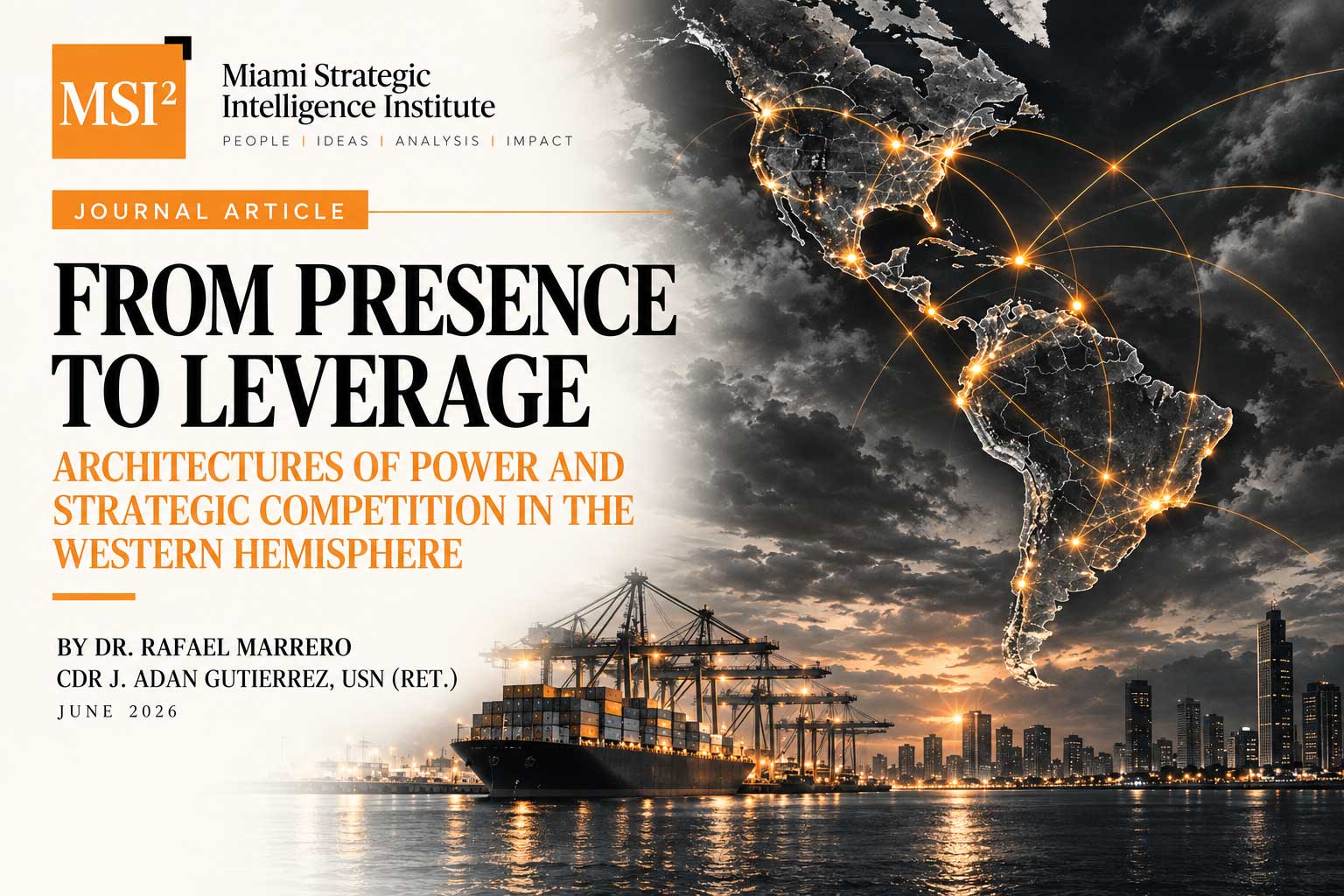
09 Sep From Presence to Leverage: Architectures of Power and Strategic Competition in the Western Hemisphere
The Western Hemisphere is entering a period in which strategic competition is increasingly shaped not only by military presence, but by the ability of states and institutions to convert economic relationships, technological capabilities, infrastructure, diplomatic partnerships, and access to critical resources into lasting influence.
For much of the modern era, strategic presence was often measured through visible indicators: military deployments, diplomatic missions, trade relationships, or political alliances. Today, power is becoming more distributed and interconnected. Influence can emerge from ownership of infrastructure, control of supply chains, access to technology, financial relationships, data networks, and the ability to provide alternatives when existing systems become vulnerable.
The result is a changing architecture of power across the Americas.
From Presence to Leverage
Presence provides access. Leverage provides influence.
A country may maintain diplomatic relations or commercial ties throughout the hemisphere without necessarily possessing the ability to shape decisions. Leverage emerges when relationships create meaningful advantages or dependencies.
Economic investment can create leverage when it connects a partner to essential infrastructure or supply chains. Technology can create leverage when institutions become dependent on particular platforms or standards. Energy relationships can create leverage when access to critical resources becomes concentrated.
This does not mean that every economic or technological relationship is inherently coercive. Interdependence can create mutual benefits and strengthen regional cooperation. The strategic question is whether dependencies are diversified, reciprocal, and resilient—or concentrated enough to become instruments of influence.
The Architecture of Economic Power
Economic relationships remain one of the most important foundations of strategic competition.
Trade, foreign investment, infrastructure financing, manufacturing capacity, and access to markets can shape the strategic choices available to governments throughout the hemisphere.
Countries seeking greater economic resilience are increasingly examining the structure of their external relationships. Dependence on a single market, supplier, financing source, or infrastructure provider can reduce strategic flexibility.
At the same time, diversified economic relationships can provide governments with additional options.
This creates an important distinction between economic presence and economic leverage.
Presence involves participation. Leverage involves the ability to influence outcomes because of that participation.
For policymakers, understanding this distinction is increasingly important when evaluating major infrastructure projects, foreign investment, supply-chain relationships, and strategic industries.
Infrastructure as Strategic Power
Infrastructure can quietly reshape regional power.
Ports, telecommunications networks, energy systems, transportation corridors, digital infrastructure, and logistics facilities determine how economies connect to one another.
Infrastructure therefore has both economic and strategic dimensions.
A new transportation corridor may improve trade and regional integration. A modern telecommunications network can expand connectivity and economic opportunity. Energy infrastructure can strengthen energy security.
But infrastructure can also create long-term dependencies.
Once a country becomes deeply integrated into a particular technological or logistical system, changing providers or developing alternatives can become expensive and difficult.
The strategic importance of infrastructure therefore extends beyond who builds it. It also involves who operates it, who controls critical components, where data flows, and what alternatives exist if relationships change.
Technology and the New Geography of Influence
Technology is becoming one of the most important arenas of strategic competition.
Artificial intelligence, advanced computing, telecommunications, cybersecurity, digital platforms, and emerging technologies increasingly influence economic productivity and national security.
The countries and institutions capable of developing, accessing, and controlling advanced technologies can gain advantages that extend well beyond the technology sector itself.
Technology also creates new forms of dependence.
A government may rely on foreign digital infrastructure. Businesses may depend on external cloud systems. Financial institutions may rely on international payment networks. Research organizations may depend on specialized computing resources.
These relationships can produce efficiency and innovation, but they also raise questions about strategic autonomy.
The central issue is not technological isolation. It is whether countries possess sufficient alternatives and domestic capabilities to prevent critical dependencies from becoming vulnerabilities.
Critical Resources and the Energy Dimension
The Western Hemisphere possesses significant natural resources that are increasingly important to global economic and technological competition.
Energy resources, critical minerals, agricultural production, and strategic commodities can create new opportunities for regional cooperation.
Countries with access to essential resources may gain greater bargaining power in international markets. Countries that control processing, transportation, or advanced manufacturing capabilities may also gain strategic advantages.
Yet resources alone do not automatically create leverage.
The ability to transform natural resources into strategic influence depends on infrastructure, investment, technology, skilled labor, market access, and institutional capacity.
This makes resource competition increasingly connected to industrial policy and technological development.
Diplomatic Networks and Strategic Choice
Diplomatic relationships remain essential to the architecture of power.
Governments throughout the hemisphere are not simply choosing between competing powers. Many seek to maintain relationships with multiple partners while protecting their own room for maneuver.
This creates a more complex strategic environment.
Countries may cooperate with one partner on infrastructure, another on trade, and another on security or technology. Such diversification can strengthen national flexibility.
For larger powers, however, this environment creates a different challenge: influence cannot be assumed simply because historical relationships exist.
Strategic relationships require continued engagement.
Diplomatic presence must therefore be supported by economic relevance, technological cooperation, institutional credibility, and an ability to provide meaningful alternatives.
Security Beyond the Military Domain
Military capabilities remain an important component of power, but contemporary strategic competition extends well beyond traditional defense.
Cybersecurity, critical infrastructure protection, financial stability, energy security, information environments, and supply-chain resilience all affect national security.
A state can face strategic pressure without experiencing a conventional military confrontation.
Cyber disruptions can affect critical services. Supply-chain disruptions can weaken economic resilience. Information manipulation can undermine public confidence. Financial pressure can constrain policy choices.
This broadens the definition of strategic competition.
Security institutions increasingly need to understand how economic, technological, political, and infrastructure systems interact.
The Role of Regional Institutions
Regional institutions can help countries manage strategic competition while protecting their sovereignty and economic interests.
Cooperation in areas such as infrastructure standards, cybersecurity, disaster response, energy security, trade, and technology can reduce vulnerabilities and improve collective resilience.
Regional cooperation can also prevent strategic competition from becoming a zero-sum contest.
Countries do not necessarily have to choose between openness and security. The objective can instead be to build systems that remain open to investment and cooperation while maintaining transparency, diversification, and resilience.
From Dependency to Strategic Resilience
The most important question for policymakers may therefore be how to convert vulnerability into resilience.
This requires identifying critical dependencies and assessing their strategic significance.
Governments and institutions can ask:
Which external relationships are essential to national resilience?
Where are supply chains overly concentrated?
Which technologies lack viable alternatives?
Who controls critical infrastructure?
What happens if a major supplier becomes unavailable?
Which resources could become strategically important?
How can regional cooperation reduce shared vulnerabilities?
These questions shift policy from reacting to individual events toward understanding the architecture that connects them.
Implications for the Western Hemisphere
The Western Hemisphere is unlikely to develop a single, uniform structure of strategic power.
Instead, influence will increasingly emerge through overlapping networks of trade, investment, technology, infrastructure, resources, diplomacy, and security cooperation.
This environment creates opportunities as well as risks.
Countries can benefit from competing sources of investment and technology while using diversification to strengthen their strategic autonomy. Regional institutions can promote cooperation and reduce vulnerabilities. Businesses and research institutions can contribute to technological and economic resilience.
But these opportunities require strategic awareness.
Economic engagement should be evaluated not only by its immediate financial benefits, but also by its long-term implications for national resilience and policy flexibility.
Conclusion
Strategic competition in the Western Hemisphere is increasingly moving from questions of presence to questions of leverage.
Military and diplomatic presence remain important, but lasting influence increasingly depends on the ability to shape the networks through which economies, technologies, resources, infrastructure, and institutions operate.
Power is therefore becoming architectural.
Those who build, finance, operate, regulate, and connect critical systems can influence the choices available to others—even without exercising direct control.
For governments across the Americas, the strategic objective should not necessarily be to eliminate interdependence. It should be to ensure that interdependence does not become excessive vulnerability.
The future balance of power in the hemisphere will depend not only on who is present, but on who has options, who controls critical connections, and who can translate relationships into strategic leverage.
Publication Details
Abstract
This article examines China's expanding role in Latin America and the Caribbean through the distinction between foreign presence and strategic leverage. Rather than evaluating ports, telecommunications networks, energy infrastructure, critical minerals, digital ecosystems, transportation corridors, development financing, and trade relationships as isolated activities, the analysis examines how interconnected systems can create cumulative influence and shape strategic outcomes.
The article introduces the Architecture of Power Framework, a model for analyzing how economic, technological, informational, financial, political, logistical, and institutional systems interact to create influence and strategic leverage. China serves as the primary case study, while the framework is designed to be applicable to states, coalitions, corporations, international institutions, and transnational actors.
The analysis emphasizes that foreign investment or engagement does not automatically constitute strategic control. Instead, the critical question is whether interconnected dependencies create leverage over time by affecting decision-making, infrastructure, technology, supply chains, economic relationships, or institutional autonomy.
The article argues that understanding these architectures is essential to assessing modern strategic competition in the Western Hemisphere and to developing policies that strengthen resilience, preserve regional agency, and protect long-term strategic autonomy.
Citation
Dr. Rafael Marrero, CDR José Adán Gutiérrez, USN (Ret.). “From Presence to Leverage: Architectures of Power and Strategic Competition in the Western Hemisphere.” Miami Strategic Intelligence Institute (MSI²). June 15, 2026.