
20 Sep Cuba’s Shadow Army in Ukraine: Havana’s Silent Alliance with Moscow
By,
CDR José Adán Gutiérrez, USN (Ret.), Senior Fellow, MSI²
Dr. Rafael Marrero, Founder and CEO, MSI²
Abstract
Evidence is mounting that Cuban nationals—ranging from hundreds to several thousand—are fighting on behalf of Russia in Ukraine. While Havana officially denies involvement and claims to oppose “mercenarism,” investigative reporting, Ukrainian intelligence estimates, and testimonies from fighters’ families point to an organized recruitment pipeline.
Cubans are lured with promises of salaries averaging 195,000 rubles per month (≈USD 2,000) and expedited Russian citizenship, only to find themselves on the front lines. The scale of this phenomenon is debated: conservative counts put several hundred in combat as of early 2024 (The Wall Street Journal, 2024), while Ukraine’s military intelligence (GUR), cited in El País, estimates up to 20,000 Cubans have cycled through Russian contracts since 2022 (El País, 2025). A September 18, 2025, U.S. congressional briefing reinforced these concerns, presenting evidence of state complicity, systemic exploitation, and the need for a coherent U.S.–EU response (U.S. House of Representatives, Subcommittee on National Security, 2025).
Introduction: From Miami’s Exiles to Ukraine’s Trenches
In Miami, a Ukrainian citizen recently put it bluntly: “A significant number of Cubans are fighting on behalf of Russia.” His conviction echoes what has surfaced through leaks, journalism, and testimonies.
This is not rumor alone. It fits a wider pattern: a regime in economic freefall, an ally desperate for soldiers, and a recruitment pipeline stretching from Havana to Tula. For the first time since Angola in the 1970s, Cubans are again fighting in a foreign war—not under their own flag, but under Russia’s (Reuters, 2023a; El País, 2025).
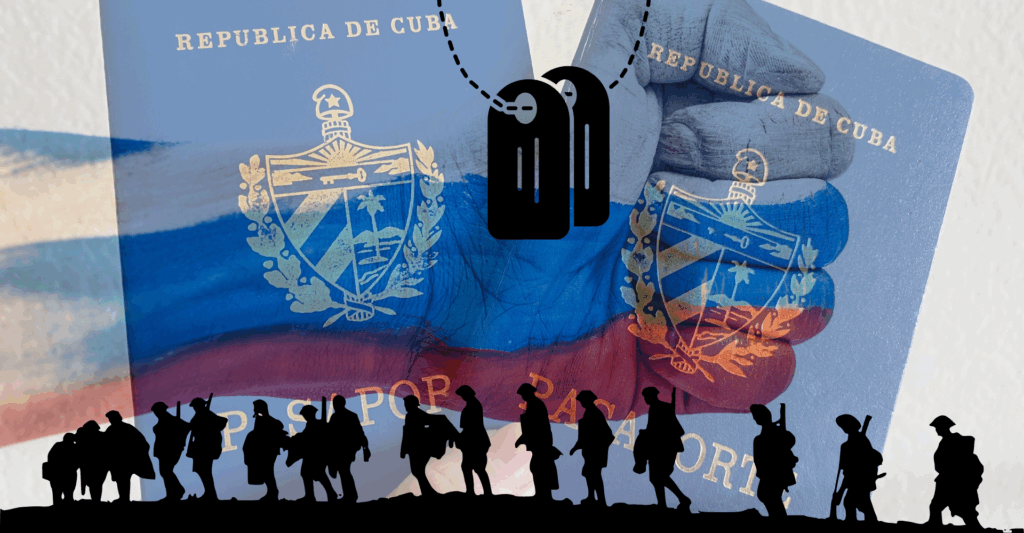
Evidence of Cuban Fighters in Ukraine
• Initial reports (2023): In May 2023, Russian outlets in Ryazan reported Cubans signing contracts with the Russian Army for citizenship (Reuters, 2023a). By summer, videos appeared of deceived young Cubans in combat (El País, 2025).
• Recruitment networks: In September 2023, Havana claimed to have dismantled a trafficking ring and arrested 17 individuals (AP, 2023; Reuters, 2023b). Yet subsequent evidence of departures cast doubt on these assurances.
• OSINT confirmation: RFE/RL’s investigative unit Schemes documented Cuban recruits training at Russia’s 106th Guards Airborne Division in Tula, corroborated by geolocated social media and satellite imagery (Radio Free Europe/Radio Liberty [RFE/RL], 2025).
• Ukrainian estimates: A Ukrainian diplomat told The Wall Street Journal in February 2024 that roughly 400 Cubans were on the front (The Wall Street Journal, 2024). Another MP cited 1,500–3,000. By June 2025, El País, citing GUR intelligence, reported a cumulative 20,000 recruits since 2022, with 6,000–7,000 active (El País, 2025). These figures remain unverified by Western intelligence but underscore the scale of concern.
Roles, Recruitment, and Exploitation
Cuban fighters are not confined to support roles; they serve as infantry in Kherson, Donbas, and Bakhmut. The death of 21-year-old Raibel Palacio in Kherson in late 2023 illustrates the cost (The Wall Street Journal, 2024).
Recruitment methods follow a pattern:
• Promises: Salaries near 195,000 rubles/month (≈USD 2,000 in 2023–2024 rates) and citizenship (TIME, 2023).
• Reality: Minimal training, poor equipment, and unpaid wages; in some cases, forced retention beyond contract expiry (TIME, 2023).
• Deception: Many recruits were told they would work in construction or security. One admitted he had “signed a contract with the devil” (Politico, 2023).
Ukrainian briefers allege that up to 40% of recruits came from Cuba’s military or security services, a claim that remains contested and unverified (El País, 2025).
Why the Secrecy?
• Havana: Maintains deniability, casting fighters as victims of traffickers. Admitting complicity could trigger unrest and sanctions.
• Moscow: Foreign recruits fill manpower gaps, but public acknowledgment would undercut the narrative of patriotic mobilization.
• Kyiv: Highlights Cuban involvement selectively, especially in EU and Latin American forums, while avoiding overemphasis to keep the spotlight on Moscow and Tehran (Reuters, 2023b).
The Congressional Dimension: Linking Havana to Moscow’s War Machine
On September 18, 2025, during a U.S. House Subcommittee on National Security briefing led by Rep. Mario Díaz-Balart, Ukrainian intelligence officers and MPs presented new data to lawmakers (U.S. House of Representatives, Subcommittee on National Security, 2025). Their evidence included:
• Scale: Over 1,000 Cuban identities verified on contracts signed between June 2023 and February 2024; at least 250 cases of forced retention after contract expiry.
• Casualties: ≥40 Cubans confirmed killed, with the real toll likely in the hundreds; median survival 140–150 days, with some dying within a week.
• Exploitation: Recruits often unpaid; a Russian recruiter admitted embezzling wages from 300–400 Cubans.
• Complicity: Large-scale recruitment is implausible without Havana’s approval; hacked emails show Russian officers recruiting on Cuban soil.
Lawmakers stressed that Cuban manpower reduces Russian casualties and prolongs the war. They situated Havana within a broader authoritarian axis—Russia, Cuba, Iran, North Korea, China, and Venezuela—that sustains aggression despite sanctions. Commissioner Rosa María Payá and Reps. Díaz-Balart, Giménez, and Salazar urged policy coherence: Europe cannot finance Havana while asking Washington to sustain Ukraine (U.S. House of Representatives, Subcommittee on National Security, 2025).
Policy Implications and Proposals
Congressional leaders proposed concrete measures:
1. Designation & Diplomacy: Push EU to suspend credits and aid to Havana; consider terrorist-state designation.
2. Targeted Sanctions: Penalize recruiters, airlines, and financial facilitators; enforce secondary sanctions on shadow fleet operators.
3. Financial Pressure: Seize immobilized Russian assets for Ukraine; disrupt Cuban laundering channels.
4. Humanitarian Measures: Establish safe-exit mechanisms for trapped Cubans via the ICRC and IOM.
5. Information Operations: Document Cuban casualties; counter Cuban/Russian propaganda in Latin America.
Geopolitical Motives
1. Economic lifeline: Moscow forgave billions in Cuban debt and supplies vital oil; manpower is Havana’s repayment (Reuters, 2023a).
2. Strategic alignment: Backing Russia signals anti-American solidarity (El País, 2025).
3. Domestic relief: Exporting unemployed or disaffected youth alleviates internal unrest.
4. Manpower as currency: If GUR’s estimate holds, Cuba is exporting fighters at a scale unseen since the Cold War—though now for cash and passports, not ideology (El País, 2025).
Conclusion: The Return of Cuba’s Expeditionary Legacy
If GUR’s estimate is accurate, Cuba’s covert role in Ukraine represents the largest overseas presence of its nationals since Angola. Whether hundreds or tens of thousands, the fact is undeniable: Cubans are fighting—and dying—for Russia.
For Moscow, Cubans are expendable reinforcements. For Havana, they are bargaining chips for oil and credit. For Washington and Brussels, they are a test of policy coherence: Western aid to Ukraine cannot coexist with European lifelines to Havana. This is tragedy and warning alike: the war in Ukraine is not Europe’s alone but a global proxy conflict that stretches from the Caribbean to the Korean Peninsula.
References
AP. (2023, September 8). Cuba arrests 17 for allegedly helping recruit its citizens to fight for Russia in Ukraine. Associated Press. https://apnews.com
El País. (2025, June 9). Russia recruits Cubans for the frontlines in Ukraine: “It’s all been a scam.” https://english.elpais.com
Politico. (2023, September). We signed a contract with the devil: How Russia recruits foreign fighters. https://politico.eu
Radio Free Europe/Radio Liberty. (2025, February 19). Russia turns to Cuban recruits as it struggles with conscription. https://rferl.org
Reuters. (2023a, September 5). Cuba uncovers human trafficking of Cubans to fight for Russia in Ukraine. https://reuters.com
Reuters. (2023b, September 15). Cuba issues conflicting statements on use of its citizens in Ukraine war. https://reuters.com
The Wall Street Journal. (2024, February 16). How Russia recruits soldiers from Cuba to fight in Ukraine. https://wsj.com
TIME. (2023, September 18). How Russia is recruiting Cubans to fight in Ukraine. https://time.com
U.S. House of Representatives, Subcommittee on National Security. (2025, September 18). Díaz-Balart National Security Briefing: Exposing Cuban regime troops fighting for Russia. Unpublished congressional testimony.
The opinions expressed in this article are those of the author and do not necessarily reflect the views of the Miami Strategic Intelligence Institute (MSI²).