26 Jul Inside Trump’s AI Action Plan: Deregulation, Infrastructure, and the Race for Global AI Dominance
By,
Luis O. Noguerol, Co-Founder & Senior Fellow, MSI²
Why Does the AI Race Matter?
In an era defined by technological rivalry, artificial intelligence (AI) is the new battleground of countries fighting for economic strength, security, and global influence.
The Trump administration’s “America’s AI Action Plan,” a wide-ranging policy roadmap, defines a new approach to this competition. Its central theme: “win the AI race” by championing deregulation, supercharging infrastructure, and promoting U.S. innovation at home and abroad.
In this article, I will examine the plan’s core pillars, the thinking behind each, and the deeper implications for America’s future in the hyper-competitive world of AI.
Pillar I: Accelerate AI Innovation
- Removing Red Tape and Onerous Regulation: At the heart of Trump’s approach is a pledge to “remove bureaucratic red tape” that, in the administration’s view, stifles innovation and hands competitive advantage to global rivals. The plan:
- Revokes prior executive orders (notably from the Biden administration) viewed as restrictive or overly cautious on AI.
- Directs federal agencies to identify, revise, or repeal regulations seen as hindering AI development and deployment.
- Proposes that federal funding for AI projects be restricted in states that create “burdensome” regulatory regimes.
This is a dramatic contrast to the EU’s AI regulatory path, emphasizing innovation over risk aversion.
Ensuring Frontier AI Reflects Free Speech and American Values
The Trump plan prioritizes the notion that AI must support “free speech” and avoid “ideological bias”.
Key policies include:
- Mandating that any large language model (LLM) contracted for federal use must be, in the government’s view, neutral and not engineered for social or political agendas.
- Removing references to misinformation, Diversity, Equity, and Inclusion (DEI), and climate change from the National Institute of Standards and Technology’s (NIST) AI Risk Management Framework.
- The administration asserts these steps will foster trust and objectivity in AI tools provided by the state, although critics warn that such policies may sideline important discussions on fairness, harm, or inclusion.
Encouraging Open-Source and Open-Weight AI
Open-source and open-weight models, where the public can access, review, and potentially contribute to the core AI algorithms, are considered vital for “democratizing” AI and cementing America’s leadership as a hub of innovation. Measures include:
- Improving access to affordable computing for startups and academics, often locked out by the high costs of commercial “hyperscaler” solutions.
- Strengthening the National AI Research Resource (NAIRR) pilot with private/public partnerships to expand compute access and research opportunities.
- Promoting the adoption of open-source AI among small and medium-sized businesses to broaden the technology’s reach.
- Enabling AI Adoption Across Sectors
While models and software exist across industries, the rate of adoption, especially in complex sectors like healthcare and energy, lags behind AI’s potential. To address this, the plan recommends:
- Creating regulatory sandboxes and “AI Centers of Excellence” to speed safe experimental deployment.
- Launching targeted partnerships (federal and private) to push national standards for AI and objectively evaluate productivity gains.
- Regularly reviewing and benchmarking U.S. progress against other powers, notably China, to ensure American AI adoption keeps pace.
- Empowering the American Workforce for the Age of AI
A significant thread throughout the plan is the emphasis on workers: ensuring that AI “complements, not replaces,” American labor. This compensates for more recent and growing concerns and sounds like the president’s plan addressed such public anxieties. Through new executive orders and Department of Labor initiatives, the plan pushes to:
- Integrate AI skills into education, apprenticeships, and workforce training programs, from high school through mid-career retraining.
- Establish federal monitoring of AI’s impact on jobs, wages, and displacement, with special programs to rapidly retrain workers in affected sectors.
- Pilot innovative approaches for upskilling and job placement, focusing on adaptability amid evolving job demands.
The administration frames this as a “worker-first” AI revolution, seeking to avoid a future where technology outpaces human opportunity.
Other efforts in this pillar include funding for automated research infrastructure, requiring data from federally funded research to be shared more widely, and targeting advanced fields like robotics and next-gen manufacturing for immediate investment.
Pillar II: Building American AI Infrastructure
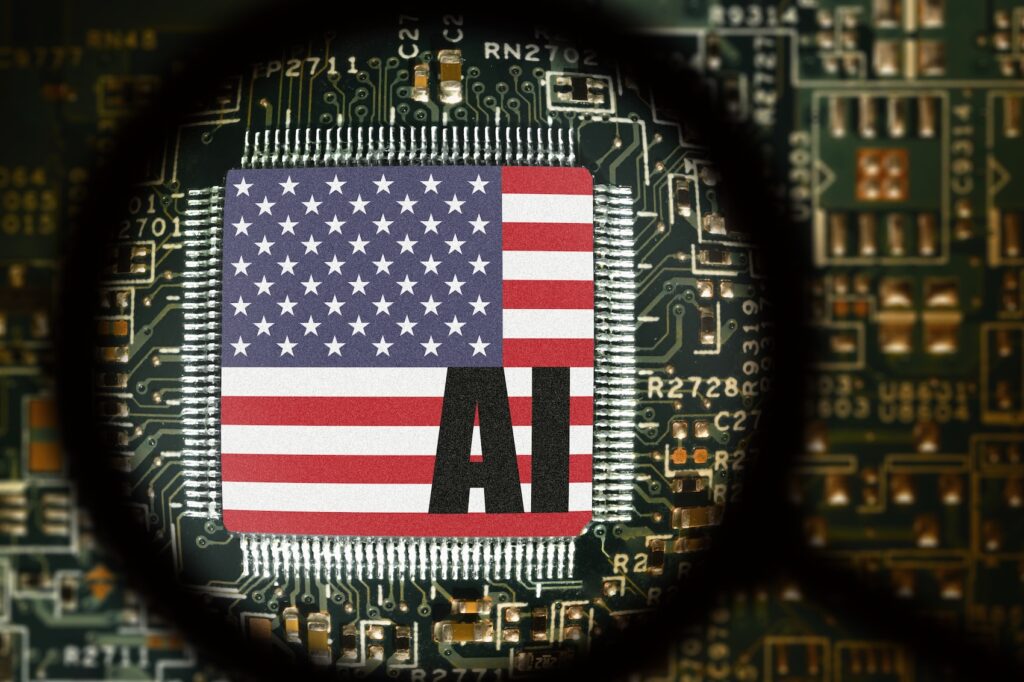
Recognizing that AI supremacy demands cutting-edge hardware, the action plan aims to:
- Expedite permitting and federal reviews for data centers, semiconductor fabs, and supporting energy infrastructure. We all know how bureaucratic and discouraging previous regulations are.
- Loosen environmental regulations tied to AI construction, including potential exemptions for data center projects on federal land or with significant energy demands. Data Centers are related to high power consumption.
By focusing on physical (not just digital) infrastructure, the administration seeks to overcome bottlenecks in computing power, a key resource in global AI development.
The president’s plan recognizes the importance of growing and modernizing the national grid, data centers, and advanced AI workloads that are “energy intensive.” The plan, therefore:
- Advises policies to prevent the premature retirement of existing (often fossil-fuel-based) power plants.
- Prioritizes connecting reliable new energy sources, especially nuclear and geothermal, to the U.S. grid, signaling support for “AI-ready” energy over rapid transition to renewables.
Another consideration on the recently released order is restoring semiconductor manufacturing and workforce development businesses. The administration treats chip manufacturing not only as an economic engine, but also as vital national security infrastructure. Some of the directed actions include:
- Launching new programs to revive domestic chip fabrication, lessen dependence on foreign suppliers, and fortify the U.S. supply chain. In other words, digital sovereignty – nothing can be better.
- Investing in workforce pipelines for electricians, HVAC technicians, and skilled trades, essential to data center and fabs construction.
- Federal Support for Critical and Secure Infrastructure
Special provisions outline the buildout of high-security data centers serving military, intelligence, and federal needs. The Department of Defense is directed to prioritize “priority access” to computing resources in a national emergency to ensure readiness and rapid deployment of military AI capabilities.
Given the sensitivity of government and critical infrastructure (and to improve cybersecurity and resilience), the plan proposes:
- New cybersecurity initiatives for data centers and national grid nodes.
- AI-specific incident response and resilience programs to prevent catastrophic technology failures or hostile action (this might be more complex in a real-life scenario than having this “on paper.”)
Pillar III: Leading in International AI Diplomacy and Security
Central to Trump’s strategy is not just dominating domestically, but promoting American AI systems, hardware, and standards to global partners and allies. The plan sets out to:
- Bundle hardware, software, models, and technical support into “full-stack” export packages for friendly nations.
- Support U.S. companies, especially in manufacturing and software, by establishing U.S. tech as the backbone for allies’ AI infrastructure.
This opens broad markets for U.S. industry but also ties world partners more tightly to American technology.
To effectively counter Chinese Influence, the plan frames the U.S.-China competition as existential, with explicit measures to:
- Counter China in international governance bodies and technical standards forums.
- Clamp down on loopholes and potential “gray market” exports of advanced chips or software to China that could be used for surveillance or military purposes.
By focusing on diplomatic and export control efforts, the document shows a belief that technological leadership confers strategic influence far beyond commerce.
To ensure unified federal standards are followed, domestic competitiveness is treated as inseparable from national unity in tech policy, and federal standards will override “regulatory patchwork” across 50 states, aiming to stop fragmentation of innovation pipelines. This is cast as an imperative for winning globally and competing with centralized competitors such as China.
As expected, the plan has sparked debate, garnered support, and drawn significant criticism.
Major tech corporations and most industry advocates have endorsed the plan’s focus on fast-tracked infrastructure, deregulatory zeal, and expanded export markets. They argue it gives American companies the tools to innovate, expand, and lead globally, especially against Chinese competitors who benefit from state-led strategies. Yet criticism is sharp and sustained from several fronts, like:
- Environmental groups say the plan’s sidelining of ecological regulations and embrace of fossil fuels risks exacerbating the climate crisis and local pollution (not strange at all).
- Consumer and civil liberties advocates warn about the dangers of an “AI free-for-all.” Loss of oversight may mean untested products and rapid deployment of potentially harmful systems without adequate accountability. They might have some points of the argument, as uncontrolled AI can easily be used against US national interests.
- Some labor organizations worry that promises of rapid retraining and new jobs may not offset the scale or speed of job disruption AI could bring.
On the international arena, geopolitical critics observe the risk of escalating a global “AI arms race” without meaningful international safeguards or collaborations. There is also worry that aggressive U.S. efforts to clamp down on Chinese participation in AI governance could cause deeper tech decoupling, fragmenting the global AI order. It is important to acknowledge these as valid concerns.
What’s Next? Implementation and Open Questions
Implementing nearly 90 distinct policy actions will stretch the federal bureaucracy, even with top-level directives. Key issues to watch in the coming year:
- How will “ideological bias” be defined operationally in government AI procurement?
- Can workforce retraining keep pace with labor market disruptions?
- Will the push for speed and infrastructure come at a cost to safety, fairness, or the environment?
- Will allies embrace new U.S. export bundles, or will “America First” rhetoric chill broader cooperation?
- Can the government’s approach to open-source and open-weight AI models deliver both innovation and sufficient guardrails?
The administration’s strong signal is clear: American AI dominance is non-negotiable. Whether this leads to lasting global leadership or triggers new risks and rivalries will depend on execution in the years ahead.
In sum, the release of President Trump’s AI Action Plan marks a pivotal moment in the United States’ technological trajectory. It is one that boldly prioritizes American innovation, deregulation, and infrastructure as the pillars of future AI dominance. It is an ambitious and potentially transformative vision. Yet, as with any strategy of this scale, its success will depend not merely on ambition, but on thoughtful execution and a willingness to adapt to international realities.
The global implications of unchecked AI development cannot be ignored, and the administration would do well to complement its pro-growth agenda with a balanced awareness of the concerns voiced by allies, partners, and global stakeholders. Only through such strategic foresight can the United States both lead and responsibly govern in the age of artificial intelligence.
References
ABC News. (2025, July 23). Trump administration’s new artificial intelligence plan focuses on deregulation. https://abcnews.go.com/Politics/trump-administrations-new-artificial-intelligence-plan-focuses-deregulation/story?id=124011520
Al Jazeera. (2025, July 23). Trump’s AI plan: Pull back restraints on tech. https://www.cnn.com/2025/07/23/tech/ai-action-plan-trump
America’s AI Action Plan – The White House. (2025, July). America’s AI Action Plan [PDF]. https://whitehouse.gov/wp-content/uploads/2025/07/Americas-AI-Action-Plan.pdf
CBS News. (2025, July 23). White House unveils U.S. strategic plan on AI: Here’s what it includes. https://www.cbsnews.com/news/trump-uai-plan-data-centers-us-infrastructure/
CNET. (2025, July 24). Trump’s AI Action Plan Is Here: 5 Key Takeaways. https://www.cnet.com/tech/services-and-software/trumps-ai-action-plan-is-here-5-key-takeaways/
Defense One. (2025, July 24). How the White House AI plan helps, and hurts, in the race against China. https://www.defenseone.com/technology/2025/07/how-white-house-ai-plan-helps-and-hurts-race-against-china/406944/
FedScoop. (2025, July 24). Trump derides copyright and state rules in AI Action Plan launch. https://www.politico.com/news/2025/07/23/trump-derides-copyright-and-state-regs-in-ai-action-plan-launch-00472443
Reuters. (2025, July 23). Trump administration to supercharge AI sales to allies, loosen environmental rules. https://www.reuters.com/legal/government/trump-administration-supercharge-ai-sales-allies-loosen-environmental-rules-2025-07-23/
The White House. (2025, July 23). White House unveils America’s AI Action Plan. https://www.whitehouse.gov/articles/2025/07/white-house-unveils-americas-ai-action-plan/
U.S. Department of Labor. (2025, July 23). Applauds President Trump’s ‘AI Action Plan’ to achieve global dominance in artificial intelligence. https://natlawreview.com/article/us-department-labor-applauds-president-trumps-ai-action-plan-achieve-global
The opinions expressed in this article are those of the author and do not necessarily reflect the views of the Miami Strategic Intelligence Institute (MSI²).