05 Sep Is the first US geopolitical alliance emerging in Latin America in the new bipolar era? The Argentine case
By,
Fabián Calle, Senior Fellow, MSI²
There is a broad academic consensus, from defensive realists like Kenneth Waltz to offensive realists like John Mearsheimer, to neo-conservatives like Charles Krauthammer, to liberals like Gilford and John Ikenberry, that the Soviet collapse between 1989 and 1991 ushered in a unipolar period lasting two decades or so. This consensus is as strong in the academic and international political worlds as that between the 15th century and 1945, the world was multipolar, and that between 1945 and 1989-1991 it was bipolar. One of the peculiarities of these years is the absence of such a consensus. For a substantial portion of those who think and execute international policy, we are rapidly entering a multipolar world. For many others, including myself, the features are clearly bipolar.
Beyond this debate, which will continue for a long time, there is little doubt that it is China that has been deploying its hard and soft power in Latin America with the greatest force and success. This is both to use it as a source of massive quantities of raw materials and also to provoke and disrupt Washington’s hegemony in the region. Without control of the Western Hemisphere, which the United States has enjoyed for more than a century, American force projection strategies toward Asia and Europe would be extremely complicated. What was done in 1917, 1941, and during the Cold War would no longer be possible to carry out so easily. China knows how to take advantage of traditional leftist nationalist and Marxist ideological niches of various kinds, but mostly with the Cathedral in Cuba and with the political and economic support of the powerful Brazilian left, which has been clashing and criticizing US power in the region for a century or more. Without forgetting the ideological cloak of the famous Global South, a category that Chinese propaganda has successfully used to disguise itself as a power that understands the plight of weak states, and that supposedly suffers from American imperialism.
Of course, China has never had the power to subjugate Latin America over the past 200 years. Therefore, it’s important to know what its traditional neighbors in the Asia-Pacific region think of Beijing’s supposed bonhomie. From India to Tibet, including Taiwan, the Philippines, South Korea, and so on.
Since Kirchnerism came to power in Argentina, the left and those opposed to the US and the idea of a world of economically and politically liberal republican democracies have sought to enlist this Southern Cone country in their anti-Washington crusade. This was especially the case starting in 2005, with Néstor Kirchner’s famous aggressiveness against George W. Bush at the Summit of Presidents in Mar del Plata, and even more so at the beginning of Cristina Fernández’s first administration, and even more acutely so in her second term, including the agreement with Iran. While Kirchner’s geopolitical romance with Venezuela was primarily for financial gain, meaning the Bolivarian dollars were rapidly buying and selling Argentine debt bonds, helping to evade the IMF’s financial oversight of public accounts, under Cristina Fernández, it took on more ideological and narrative forms. This was combined with the cultivation of a close relationship and admiration for Putin’s Russia. This included a private meeting between the former Argentine president and spy Edward Snowden, a refugee in Russian territory. This extended to the traumatic and fragile term of Alberto Fernández, with Cristina Fernández as Vice President and government guardian, when, in the midst of the pandemic, it was decided to abandon an already advanced and coordinated cooperation with a very important US laboratory in favor of the purchase and local production of Russian vaccines. This domestic production never materialized despite the document and video with Putin in person.
Returning to China, starting in 2010, it began exploring the best location in Argentina to install a powerful antenna linked to its scientific and military program for deep space and the far side of the moon. Construction began in 2014 and was completed in 2017, and since then, some twenty Chinese military scientists have been using these facilities. But as often happens in the volatile nature of human life, the 2023 presidential elections promised a huge Black Swan. The arrival of a controversial and media-savvy libertarian with an excellent economic background and a style that quickly reached broad sectors of young people from all social strata: Javier Milei. His candidacy, initially encouraged by Kirchnerism and its ally Sergio Massa to divide the opposition vote, mutated into a political Frankenstein that crushed them in the second round of elections with a 12-point lead and victories in historic areas of Kirchnerist clientelism. While from the outset, the new President emphasized that his priority would be the economy and avoiding the outbreak of hyperinflation due to the massive monetary printing undertaken by the ruling party in an attempt to win and postpone the outbreak until after 2023, he did not hesitate to establish certain clear lines of foreign policy. The priority would be a strong rapprochement and cooperation with the United States and Israel, as well as with Western, democratic, and capitalist powers in Europe and Asia. This should not imply, harm, or alter trade or private flows with the Brazil of “Lula” Da Silva, the Chile of the weak Gabriel Boric, the Colombia of Gustavo Petro, or the Mexico of Andrés Manuel López Obrador and his successor, Claudia Sheinbaum Pardo, even less so with China as Argentina’s second-largest trading partner, and the same with Russia.
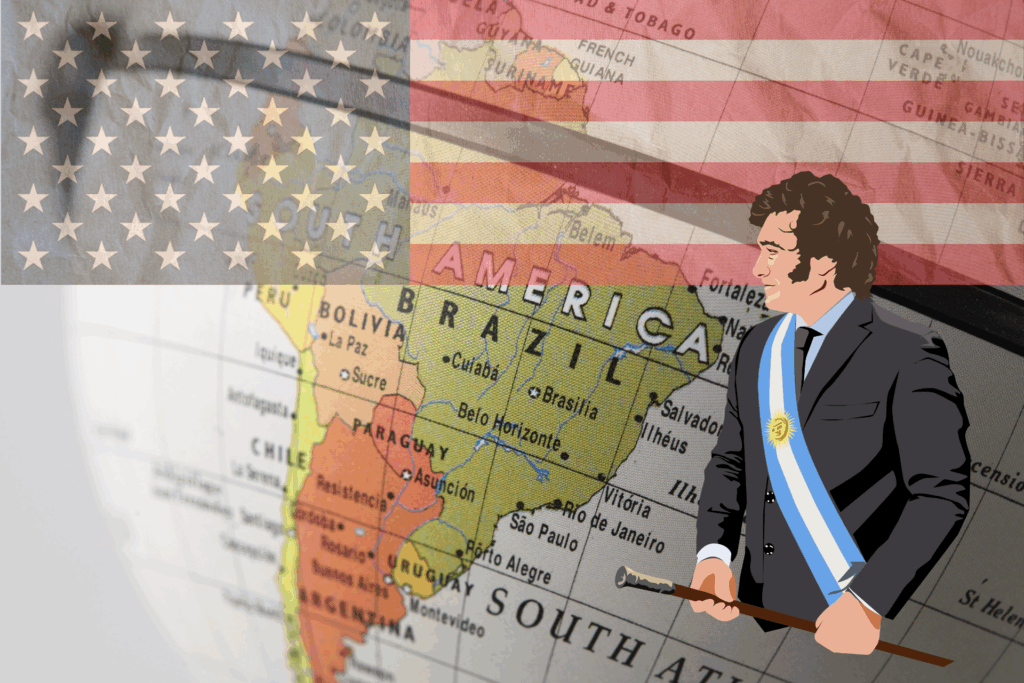
To the surprise of many, and especially of Kirchnerism and its internal and external allies, neither Pope Francis nor the Joe Biden administration showed any signs of rejection or put any obstacles in the way of Milei’s first months in power. The Holy Father treated the new Argentine President with unusual affection and gestures, and Democratic Washington embraced him from November, even before taking office, with unexpectedly supportive attitudes. Since 2021, the Biden administration has preferred the rise to power of leftist political leaders like Lula, Petro, and Boric, whose main asset was their personal and ideological distance from Donald Trump. It is unusual for a global superpower to subordinate its geopolitics to the internal ideological struggles that have intensified since Trump’s victory in 2016 and the bitter political judicial fight following the 2020 elections. Everything pointed to this continuing, making Milei’s life difficult. Until his victory, when it came to Latin American policy, the Democratic administration viewed favorably the same leaders who preferred China, Russia, Venezuela, and Cuba itself. Lula implying that Ukraine was to blame for the war with Russia for defending itself and accusing Israel of genocide, causing “millions” of deaths in Gaza, and Petro and Boric harshly attacking the same country, seems to have led Washington to rethink certain things. Two meetings in just a few months between Milei’s former Chief of Staff and the CIA Director, the Secretary of State’s visit to Buenos Aires, praise from Biden’s Treasury Secretary, and then the presence and support for the Argentine economic plan by Trump’s appointee, a constant presence and events with important second-ranking officials of the American power, and visits from the commander of the Southern Command, General Laura Richardson, are a forceful example of this. Richardson had not one but two long meetings and ceremonies with President Milei, one in Tierra del Fuego and another in Buenos Aires. The first promoted bilateral cooperation for stability in the South Atlantic and cooperation in the Antarctic sector. His successor at the helm of Southern Command, Admiral Alvin Hosley, would visit Argentina twice more between 2024 and 2025. Just over 50 years ago, Henry Kissinger defined Argentina as a dagger stuck in the South Pole, not to mention its access to the strategic natural passages in Magallanes and adjacent areas. Sooner rather than later, China will challenge the US for control of the seas and strategic passages. Milei effectively ended any possibility of a Chinese port in that region, as promoted by the Kirchner administration. A few days earlier, the Argentine government signed a letter of intent for the purchase of 24 F-16 MLU fighter jets from Denmark, with strong support from the Pentagon.
Likewise, Buenos Aires’ interest in advancing the acquisition and partial domestic manufacture of 127 Stryker 8×8 combat vehicles is taking shape. The first eight were acquired in August 2025. Added to all this is the firm desire to cooperate and coordinate for better and greater control of the waterway formed by the Paraguay and Paraná Rivers, a strategic route under scrutiny by various analysts, considering it the gateway for Bolivian cocaine to Europe, Africa, and Asia. The solid presence of security forces from Cuba, Venezuela, Iran, and Russia on Bolivian territory lends this Argentine-American agenda a clear and present urgency. Israel appears to be moving in the same direction, becoming increasingly aware of the magnitude of the threat.
In other words, Milei is betting as heavily on foreign policy as he is on the economic front. His domestic and foreign rivals and enemies know that his rhetoric and actions represent a serious ideological and geopolitical challenge. Hence, the urgency to weaken him as quickly as possible and demonstrate that his personality and ideas were nothing more than a flash in the pan, soon to be forgotten due to their failure. Taking advantage of the harsh months of adjustments implemented in the first half of 2024 and the 2025 legislative and municipal elections, Milei has attempted to create an Argentine version of October 2019 in Chile. Milei’s enemies are clear about what to do and that it must be done quickly. The coming months will determine whether his allies, especially the US and Israel, are willing to bet so heavily to help him stabilize the Argentine economy and sociopolitical situation. As has been heard in some corridors of power in Buenos Aires, the mere fact that Washington were to revoke visas for those consciously or unconsciously promoting the destabilization of the Argentine president would neutralize part of the threat. As they say, behind every ironic joke there is some truth. It goes without saying that this recipe would not be most effective against those actors supporting Milei’s worsening problems from abroad. On that front, the actions to be taken by the US, Israel, and other allies will surely remain a state secret for a long time. We will soon find out if Washington is as determined to support Milei as its enemies are to end the liberal and pro-Western experiment that began in December 2023 in Argentina. The Argentine president’s failure would be an earthquake that would resonate far beyond his own country’s borders. Washington’s lack of interest in helping Argentina during the fateful months of 2001 and 2002 was paid for with two decades of Kirchnerism, allied internationally with the most important rivals of American power. It is often said that history doesn’t repeat itself, but it does rhyme. Let’s hope that some 2.0 version of the great George Kennan has written or is writing a long telegram in the coming months that, with realistic visions, guides Washington’s much-needed “grand strategy” for the region.
The opinions expressed in this article are those of the author and do not necessarily reflect the views of the Miami Strategic Intelligence Institute (MSI²).