28 Nov Opinion: Chile’s Moment of Truth
By,
Roberto Ampuero, Guest Senior Analyst
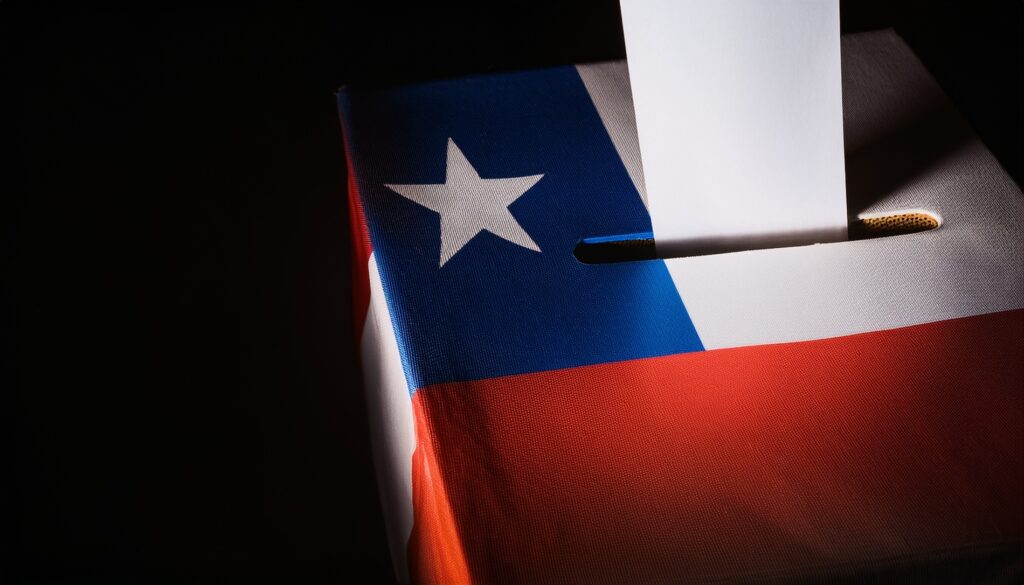
The election on December 14 is one of the most decisive in recent decades. Why? Because we must choose between the continuity of Gabriel Boric, expressed through the Communist candidate Jeannette Jara, leader of the left now dominated by the Communist Party and the Broad Front, or the Republican José Antonio Kast, who represents, according to the polls, the majority of Chileans who long for a safe country with controlled borders, where there is work, order, efficient management of public health and education, and feasible access to housing. All of this within a framework of respect for our culture and traditions, symbols and history, in freedom and with a State that applies and enforces the law, and continues to be a reliable member of the international community of values we belong to.
It is therefore also a moment of great responsibility for the parties and movements that identify with Kast’s emergency platform, which includes governing in all areas, but with a sense of urgency placed from the outset on the sectors where Chile faces an extremely critical situation.
The challenge for these parties is to push to the background the internal adjustments that naturally follow elections, especially in those groups disappointed by the results. It also implies prioritizing support for the leading candidacy, placing Chile first.
Gestures are required on both sides, of course. The sector cannot fail in this. The leading option, according to the polls, must maintain serenity, prudence, and humility, and show citizens an image of unity, cooperation, and the will to set the country back on the path to prosperity. It is not enough to proclaim this; it must be shown before the election—and the sooner, the better.
This requires that opposition groups whose results declined on November 16 set aside the natural search for causes of defeat and focus on supporting the opposition candidate against continuity.
On December 14, Chile will face a decisive crossroads: either continue declining in the continental ranking or regain the privileged position we held until recently, thanks to the achievements of the much-maligned “thirty years.”
On the other hand, the national debate cannot continue revolving around whether Chile is “falling apart or not.” That sad metaphor is limited to the material realm and ignores something worse: Chile is not falling apart, but falling to deaths, to children murdered in schools, to adults dying in their homes, to executions in public squares, to people shot while defending their families, their homes, or their cars, or while walking or riding public transportation.
More than falling apart, Chile is falling to death, and that is the great current tragedy. The economy will resume its course, and what was destroyed will be rebuilt, but death is death, and fear is fear. These are irreversible.
Chile cannot continue tied hand and foot before rampant criminality and drug trafficking that is already infiltrating institutions. We cannot continue without genuine control over certain neighborhoods and territories, nor over stretches of the border, those borders which, when guarded, allowed us to become the nation we are. We do not export emigrants like 21st-century Socialism or the Soviet Eastern European communism extinguished in 1989.
We are aware that we all came to this land from elsewhere. In the beginning, we all arrived from beyond the ocean, the mountains, or the desert. We are not xenophobic, but we demand that those who come to this country do so by following the rules of the game, the fair play, respecting our institutions and way of being, of which we feel heirs.
We love and take pride in this land at the end of the world, a narrow balcony hanging over the Pacific, a territory battered by earthquakes and tsunamis, droughts and storms, where nothing has been given to us for free. We respect the particularities of other people and countries, but in our territory, we demand the minimum from those who wish to enter: they must come through the door and abide by our laws.
For all these reasons, the December election is not just another election, because on it depends whether Chile recovers from the damage inflicted since the October riots, the worst attack our nation has suffered. The damage is immense and not only material.
It was a hybrid war with multiple objectives. It attacked infrastructure but also culture and spirituality (that is why churches, religious images, museums, libraries, heritage buildings, monuments, national symbols were burned), our dignity (hence the “only those who dance may pass”), our way of being (which made us sullen and distrustful), our key institutions (the armed forces and police were attacked), and today we are victims of blackmail (if we vote for the right, the left will burn the country again).
We do not accept that blackmail! And in this sense, it is necessary to be clear: the left still has not condemned the uprising as a political weapon, nor has it condemned violence as a tool to prevent the citizens will expressed at the ballot box from being fulfilled. Those who loudly proclaim “never again” now “pass,” remain silent, they don’t even whisper. When will we hear the cry of “never again” to the violent uprising as a political weapon?
Opposition parties that experienced defeats in the recent elections are traversing a difficult path to heal wounds. This is understandable. They must reposition themselves in the face of a global and national paradigm shift, and at the same time, prioritize the interests of Chile in an emergency. It is an enormous challenge, because “this is no time for pastries,” as the Spanish saying goes. The opposition parties and movements are expected (and required) to prioritize objectives and come together around the candidate of change and the opposition platform.
December 14 will be the day of definitions for the country, the decisive day, “the moment of truth,” as an 18th-century Cuban proverb says.
The opinions expressed in this article are those of the author and do not necessarily reflect the views of the Miami Strategic Intelligence Institute (MSI²).