05 Feb Opinion – The End of the Cuban Communist Dictatorship
By,
Julio Shiling, Senior Guest Analyst
In a decisive move that aligns with the United States’ renewed focus on national interests, the Trump administration is reportedly seeking regime change in Cuba, aiming to dismantle the 67-year communist dictatorship by the end of 2026. This policy, grounded in recent developments and strategic imperatives, represents a long-awaited correction to decades of external dependency and oppression on the island.
By leveraging economic vulnerabilities, internal collaborations, and military presence, the United States is prepared to restore Cuba’s true sovereignty, freeing it from the parasitic ties that have sustained a tyrannical regime.
The Question of Sovereignty
At its core, Castro-communism has never embodied true Cuban sovereignty. It was born and developed as a puppet of international forces. From the beginning, Fidel and Raúl Castro’s quest for power against the regime of Fulgencio Batista was intertwined with Soviet influence. Soviet espionage within the United States Department of State succeeded in promoting disinformation, allowing Moscow to strengthen the rebels while concealing the fact that the Castro brothers had connections with the USSR. The U.S. arms embargo of 1958 played a decisive role in the seizure of power on January 1, 1959, more than any rebel military triumph. The Cuban Communist Party, founded in the 1920s, was a direct descendant of global communism, conceived and fully financed by foreign ideologues.
After 1959, the regime’s survival depended on chronic external aid. Soviet subsidies sustained the economy until the fall of the Berlin Wall in 1989, after which foreign loans and Western investments in state-capitalist joint ventures filled the gap. This parasitic dependency persisted. Venezuelan oil under Hugo Chávez and Nicolás Maduro became a lifeline, supplemented by the leasing of neo-slave labor abroad in exchange for hard currency. Illicit drug money, another source of income for regime survival, is channeled through geopolitical networks.
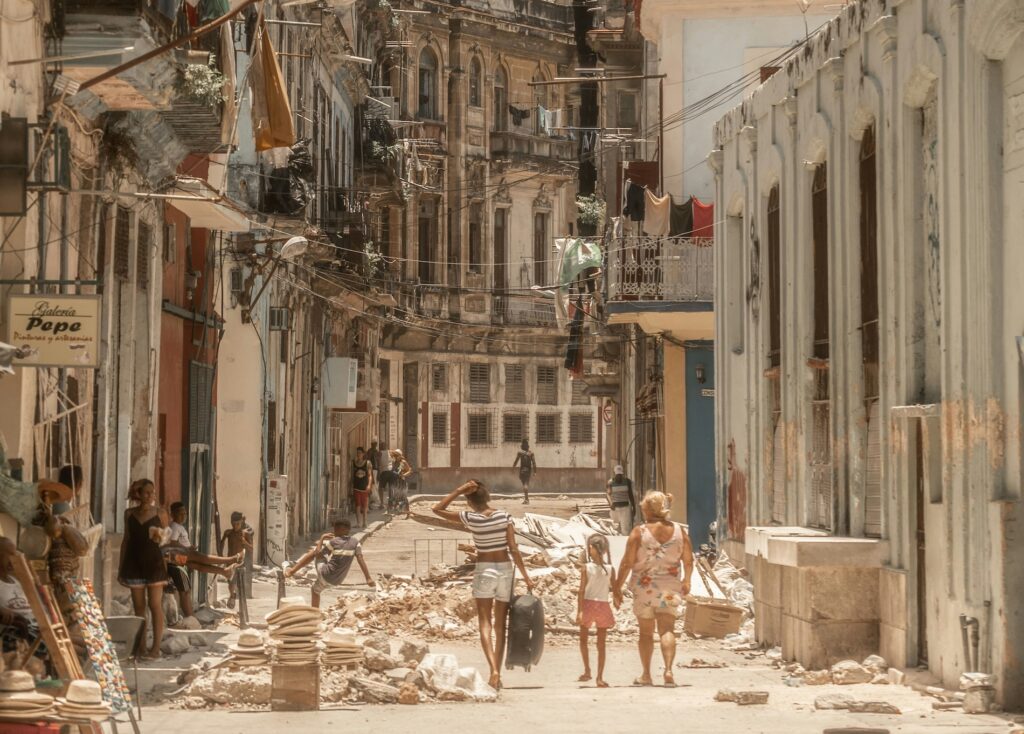
This dependency highlights that Cuban communism was never self-sufficient or sovereign. It thrived as a leech on foreign entities, subjugating its people to maintain power. Ending this dictatorship is not a violation of sovereignty. It is a liberation from foreign-imposed chains, allowing Cubans to reclaim the destiny of their nation, free from the ghosts of Moscow, the oil of Caracas, or the growing influence of Beijing.
The Fragility of the Regime and the U.S. Strategy
A recent report from The Wall Street Journal highlights the Trump administration’s opportunistic push for regime change, viewing the Cuban regime’s control as exceptionally weak. Without a concrete plan yet formalized, U.S. officials are seeking individuals within Havana’s apparatus to orchestrate a political transition and remove leaders such as 94-year-old Raúl Castro and dictator Miguel Díaz-Canel. The economy is teetering on the edge of collapse, plagued by shortages of basic goods, medicine, and power outages. The capture of Maduro in Venezuela, led by the United States on January 3, 2026, cut off Cuba’s vital oil subsidy, leaving the island just weeks away from exhausting its fuel reserves. The administration intends to block remaining shipments, accelerating the regime’s downfall.
This plan is based on the successful Venezuelan operation, in which an internal asset facilitated concessions and Maduro’s removal. U.S. teams have contacted Cuban exiles and civic groups in Miami and Washington to identify potential collaborators.
A dual strategy emerges: increasing pressure while offering an “exit ramp” for negotiated departures. President Trump’s Truth Social post on January 11 summarized it: “NO MORE OIL OR MONEY FOR CUBA, NOTHING!”, urging a deal before it is too late. The White House’s silence in response to questions underscores a calculated, results-oriented approach. Far from reckless, this reaffirms the United States’ commitment to hemispheric stability, leveraging Cuba’s self-inflicted vulnerabilities to foster a democratic transition.
Military Presence as a Deterrent Element
Complementing economic leverage, U.S. military assets signal determination. The nuclear-powered aircraft carrier USS George H.W. Bush, capable of deploying more than 90 aircraft and 5,000 personnel, positioned itself 60 nautical miles north of Varadero, where it conducted live-fire exercises. This follows the repositioning of amphibious ships such as USS Iwo Jima and USS San Antonio to nearby waters after Maduro’s removal. The silence of Cuban authorities speaks volumes, while Díaz-Canel’s defiant rhetoric, calling Trump’s warnings “incitement to massacre,” reveals desperation, not strength.
Trump has publicly described Cuba as a country “that is sinking” without Venezuela’s assistance, hinting at intervention if necessary: “go in and destroy the place.” This posture is not aggression but a prudent demonstration of strength, deterring regime intransigence and protecting U.S. interests. It echoes historical determination, ensuring that past appeasements that allowed communism to spread just miles from Florida’s shores are not repeated.
The “Donroe Doctrine”: Strategic Foundation
These actions are grounded in the U.S. Department of State Strategic Plan for Fiscal Years 2026–2030, published by Secretary Marco Rubio. This “America First” framework revives the Monroe Doctrine as the “Donroe Doctrine,” declaring the Western Hemisphere off-limits to extra-hemispheric threats such as China or Russia. Objective 2 prioritizes countering foreign influence, military bases, debt traps, and control of critical assets, while strengthening alliances through fair trade, nearshoring, and counternarcotics efforts.
For Cuba, this means eradicating a vestige of the Soviet era, aligning with goals of suppressing narco-terrorism and promoting market-oriented prosperity. By reallocating 40% of foreign aid to the hemisphere, the United States is investing in alternatives to communist models, fostering regional primacy essential for domestic renewal. This doctrine formalizes Trump’s vision: a strong backyard free of adversaries that reinforces U.S. global influence.
In conclusion, the United States’ goal of ending Cuban communism is a principled stance in favor of sovereignty, exploiting a fragile regime through strategic pressure, military deterrence, and doctrinal clarity. This is not imperialism but an antidote to decades of foreign parasitism, promising a freer and more prosperous Cuba integrated into a secure Western Hemisphere. As Trump asserts, now is the time to make deals; the alternative is inevitable collapse. This policy deserves full support, as it heralds a new era of U.S. leadership and Cuba’s liberation.
The opinions expressed in this article are those of the author and do not necessarily reflect the views of the Miami Strategic Intelligence Institute (MSI²).