08 Dec Opinion: The U.S. and Russia Bring Back the Realist Playbook. Bad News for Beijing
By,
Fabián Calle, Senior Fellow, MSI²
In recent days, a 28-point draft prepared in total secrecy by Trump’s and Putin’s negotiators has begun to circulate. Everything indicates that NATO and the European Union’s countries were not consulted. Clearly, the White House acted as great powers usually do when dealing with sensitive and highly relevant issues: directly and bilaterally with the counterpart with whom it seeks to settle a conflict.
The progressive press in the U.S. and Europe, just minutes after the document became known, dramatically announced that it represented Washington’s abandonment of Ukraine. All of it seasoned with the recurring cliché of Trump’s alleged predisposition to negotiate with powerful dictators in general and with Putin in particular. U.S. Democrats continue to orbit around one of their main talking points in the battle with Trump since H. Clinton’s defeat in November 2016. That is, Moscow is a stealthy and all-powerful ally of the current resident of the White House.
In other words, for nine years, Putin and his followers have supposedly manipulated U.S. political dynamics at will. With a GDP more than 12 times smaller than that of the U.S. and one-third of its population, the Russians would be achieving their objectives within American domestic politics.
Biden’s victory in 2020 complicates this narrative, but resorting to Trump’s alleged mismanagement of the Chinese pandemic that year serves as an explanatory variable. Needless to say, if one examines the indicators of economic, technological, demographic, and cultural power, the only major strategic rival (now and in the foreseeable future) that the U.S. has faced since the end of the unipolar moment initiated by the collapse of the USSR is China, along with its Marxist-Leninist party.
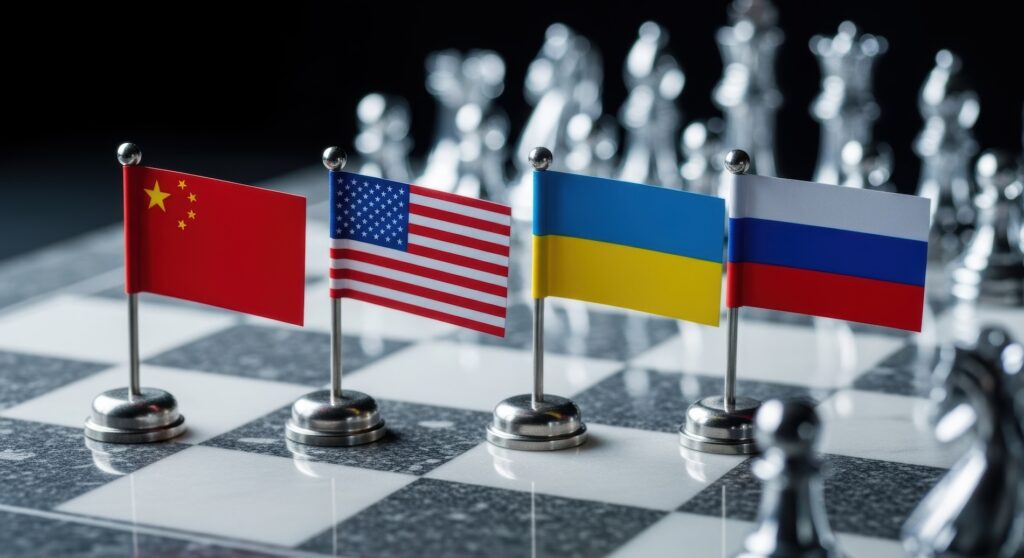
Therefore, the Democratic trauma with Russia has only made things easier for Beijing. Putin’s serious miscalculation in February 2022, which led to a war intended to last three or four weeks, has now lasted almost four years. This has had a profoundly negative impact on Moscow’s diplomatic and commercial ties with the U.S., Europe, and Japan. All of this has facilitated (and continues to facilitate) matters for the leaders of Communist China.
Since returning to power, Trump has understood this strategic board very clearly and has been seeking a solution that would allow Russia a certain margin of maneuver so as not to be slowly swallowed by the Asian giant. Russian diplomacy is well aware that being at Beijing’s mercy is not a safe option. These two states have had centuries of disagreements and conflicts, both during monarchical periods and during the decades when both were ruled by communism.
It is worth recalling the harsh accusations exchanged between Khrushchev and Mao from the late 1950s and early 1960s, the violent military clash in 1969, and finally, China’s rapprochement with Nixon and Kissinger’s U.S. in 1972.
The official history of the Chinese regime never fails to recall the amputation the country suffered at the hands of Russia in areas of what is now Siberia in the mid-19th century. On their shared border, for every Russian citizen, there are 20 or more on the other side.
Returning to the 28 points presented by Washington and Moscow to Kyiv, a closer and less emotional reading shows something more balanced and realistic than a simple unconditional surrender.
Let us see. Ukraine could maintain military forces half the size of the current ones. That is, the same or slightly more than it had in 2022. It would not have to disarm itself by any means. Yes, its ability to strike deep into Russia (100 km or more) would be reduced. As expected, it would not be a formal member of NATO. Nevertheless, there is little doubt that intense cooperation will continue between the Atlantic Alliance and Kyiv in the areas of intelligence, logistics, and military technology.
Entry into the European Union is not vetoed, which is excellent news for postwar reconstruction efforts. The areas of Donbas that Ukraine would cede would become part of a demilitarized buffer zone.
Likewise, Kyiv would have access to major rivers and safe routes for its exports via the Black Sea. The agreement also establishes the call for elections in Ukraine within the first 100 days of signing and the suspension of the prohibition of Russian as a second language. Both the U.S. and the European Union commit to contributing $100 billion each. In the first case, in exchange for strategic natural resources. Regarding economic sanctions against Russia, they would be lifted gradually. If Moscow violated the agreement, they would all be reactivated at once and immediately.
Lastly, but no less importantly, Washington commits to providing security guarantees to Ukraine if Russian aggression is verified. If Kyiv initiates hostilities, the White House would not participate and would cut all assistance.
This brief summary reflects two clear realities. On the tactical level, Russia gains a bit more territory each day, having the advantage in manpower, artillery, and air power. There is a real possibility that, at some point next year, some form of partial or even major collapse of Ukrainian lines could occur. In Russia’s case, its strategic predicament is reflected in its growing and risky dependence on China, its dependence on international oil and gas prices, and the flight of valuable human capital.
We must pay attention in the coming days and weeks, when, not coincidentally, decisive hours for the Venezuelan dictatorship and its mentor, Cuba, as well as Kyiv’s response to the 28 points, will converge.
It is worth recalling that the Trump–Putin Summit in Alaska, months ago, was dismissed and criticized by many of the world’s leading media outlets and analysts.
It is now clearer that a strategic dialogue began to take shape there, one that goes far beyond Ukraine and the short term for both the U.S. and Russia. If this direction continues, China will have to accept that the good times of phobias and the derailment of dialogue between the White House and the Kremlin are coming to an end.
It was good while it lasted for Beijing’s broad global ambitions and for its eternal ruler, Xi Jinping.
The opinions expressed in this article are those of the author and do not necessarily reflect the views of the Miami Strategic Intelligence Institute (MSI²).