





03 Nov Analysis: Digital Transformation and the Conquest of the Poles in the 21st Century
“Whoever leads in Artificial Intelligence will rule the world.”
Vladimir Putin, President of the Russian Federation, September 1, 2017
AI, Climate Change, and the Geopolitics of the Polar Regions
Introduction
Since 2022, the emergence of large language models has placed artificial intelligence (AI) at the center of the technological, economic, and security agenda. However, behind every query to these models lies a physical infrastructure that consumes electricity, water, and space. This material dimension connects AI with two global dynamics: climate change, which alters the thermal conditions under which data centers operate, and polar geopolitics, which intensifies as ice retreats, polar regions become more accessible, and interest in them grows (Dodds & Nuttall, 2016).
In this context, it is worth asking: To what extent does the energy and cooling demand required for AI operations, combined with global warming, encourage the relocation of digital infrastructure toward colder latitudes, and how does this relate to competition among major powers for polar spaces and routes?
An initial clarification is necessary. The premise that ocean warming “has forced” companies to migrate northward goes beyond the available evidence. Location decisions are primarily driven by electricity costs, renewable energy availability, tax incentives, and connectivity (Lei & Masanet, 2022; International Energy Agency [IEA], 2025). Accordingly, this article treats climate as a variable to be analyzed, not as an assumption.
Thus, this analysis proposes a combination of three approaches. The first is the critical geopolitics of common spaces, which conceives of the Arctic and Antarctica as areas of special governance and disputes over access (Dodds & Nuttall, 2016). The second concerns classical and contemporary maritime strategy, which emphasizes control of routes, chokepoints, and access points as the foundation of naval and commercial power (Mahan, 1890/1987; Till, 2018). Finally, the third is the climate, energy, and computing nexus, which examines AI’s energy, water, and carbon footprints (Strubell et al., 2019; Luccioni et al., 2023; Li et al., 2023).
AI Energy Demand
Early studies warning about the environmental cost of model training estimated that training certain natural language processing models, including architecture search, could emit an amount of CO₂ equivalent to several lifetimes of an average automobile (Strubell et al., 2019). Subsequent studies qualified these figures, showing that hardware efficiency, model architecture, and the electricity mix at the training location could reduce emissions by orders of magnitude (Patterson et al., 2021), while also estimating that a carbon footprint depends critically on the electricity grid supplying it (Luccioni et al., 2023).
Preliminary studies calculated that between 2010 and 2018, the computing capacity of data centers worldwide increased more than fivefold, while their electricity consumption rose by only around 6% (Masanet et al., 2020). However, more recent studies warn that the widespread incorporation of generative AI into everyday services, such as search engines, could significantly increase the sector’s electricity demand (De Vries, 2023). The Lawrence Berkeley National Laboratory report estimates that U.S. data centers consumed approximately 4.4% of the country’s electricity in 2023 and projects a range of 6.7% to 12% by 2028 (Shehabi et al., 2024). Globally, the IEA (2025) projects that data center electricity consumption will more than double by 2030, with AI as the main driver of this growth.
Cooling adds a second dimension: water. The water footprint of AI, including direct cooling and water consumed in electricity generation, is estimated to be an emerging constraint, particularly in water-stressed regions (Li et al., 2023). This growing need offers an initial explanation for the attractiveness of geographical areas with colder temperatures and abundant water and energy resources.
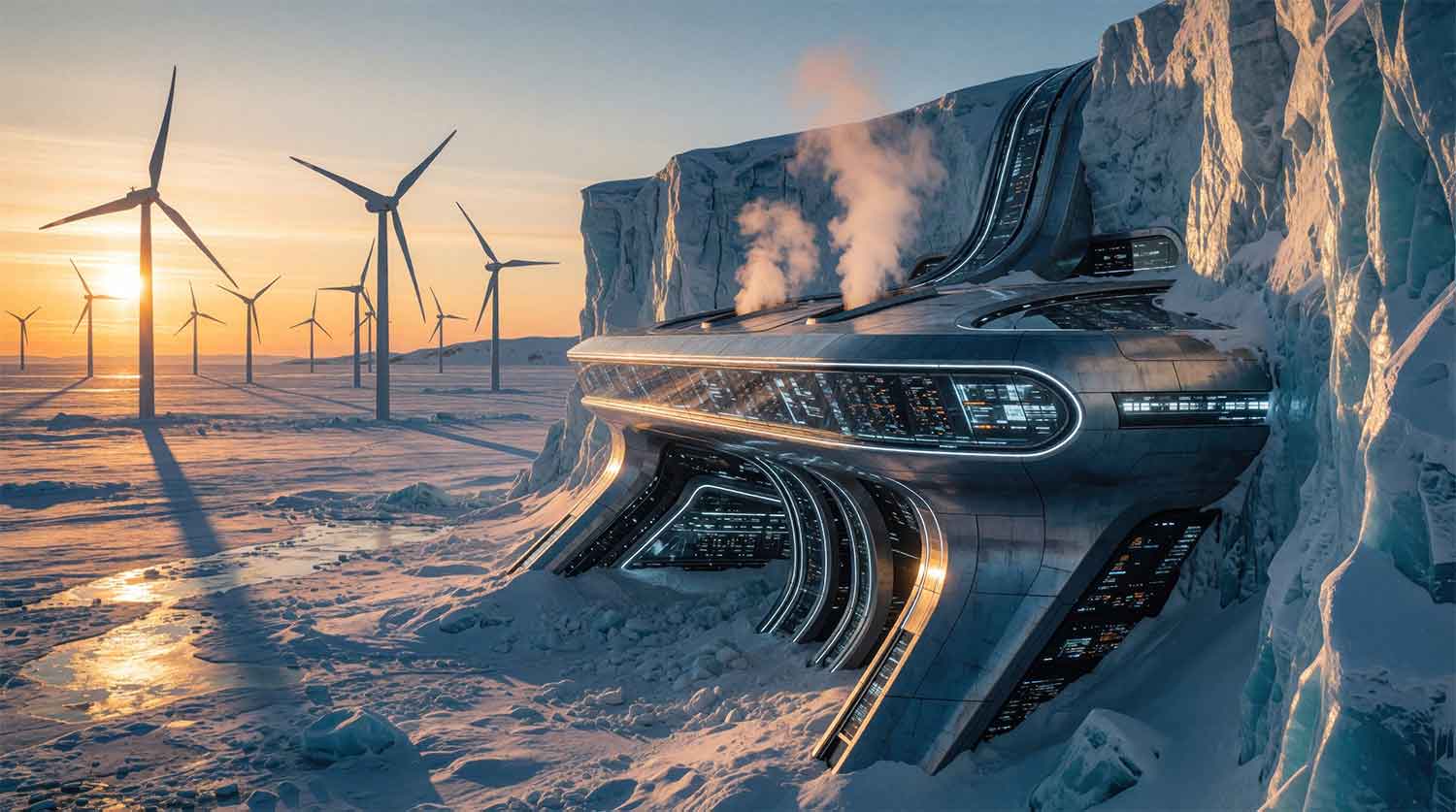 Photo credit: Adobe Stock (Licensed)
Warming, Cooling, and Data Center Location
The ocean and atmosphere continue to warm. The United Kingdom’s Met Office and the World Meteorological Organization (WMO) project that 2026 will be the fourth consecutive year to exceed the 1.4°C threshold (with an estimated average of around 1.46°C). Likewise, the recently concluded month of August was the hottest on record (tying July 2023), reaching a global average surface temperature of 16.96°C (approximately +1.65°C above the preindustrial era) (UN News, 2026). Furthermore, oceans have maintained historically high surface temperatures, with marine heat waves affecting more than 80% of ocean surfaces during the first half of the year (Vilela, 2026). Along these lines, reports from the United Nations Environment Programme (UNEP) and the WMO warn that the planet is heading toward temporarily exceeding the critical 1.5°C limit established by the Paris Agreement in the coming years, further driven by the transition toward a new El Niño event (UN News et al., 2026).
For data centers, this implies greater demand for mechanical cooling and reduced availability of free cooling in temperate and warm regions (Masanet et al., 2020).
Nevertheless, the evidence does not support the assertion that climate is the primary cause determining the future location of digital infrastructure. The IEA (2025) highlights energy availability, grid capacity, and connection timelines as the limiting factors in data center deployment. In Northern Europe, the predominance of competitively priced hydroelectric and wind power, along with tax incentives, are often just as decisive as ambient temperature.
An Opening Arctic
The Arctic is one of the regions where changes relative to historical climate records have shown the greatest variations. Studies show that since 1979, this region has warmed nearly four times faster than the global average. The retreat of sea ice is changing the region’s strategic and commercial calculations (Rantanen et al., 2022).
Accordingly, studies project that by the middle of this century, trans-Arctic routes will be navigable by ice-strengthened vessels during summer and by non-ice-strengthened vessels under high-emissions scenarios (Smith and Stephenson, 2013).
These developments open the debate over three routes. The Northern Sea Route, which follows the Russian coast and is subject to Moscow’s regulatory regime. The Northwest Passage, which crosses the Canadian Arctic Archipelago and is the subject of a legal controversy, is considered internal waters by Canada, while the United States and other actors regard it as a strait used for international navigation (Byers, 2013). The Transpolar Route, still theoretical, would cross the central Arctic Ocean and lie outside coastal jurisdictions, giving it particular geopolitical value (Melia et al., 2016).
Digital infrastructure overlaps with this geography, as submarine fiber-optic cables and high-latitude satellite communication ground stations, such as those in Svalbard or Greenland, are already present.
This new geographical reality, resulting from longer periods without ice or reduced ice thickness that allows new navigable routes to open for vessels previously denied access, leads to an examination of how major powers and coastal nations are positioning themselves in response to these changes.
Russia views the Arctic as a central region for its economy and security, linking the development of the Northern Sea Route to hydrocarbon exploitation and the strengthening of its military presence and icebreaker fleet (Dodds & Nuttall, 2016; Government of the Russian Federation, 2020).
The United States, for its part, is an Arctic state through Alaska and its presence in Greenland through Pituffik Space Base. Its 2022 strategy emphasizes security, climate change adaptation, sustainable economic development, and international cooperation (The White House, 2022). These priorities were reinforced by the recent signing of the Trilateral Arctic Security Agreement in September between the United States, Denmark, and Greenland.
China defines itself as a “near-Arctic state” and proposes a “Polar Silk Road” integrated into its global connectivity initiative (State Council Information Office of the People’s Republic of China, 2018). This could be understood as part of a strategy reflecting its ambition to become a major polar power, supported by science, investment, and diplomacy (Brady, 2017).
Finally, the Nordic states, Canada, and NATO complete the Arctic analytical picture. Finland’s and Sweden’s accession to the Atlantic Alliance in 2023 and 2024, respectively, reshaped the security balance. In governance terms, the High North is governed by the United Nations Convention on the Law of the Sea (UNCLOS) (United Nations, 1982) and mechanisms such as the Arctic Council (Natenadze, 2024).
The Ilulissat Declaration of 2008 reaffirmed the commitment of the five coastal states to resolving disputes in accordance with international law (Arctic Ocean Conference, 2008). However, cooperation has been strained by recent geopolitical rivalry, increasing the importance of protecting critical infrastructure such as cables and data centers.
Antarctica: A Different Logic
Antarctica does not follow the same dynamics as the Arctic. The Antarctic Treaty (1959) freezes territorial claims, reserves the continent for peaceful purposes, and promotes scientific cooperation, while the Madrid Protocol (1991) prohibits mining activities and establishes an environmental protection regime (Secretariat of the Antarctic Treaty, 1959, 1991). Nevertheless, decisions made over the coming decades will determine the continent’s future amid climate pressures and growing interest in resources (Rintoul et al., 2018).
Within this framework, a data center in Antarctica appears legally and logistically unfeasible, despite its extremely cold climate. Thus, the strategic interest would lie elsewhere: scientific presence, logistics, and projection from gateway locations. Cities such as Punta Arenas, Ushuaia, Hobart, Christchurch, and Cape Town serve as access platforms, while the southern passages (Strait of Magellan, Beagle Channel, and Drake Passage) acquire strategic relevance as routes for interoceanic connectivity and access to the continent (Till, 2018).
From a South American perspective, Chile occupies a particular position as a gateway country to Antarctica, with a growing presence of digital infrastructure on its continental territory. This suggests that the relationship between AI and the poles in the Southern Hemisphere operates less through the installation of data centers on the ice and more through logistical, scientific, and connectivity positioning in southern latitudes.
Conclusions
- The energy demand generated by the infrastructure associated with data centers that enable AI is real and growing, and the efficiency gains that contained consumption during the previous decade are no longer sufficient to offset the increasing workload.
- Global warming and water constraints increase the attractiveness of cold climates, but the main location factor remains access to abundant, clean, and inexpensive energy, together with legal certainty and connectivity.
- The opening of the Arctic is creating a convergence of routes, resources, and connectivity in which major powers compete for presence, rules, and infrastructure control.
- Antarctica, as a result of the Antarctic Treaty and the Madrid Protocol, has achieved relative restraint regarding the advance toward the exploitation of its territories. Therefore, at least in the short term, the establishment of data infrastructure appears unlikely, although the same cannot be said of digital connectivity infrastructure such as submarine cables. Consequently, strategic projection toward Antarctica and the southern passages must also be considered in terms of digital and energy infrastructure.
- A future agenda requires analyzing the location of new investments, assessing the security of polar submarine cables, and studying the role of southern gateways in Antarctic projection.
Bibliography
Arctic Ocean Conference. (2008). The Ilulissat Declaration. Ilulissat, Greenland, May 27–29, 2008.
Brady, A.-M. (2017). China as a polar great power. Cambridge University Press.
Byers, M. (2013). International law and the Arctic. Cambridge University Press.
de Vries, A. (2023). The growing energy footprint of artificial intelligence. Joule, 7(10), 2191–2194. https://doi.org/10.1016/j.joule.2023.09.004
Dodds, K., & Nuttall, M. (2016). The scramble for the poles: The geopolitics of the Arctic and Antarctic. Polity Press.
Government of the Russian Federation. (2020). Fundamentals of the state policy of the Russian Federation in the Arctic for the period up to 2035 [Presidential Decree No. 164].
International Energy Agency. (2025). Energy and AI. https://www.iea.org/reports/energy-and-ai
Lei, N., & Masanet, E. (2022). Climate- and technology-specific PUE and WUE estimations for U.S. data centers using a hybrid statistical and thermodynamics-based approach. Resources, Conservation and Recycling, 182, Article 106323. https://doi.org/10.1016/j.resconrec.2022.106323
Li, P., Yang, J., Islam, M. A., & Ren, S. (2023). Making AI less “thirsty”: Uncovering and addressing the secret water footprint of AI models (arXiv:2304.03271). arXiv. https://doi.org/10.48550/arXiv.2304.03271
Luccioni, A. S., Viguier, S., & Ligozat, A.-L. (2023). Estimating the carbon footprint of BLOOM, a 176B parameter language model. Journal of Machine Learning Research, 24(253), 1–15.
Mahan, A. T. (1987). The influence of sea power upon history, 1660–1783. Dover. (Original work published in 1890)
Masanet, E., Shehabi, A., Lei, N., Smith, S., & Koomey, J. (2020). Recalibrating global data center energy-use estimates. Science, 367(6481), 984–986. https://doi.org/10.1126/science.aba3758
Melia, N., Haines, K., & Hawkins, E. (2016). Sea ice decline and 21st-century trans-Arctic shipping routes. Geophysical Research Letters, 43(18), 9720–9728. https://doi.org/10.1002/2016GL069315
United Nations. (1982). United Nations Convention on the Law of the Sea. https://www.un.org/depts/los/convention_agreements/texts/unclos/unclos_s.pdf
Natenadze, V. (2024). High North. Caucasus Journal of Social Sciences, 17(1), 221–236. https://doi.org/10.62343/cjss.2024.249
UN News. (2026, September 11). Earth experiences its hottest August since records began. https://news.un.org/es/story/2026/09/1541896
UN News. (2026, May 28). The planet is heading toward a period of unprecedented extreme heat. https://news.un.org/es/story/2026/05/1541496
Patterson, D., Gonzalez, J., Le, Q., Liang, C., Munguia, L.-M., Rothchild, D., So, D., Texier, M., & Dean, J. (2021). Carbon emissions and large neural network training (arXiv:2104.10350). arXiv. https://doi.org/10.48550/arXiv.2104.10350
Rantanen, M., Karpechko, A. Y., Lipponen, A., Nordling, K., Hyvärinen, O., Ruosteenoja, K., Vihma, T., & Laaksonen, A. (2022). The Arctic has warmed nearly four times faster than the globe since 1979. Communications Earth & Environment, 3, Article 168. https://doi.org/10.1038/s43247-022-00498-3
Rintoul, S. R., Chown, S. L., DeConto, R. M., England, M. H., Fricker, H. A., Masson-Delmotte, V., Naish, T. R., Siegert, M. J., & Xavier, J. C. (2018). Choosing the future of Antarctica. Nature, 558(7709), 233–241. https://doi.org/10.1038/s41586-018-0173-4
Secretariat of the Antarctic Treaty. (1959). The Antarctic Treaty. https://www.ats.aq
Secretariat of the Antarctic Treaty. (1991). Protocol on Environmental Protection to the Antarctic Treaty. https://www.ats.aq
Shehabi, A., Smith, S. J., Hubbard, A., Newkirk, A., Lei, N., Siddik, M. A. B., Holecek, B., Koomey, J., Masanet, E., & Sartor, D. (2024). 2024 United States data center energy usage report (LBNL-2001637). Lawrence Berkeley National Laboratory. https://doi.org/10.71468/P1WC7Q
Smith, L. C., & Stephenson, S. R. (2013). New Trans-Arctic shipping routes navigable by midcentury? Proceedings of the National Academy of Sciences, 110(13), E1191–E1195. https://doi.org/10.1073/pnas.1214212110
State Council Information Office of the People’s Republic of China. (2018). China’s Arctic policy. https://english.www.gov.cn/archive/white_paper/2018/01/26/content_281476026660336.htm
Strubell, E., Ganesh, A., & McCallum, A. (2019). Energy and policy considerations for deep learning in NLP. In Proceedings of the 57th Annual Meeting of the Association for Computational Linguistics (pp. 3645–3650). Association for Computational Linguistics. https://doi.org/10.18653/v1/P19-1355
The White House. (2022). National strategy for the Arctic region.
Till, G. (2018). Seapower: A guide for the twenty-first century (4th ed.). Routledge.
Vilela, A. (2026). The world approaches a new climate threshold: 1.4°C of global warming in 2026. https://latam-green.com/nuevo-umbral-climatico-calentamiento-global-2026/
Publication Details
Abstract
The expansion of generative artificial intelligence has significantly increased the electricity and cooling demands of data centers, while atmospheric and ocean warming reduces cooling efficiency in temperate and warm latitudes. This article examines whether this dual phenomenon is redirecting digital infrastructure toward higher latitudes and what consequences it has for competition among major powers in the Arctic and, under a very different logic, in Antarctica. It argues that climate is a relevant but secondary location factor compared with energy, latency, and legal certainty, and that digital infrastructure (data centers, submarine cables, and satellite ground stations) has become a new vector of polar rivalry, alongside resources and maritime routes.
Citation
RAdm Chilean Navy (Ret.) Leonardo Quijarro Santibáñez. “Analysis: Digital Transformation and the Conquest of the Poles in the 21st Century.” Miami Strategic Intelligence Institute (MSI²). October 29, 2026.