16 Sep Colombia’s Defense Under Sánchez: Modernization Likely, Autonomy Unlikely
Executive Summary
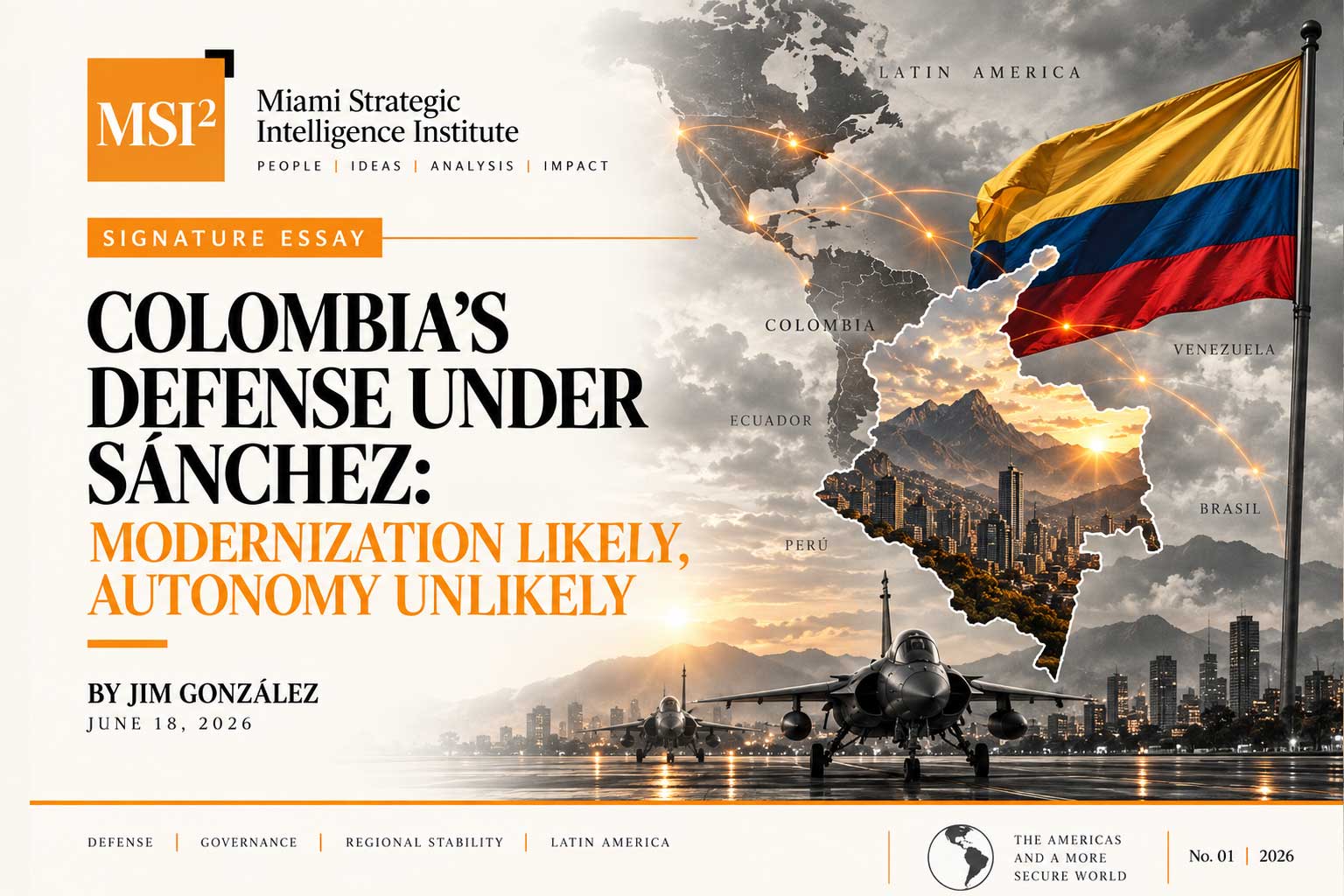
This assessment evaluates General Pedro Arnulfo Sánchez Suárez’s first year as Colombia’s Minister of National Defense, focusing on military modernization, strategic autonomy, and U.S.–Colombia defense relations. It finds notable progress in modernization, including the Gripen acquisition and anti-drone initiatives, but limited advances in autonomy due to enduring external dependencies. Domestic instability and rising violence continue to constrain long-term strategic planning.
General Pedro Arnulfo Sánchez Suárez assumed Colombia’s Ministry of National Defense in March 2025, becoming the first retired military officer to hold the post in 35 years. This assessment evaluates the effectiveness of Sánchez’s implementation of three stated defense policy objectives: military modernization, strategic autonomy, and recalibration of U.S.–Colombia defense relations. Drawing on primary government sources, Congressional Research Service reports, think tank analyses, and international media published between February 2025 and February 2026, the assessment finds that Sánchez made measurable progress on modernization. Colombia’s $3.6 billion Gripen acquisition and a $1.68 billion National Anti-Drone Shield anchored the modernization gains while Sánchez simultaneously preserved essential bilateral military cooperation with Washington.
Strategic autonomy advanced symbolically but remained constrained by technological dependencies. Rising domestic political tensions, the collapse of President Gustavo Petro’s Total Peace initiative, and escalating rural violence complicated Sánchez’s ability to execute a coherent, long-term defense architecture. The assessment concludes that Sánchez achieved partial, uneven implementation of his objectives, with modernization gains outpacing institutional reform and strategic coherence.
Modernization: Where Sánchez Delivered
The most tangible and strategically significant achievement of Sánchez’s tenure was the acceleration of Colombia’s long-delayed military modernization program. According to teleSUR English (2025), the government announced a ten-year, $12.7 billion defense investment framework through a CONPES policy document, prioritizing mobility, technology, and human security principles. Sánchez directly linked the investment to operational necessity, stating: “With that budget we are going to have mobility and maneuver. The helicopters will fly everything the mission demands” (Infobae Colombia, 2025, March 4).
The centerpiece of modernization was Colombia’s selection of the Saab Gripen E/F to replace the aging Kfir fleet. Reuters (2025) reported that Sánchez announced that Colombia would decide within months on a NATO country supplier, framing the decision as “an issue of sovereignty.” Colombia formally selected the Gripen in April 2025 and signed a $3.6 billion contract with Saab on November 14, 2025 (Al Jazeera, 2025; Breaking Defense, 2025, November 15). The contract covers 17 aircraft with deliveries scheduled by Saab between 2026 and 2032. Defense Security Asia (2025) noted that the acquisition represented Colombia’s largest-ever combat aviation purchase and included comprehensive offset agreements covering aeronautics, cybersecurity, health, sustainable energy, and water purification. The deal moved the Colombian Aerospace Force from a deteriorating, diplomatically complicated Israeli platform to a modern, European-supplied multirole fighter.
As Reuters (2026) reported, Sánchez launched the National Anti-Drone Shield Program (Escudo Nacional Antidrones) on January 16, 2026. The $1.68 billion initiative targets the proliferating use of armed-group drones across Colombian territory and borders. The Miami Strategic Intelligence analysis (MSI², 2025) also noted Colombian investments in domestic defense production through Indumil and COTECMAR, demonstrating movement toward reduced import dependency.
Sánchez also confronted the protracted crisis of Colombia’s grounded Russian-built Mi-17 helicopter fleet. Colombia operated over 20 Soviet-made Mi-17 transport helicopters, but only nine remained operational by early 2025, with 18 aircraft grounded due to spare parts shortages and maintenance backlogs (Bulgarian Military, 2024; The City Paper Bogotá, 2025). The Mi-17s, acquired between 1996 and 2009, provided critical heavy-lift capability for troop transport, resupply operations, and wildfire suppression across Colombia’s challenging terrain. As ColombiaOne (2024) reported, Western sanctions on Russian suppliers following the Ukraine invasion complicated maintenance contracting.
Bulgarian Military (2024) documented that Sánchez’s predecessor, Iván Velásquez, had allocated $63 million for a modernization program in late 2024, but implementation lagged. Under Sánchez, the Colombian Army contracted the U.S. firm VSC to perform maintenance, reconstruction, and spare parts provisioning, bypassing Russian contractors entirely (Zona Militar, 2025, May 24). Zona Militar (2025) reported that by mid-2025, three Mi-17s had undergone flight testing, with eleven aircraft projected to return to service by year-end. The recovery restored 40% of the fleet and added 750 annual flight hours to operational capacity. The accelerated Mi-17 recovery demonstrated Sánchez’s willingness to prioritize operational necessity over diplomatic sensitivities, solving a maintenance impasse that had persisted for over two years.
The Gripen, anti-drone, domestic production, and Mi-17 recovery decisions, while historically significant, intersect directly with the strategic autonomy questions examined in the next section.
Strategic Autonomy: The Illusion of Independence
Strategic autonomy represented the most contested and ideologically charged dimension of Sánchez’s defense agenda. The Petro government framed the Gripen acquisition explicitly as a sovereignty statement, choosing a European supplier over U.S.-backed F-16s (IARI, 2025). American officials linked the F-16 offer to NATO interoperability benefits and conducted an aggressive lobbying campaign throughout early 2025. President Petro described the Gripen as “a deterrent weapon to achieve peace” (IARI, 2025). González (2025) characterized procurement as reflecting a tug-of-war within the Petro administration between strategic alignment and autonomy. The parallel move to procure Swedish Gripen jets, rejecting U.S. and Israeli offers, suggested an effort to diversify dependencies and avoid becoming a geopolitical pawn. Petro also positioned the purchase within a broader diversification strategy that included Colombia’s accession to the BRICS New Development Bank in June 2025.
However, the Miami Strategic Intelligence assessment (MSI², 2025) exposed a fundamental paradox within Colombia’s autonomy claims. Because the Gripen E/F uses the American-made GE F414G engine, exports remain subject to U.S. approval under International Traffic in Arms Regulations (ITAR). Colombia purchased procurement diversification at a 47% cost premium over the F-16 alternative (MSI², 2025) while retaining full exposure to American regulatory jurisdiction over critical propulsion systems. Colombia gained procurement-source independence but not operational independence.
Beyond aviation, the Spanish Institute for Strategic Studies (2025) documented a broader pattern of strategic diversification, including Colombia’s growing defense industrial cooperation with Sweden under a 2017 memorandum of understanding. Army Recognition (2025) documented Colombia’s acceleration of domestic production through ExpoDefensa 2025, where Indumil (Military Industries) unveiled new assault rifle platforms, robotic EOD systems, and drone technologies. The Indumil and COTECMAR production advances demonstrated genuine momentum toward self-sufficiency. Nevertheless, IARI (2025) concluded that no single ministerial term could sever structural dependencies on U.S. intelligence sharing, counter-narcotics frameworks, and defense industrial relationships built over two decades. Strategic autonomy under Sánchez remained an aspirational posture rather than an achieved condition, and the posture’s real impact depended significantly on how bilateral relations with Washington evolved, the question addressed in the final analytical section.
Managing Washington: Institutional Resilience Under Political Strain
No dimension of Sánchez’s tenure proved more volatile or operationally consequential than the management of U.S.–Colombia defense relations. The relationship deteriorated rapidly in January 2025 when Petro publicly refused to accept U.S. deportation flights, triggering a presidential threat from U.S. President Donald Trump to suspend all U.S. payments to Colombia (Breaking Defense, 2025, October 24). Breaking Defense (2025) and CRS (2025) reported that at risk was approximately $377 million in annual U.S. foreign assistance, including $37 million in Foreign Military Financing and critical maintenance support for the Colombian Army’s Black Hawk helicopter fleet.
Sánchez consistently functioned as a moderating institutional anchor throughout the bilateral turbulence. Sánchez addressed the bilateral friction in a January 2026 Globe and Mail interview: “We do not see the United States as a threat. If any channel of international cooperation were to break, drug traffickers would win” (VanderKlippe, 2026). This posture contrasted sharply with Petro’s confrontational rhetoric and reflected Sánchez’s institutional preference for preserving military-to-military cooperation regardless of political noise at the presidential level.
The institutional record supported Sánchez’s framing. Despite the diplomatic friction, U.S. Army (2025) records confirmed that the two militaries conducted their 16th annual army-to-army staff talks in September 2025. The two armies signed 47 agreed-upon actions organized around institutional capacity, modernization, and countermeasures against transnational criminal organizations. Sánchez personally visited SOUTHCOM in May 2025 and held discussions with Admiral Alvin Holsey (U.S. Southern Command, 2025, May 5). As the Embassy of Colombia in the United States (2025) documented, Admiral Francisco Cubides conducted a separate Washington engagement in March 2025, meeting with State Department officials, congressional leaders, and representatives of intelligence agencies. González (2025) noted that in March 2025, General Carlos Triana and Gloria Miranda visited Washington for high-level counter-narcotics discussions, signaling a robust renewal of joint operations. Cubides also visited NATO headquarters in May 2025, where he met with NATO military leadership to advance NATO-Colombia cooperation (González, 2025). Colombia received an invitation to NATO’s Southern Flank Strategic Dialogue, positioning the country as a privileged interlocutor within transatlantic security frameworks and marking a qualitative shift in its international security profile (González, 2025).
Colombia committed publicly to continued counter-narcotics cooperation, with Sánchez insisting before an AFP correspondent that Colombia was “absolutely committed” to the drug fight as a U.S. certification deadline loomed in September 2025 (Agence France-Presse, 2025). Reuters (2026, January 5) reported that the Colombian government reaffirmed this commitment at the start of 2026. The U.S. Department of State (2026) confirmed that Secretary of State Marco Rubio and Colombian Foreign Minister Rosa Yolanda Villavicencio held a call on January 23, 2026, to discuss counternarcotics cooperation ahead of a planned bilateral presidential meeting. The Ministerio de Defensa Nacional (2026) dispatched Sánchez to Washington in January 2026, where Infobae Colombia (2026) reported meetings with senior U.S. administration officials. El Espectador (2026) reported that Sánchez confirmed the extradition date for the cartel figure known as “Pipe Tuluá” during that same visit. The February 2026 Petro–Trump agreement to jointly pursue ELN commanders Mordisco, Chiquito Malo, and Pablito demonstrated operational security cooperation at the highest bilateral level (El Espectador, 2026, February 7). That agreement confirmed the durability of security collaboration despite sustained political tensions between the two governments.
The regional security environment added further complexity. The Guardian (2026) reported that U.S. military operations under Operation Southern Spear killed 133 individuals aboard suspected drug-trafficking vessels in the Caribbean by mid-February 2026. The Operation Southern Spear strikes raised alarm in Bogotá about regional stability and potential spillover effects along the Venezuelan border. Sánchez ordered military deployments to the Venezuelan frontier following U.S. strikes near Venezuelan territory (El Espectador, 2026, January 3). The U.S. Southern Command posture statement (2025) identified Colombia as a host for a Rotary Aviation and Communications Electronics Center of Excellence, underscoring the structural depth of bilateral security cooperation that Sánchez worked to preserve.
The Catatumbo crisis escalated into a bilateral diplomatic priority by April 2026. As Baillie (2026) reported, President Petro announced on April 21 that he would meet Venezuela’s acting president, Delcy Rodríguez, in Caracas on April 24. Petro instructed Sánchez to design a delegation that emphasizes defense-sector participation with military and police authorities to structure a joint border security plan. The meeting occurred in the context of Venezuela’s post-Maduro political transition following the U.S. military seizure of former president Nicolás Maduro in January 2026 (The City Paper Bogotá, 2026). According to News4JAX (2026), Petro stressed the necessity of close intelligence collaboration, warning that without coordination, military operations would land in the wrong places and kill civilians. The Venezuela engagement confirmed Sánchez’s role as the administration’s primary crisis manager for regional security coordination.
The Final Analysis: Partial Gains, Binding Constraints, and an Uncertain Transition
General Pedro Arnulfo Sánchez Suárez partially and asymmetrically implemented his stated defense policy objectives during his first year as Colombia’s defense minister. Military modernization recorded the clearest gains of Sánchez’s tenure. The Gripen contract, the National Anti-Drone Shield, the ten-year CONPES investment framework, and the domestic production initiatives of ExpoDefensa 2025 collectively represented the most substantive military investment cycle in a generation. Bilateral military-to-military relations with the United States proved resilient at the institutional level, sustained by Sánchez’s consistent diplomatic professionalism even as Petro’s rhetoric destabilized political relations.
Strategic autonomy advanced rhetorically and symbolically but remained structurally constrained by ITAR dependencies, intelligence-sharing obligations (CRS, 2025), and the weight of two decades of U.S.-funded counter-narcotics architecture. The domestic security environment, characterized by collapsed peace negotiations, rising rural violence, and an operationally weakened armed forces, imposed the most binding constraints on Sánchez’s capacity for coherent, long-term defense planning. The evidence suggests that Sánchez performed most effectively as an institutional stabilizer and procurement accelerator, less effectively as a strategic reformer capable of reorienting Colombia’s fundamental defense posture within a compressed political timeline. With presidential elections scheduled for May 31, 2026, we assessed that the durability of the modernization investments Sánchez initiated will depend on whether Colombia’s next government elects to sustain or redirect them. The compressed timeline, May 31 first round, potential June 21 runoff, and August 2026 presidential transition will determine whether Gripen deliveries, Mi-17 recovery, and anti-drone deployments proceed as planned or face policy discontinuity.
References
Al Jazeera. (2026, March 8). Colombia elects Congress, chooses presidential candidates amid US tensions. https://www.aljazeera.com/news/2026/3/8/colombia-elects-congress-chooses-presidential-candidates-amid-us-tensions
Armed Conflict Location & Event Data Project (ACLED). (2025). ‘Total peace’ paradox in Colombia: Petro’s policy reduced violence, armed groups grew stronger. ReliefWeb. https://reliefweb.int/report/colombia/total-peace-paradox-colombia-petros-policy-reduced-violence-armed-groups-grew-stronger
Army Recognition. (2025, October). Day 2 ExpoDefensa 2025: Colombia unveils strategic defense innovations and military products. https://www.armyrecognition.com/news/expodefensa-2025/day-2-expodefensa-2025-colombia-unveils-strategic-defense-innovations-and-military-products
Baillie, C. (2026, April 23). Colombia’s President Petro says meeting with Delcy Rodríguez will focus on border security. The Orinoco Tribune. https://orinocotribune.com/colombias-president-petro-says-meeting-with-delcy-rodriguez-will-focus-on-border-security/
Breaking Defense. (2025, November 15). Colombia signs $3.6B deal for Gripen fighters. https://breakingdefense.com/2025/11/colombia-signs-3-6b-deal-for-gripen-fighters/
Breaking Defense. (2025, October 24). If the US cuts Colombian military aid, Bogota’s Black Hawks likely first to feel it. https://breakingdefense.com/2025/10/us-colombia-trump-carranza-military-aid-black-hawks/
Bulgarian Military. (2024, December 7). Colombia to modernize 18 Soviet-made Mil Mi-17 helicopters. https://bulgarianmilitary.com/2024/12/07/colombia-to-modernize-18-soviet-made-mil-mi-17-helicopters/
Bulgarian Military. (2024, December 7). Colombia to modernize 18 Soviet-made Mil Mi-17 helicopters. https://bulgarianmilitary.com/2024/12/07/colombia-to-modernize-18-soviet-made-mil-mi-17-helicopters/
ColombiaOne. (2025, April 28). Time is running out for Petro’s total peace in Colombia. https://colombiaone.com/2025/04/28/colombia-petro-total-peace/
ColombiaOne. (2025, February 20). Petro appoints General Pedro Sanchez as new defense minister of Colombia. https://colombiaone.com/2025/02/20/colombia-new-defense-minister-general-pedro-sanchez/
ColombiaOne. (2025, September 21). Colombia’s peace process: Progress, setbacks, and the armed groups still shaping the nation’s future. https://colombiaone.com/2025/09/20/colombia-peace-process-armed-groups/
ColombiaOne. (2026, February 26). Colombia’s Petro reaches highest approval rating since taking office. https://colombiaone.com/2026/02/26/colombia-petro-highest-approval-rating-since-taking-office/
Congressional Research Service. (2025, May 30). Colombia: Background and U.S. relations (Report No. R48287). U.S. Congress. https://www.congress.gov/crs_external_products/R/PDF/R48287/R48287.5.pdf
Defence Security Asia. (2025, November 15). Colombia signs $3.6 billion contract for 17 Saab Gripen E/F fighters in landmark modernization drive. https://defencesecurityasia.com/en/colombia-signs-eu3b-gripen-fighter-jet-deal-2025/
El Espectador. (2026, February 2). Ya hay fecha de extradición de “Pipe Tuluá”: MinDefensa lo confirmó durante visita a EE. UU. https://www.elespectador.com/judicial/ya-hay-fecha-de-extradicion-de-pipe-tulua-mindefensa-lo-confirmo-durante-visita-a-ee-uu/
El Espectador. (2026, February 7). Mordisco, Chiquito Malo y Pablito: el perfil de los jefes criminales que Petro acordó capturar con Trump. https://www.elespectador.com/colombia-20/paz-y-memoria/quienes-son-mordisco-chiquito-malo-y-pablito-los-jefes-criminales-que-petro-acordo-capturar-con-trump/
El Espectador. (2026, January 3). Mindefensa confirma despliegue militar en la frontera con Venezuela, tras ataque de EE. UU. https://www.elespectador.com/judicial/mindefensa-confirma-despliegue-militar-en-la-frontera-con-venezuela-tras-ataque-de-ee-uu/
El País (América Colombia). (2026, January 14). El ministro de Defensa niega que el Gobierno haya usado Pegasus para espiar a su colega de Justicia. https://elpais.com/america-colombia/2026-01-14/el-ministro-de-defensa-de-colombia-niega-que-el-gobierno-haya-usado-pegasus-para-espiar-a-su-colega-de-justicia.html
Embassy of Colombia in the United States. (2025, March 8). Colombia and the United States strengthen security and defence cooperation. https://www.colombiaemb.org/post/colombia-and-the-united-states-strengthen-security-and-defence-cooperation
González, J. (2025, June 29). From ceasefires to kinetic force: Inside Colombia’s bold security overhaul. Miami Strategic Intelligence Institute. https://msi2.substack.com/p/from-ceasefires-to-kinetic-force
Infobae Colombia. (2025, March 4). Pedro Arnulfo Sánchez Suárez asumió oficialmente como ministro de Defensa de Colombia. https://www.infobae.com/colombia/2025/03/04/pedro-arnulfo-sanchez-suarez-asume-oficialmente-como-ministro-de-defensa-de-colombia/
Infobae Colombia. (2026, January 12). Ministro de Defensa inicia gira por Estados Unidos, previo visita de Gustavo Petro. https://www.infobae.com/colombia/2026/01/12/ministro-de-defensa-inicia-gira-por-estados-unidos-previo-visita-de-gustavo-petro-se-reunira-con-altos-funcionarios-de-donald-trump/
InSight Crime. (2026, January 15). GameChangers 2025: Colombia’s total peace remains in pieces. https://insightcrime.org/news/gamechangers-2025-colombia-total-peace-in-pieces/
Instituto de Altos Estudios Internacionales (IARI). (2025, July 3). Colombia aims to achieve strategic autonomy. https://iari.site/2025/07/02/colombia-aims-to-achieve-strategic-autonomy/
International Crisis Group. (2025, January 30). Colombia: From “total peace” to local peace. https://www.crisisgroup.org/latin-america-caribbean/andes/colombia/colombia-total-peace-local-peace
KDH News. (2026, April 25). Colombia’s leader visits Venezuela for key talks with acting President Delcy Rodríguez. https://kdhnews.com/news/world/colombias-leader-visits-venezuela-for-key-talks-with-acting-president-delcy-rodr-guez/article_32cf67ef-f40a-544c-8664-c93782f9e68b.html
KSAT. (2026, March 9). Colombians are electing a new Congress and choosing presidential candidates. https://www.ksat.com/news/2026/03/08/colombians-are-electing-a-new-congress-and-choosing-presidential-candidates/
Local 10. (2026, April 23). Colombia’s leader to visit Venezuela for key talks with acting President Delcy Rodríguez. https://www.local10.com/news/2026/04/23/colombias-leader-to-visit-venezuela-for-key-talks-with-acting-president-delcy-rodriguez/
Madhani, A., & Suárez, A. (2026, March 8). Colombians headed to the polls to elect a new Congress and choose presidential candidates. PBS News. https://www.pbs.org/newshour/world/colombians-headed-to-the-polls-to-elect-a-new-congress-and-choose-presidential-candidates
Miami Strategic Intelligence Institute (MSI²). (2025). Colombia’s Gripen acquisition: Strategic independence or operational imperative? https://miastrategicintel.com/colombias-gripen-acquisition-strategic-independence-or-operational-imperative/
Middle East Bulletin. (2026, April 25). Colombian President Gustavo Petro meets Venezuela’s acting leader Delcy Rodríguez for key talks. https://www.middleeastbulletin.com/gustavo-petro-venezuela-visit-2026-talks-with-delcy-rodrguez-explained
Ministerio de Defensa Nacional (Colombia). (2026, January 12). MinDefensa adelanta desde hoy agenda en EE. UU. https://www.mindefensa.gov.co/prensa/noticia-visualizacion/MinDefensa-adelanta-desde-hoy-agenda-en-EEUU
News4JAX. (2026, April 23). Colombia’s leader to visit Venezuela for key talks with acting President Delcy Rodríguez. https://www.news4jax.com/news/2026/04/23/colombias-leader-to-visit-venezuela-for-key-talks-with-acting-president-delcy-rodriguez/
Reuters. (2025, February 19). Colombia’s Petro taps general for defense minister [via U.S. News & World Report]. https://www.usnews.com/news/top-news/articles/2025-02-19/colombias-petro-names-general-pedro-sanchez-as-defense-minister
Reuters. (2025, March 17). Colombia to decide which NATO fighter jets to buy within months, minister says [via U.S. News & World Report]. https://www.usnews.com/news/world/articles/2025-03-17/colombia-to-decide-which-nato-fighter-jets-to-buy-within-months-minister-says
Reuters. (2026, January 16). Colombia to launch $1.7 billion anti-drone shield. https://www.reuters.com/world/americas/colombia-unveils-168-billion-plan-counter-drone-threats-2026-01-16/
Reuters. (2026, January 5). Colombia to continue work with U.S. on drug trafficking, government says. https://www.reuters.com/world/americas/colombia-continue-work-with-us-drug-trafficking-government-says-2026-01-05/
Spanish Institute for Strategic Studies. (2025). Total peace in Colombia: More shadows than light in the transformation (IEEE Analysis Document No. 104/2025). Ministry of Defence of Spain. https://www.defensa.gob.es/documents/2073105/2320887/la_paz_total_en_colombia_2025_dieeeo104_eng.pdf
teleSUR English. (2025, December 22). 10-year Colombia defense budget 2025 plan: $12.7 billion to counter armed violence and restore state presence. https://www.telesurenglish.net/colombia-defense-budget-2025/
The City Paper Bogotá. (2025, January 31). U.S Executive Order to Freeze Aid impacts Colombia’s Black Hawk fleet. https://thecitypaperbogota.com/news/executive-order-to-freeze-aid-impacts-colombias-black-hawk-fleet/
The City Paper Bogotá. (2026, April 24). Petro to meet Venezuela’s Delcy Rodríguez in Caracas, focus on border security. https://thecitypaperbogota.com/news/petro-to-meet-venezuelas-delcy-rodriguez-in-caracas-focus-on-border-security/
The Guardian. (2026, February 13). US strikes second alleged drug boat in a week, bringing death toll to 133. https://www.theguardian.com/us-news/2026/feb/13/us-boat-strike-caribbean-drugs
The Rio Times. (2025, May 5). Colombia shifts defense spending to Swedish jets after years of neglect. https://www.riotimesonline.com/colombia-shifts-defense-spending-to-swedish-jets-after-years-of-neglect/
U.S. Army. (2025, September 8). U.S., Colombian armies strengthen partnership with 2025 staff talks, signing agreed-to-actions. https://www.army.mil/article/288326/u_s_colombian_armies_strengthen_partnership_with_2025_staff_talks_signing_agreed_to_actions
U.S. Department of State, Office of the Spokesperson. (2026, January 23). Secretary Rubio’s call with Colombian Foreign Minister Villavicencio. https://www.state.gov/releases/office-of-the-spokesperson/2026/01/secretary-rubios-call-with-colombian-foreign-minister-villavicencio
U.S. Department of State. (2025, January 21). U.S. security cooperation with Colombia. https://www.state.gov/u-s-security-cooperation-with-colombia
U.S. Department of State (n.d.). ITA: https://www.pmddtc.state.gov/ddtc_public?id=ddtc_public_portal_itar_landing
U.S. Southern Command. (2025). U.S. Southern Command posture statement 2025. https://www.southcom.mil/Portals/7/Documents/Posture%20Statements/2025_SOUTHCOM_Posture_Statement_FINAL.pdf
U.S. Southern Command. (2025, May 5). Colombian Minister of Defense visits SOUTHCOM [Press release]. https://www.southcom.mil/News/PressReleases/Article/4174473/colombian-minister-of-defense-visits-southcom/
VanderKlippe, N. (2026, January 6). Colombian defence minister dismisses Trump’s threats, says U.S. is not an enemy. The Globe and Mail. https://www.theglobeandmail.com/world/article-colombia-defence-minister-trump-threat-pedro-sanchez-venezuela-maduro/
WTOP News. (2026, April 23). Colombia’s leader to visit Venezuela for key talks with acting President Delcy Rodríguez. https://wtop.com/world/2026/04/colombias-leader-to-visit-venezuela-for-key-talks-with-acting-president-delcy-rodriguez/
Zona Militar. (2025, April 28). The Colombian Army is progressing with the refurbishment and reactivation of its fleet of Russian-made Mil Mi-17 helicopters. https://www.zona-militar.com/en/2025/04/28/the-colombian-army-is-progressing-with-the-refurbishment-and-reactivation-of-its-fleet-of-russian-made-mil-mi-17-helicopters/
Zona Militar. (2025, April 28). The Colombian Army is progressing with the refurbishment and reactivation of its fleet of Russian-made Mil Mi-17 helicopters. https://www.zona-militar.com/en/2025/04/28/the-colombian-army-is-progressing-with-the-refurbishment-and-reactivation-of-its-fleet-of-russian-made-mil-mi-17-helicopters/
Zona Militar. (2025, May 24). The National Army of Colombia advances in the recovery of its fleet of Mi-17 helicopters of Russian origin. https://www.zona-militar.com/en/2025/05/24/the-national-army-of-colombia-advances-in-the-recovery-of-its-fleet-of-mi-17-helicopters-of-russian-origin/
Zona Militar. (2025, May 24). The National Army of Colombia advances in the recovery of its fleet of Mi-17 helicopters of Russian origin. https://www.zona-militar.com/en/2025/05/24/the-national-army-of-colombia-advances-in-the-recovery-of-its-fleet-of-mi-17-helicopters-of-russian-origin/
U.S. Department of State (n.d.). ITA: https://www.pmddtc.state.gov/ddtc_public?id=ddtc_public_portal_itar_landing
Publication Details
Abstract
This assessment examines General Pedro Arnulfo Sánchez Suárez’s first year as Colombia’s Minister of National Defense, focusing on three stated defense-policy objectives: military modernization, strategic autonomy, and the recalibration of Colombia’s defense relationship with the United States.
The assessment finds measurable progress in military modernization, particularly through Colombia’s acquisition of Gripen fighter aircraft and development of an anti-drone capability. At the same time, progress toward strategic autonomy remained constrained by technological, industrial, and operational dependencies on external partners.
Sánchez assumed the defense portfolio amid significant domestic security challenges, including renewed violence involving the ELN and dissident armed groups, weakening territorial control in some rural areas, and uncertainty surrounding President Gustavo Petro’s Total Peace initiative. These conditions complicated efforts to establish a coherent long-term defense architecture.
The assessment further examines Colombia’s relationship with the United States, including the continuing importance of bilateral military cooperation, security assistance, interoperability, and defense modernization. While Bogotá has pursued greater diversification and autonomy, its defense establishment continues to depend substantially on foreign technology, equipment, training, and logistical support.
Overall, the assessment identifies an uneven pattern of implementation: modernization has advanced more rapidly than institutional reform and strategic autonomy, while domestic instability continues to constrain Colombia’s ability to develop a fully coherent long-term defense strategy.
Citation
Jaime (Jim) Gonzalez. “Colombia’s Defense Under Sánchez: Modernization Likely, Autonomy Unlikely.” Miami Strategic Intelligence Institute (MSI²). June 18, 2026.