17 Sep From Africa’s Fog to Latin America’s Haze: Convergences of Hybrid Insurgency and State Erosion
Executive Summary
This article analyzes, based on evolving situations, systemic state destabilization through a comparative assessment of the African Sahel, the Great Lakes region, and the Andean arc in Latin America. It argues that, despite ideological divergences, insurgent groups in Mali, Nigeria, the Democratic Republic of the Congo (DRC), and Colombia share a pattern of “hybrid insurgency.” This phenomenon exploits governance gaps to erode national sovereignty, using territorial control and institutional infiltration as tools to deepen fractures, weakening sovereign states.
I. Introduction: The Phenomenon of Geopolitical Haze
International security literature has tended to compartmentalize studies of state stability by region, preventing the identification of structural convergences with significant explanatory value. The assassination of Mali’s Minister of Defense, the confirmed jihadist infiltration in Abuja, and the escalation of armed violence in Colombia on the eve of elections are not disconnected events: they are manifestations of the same systemic phenomenon of erosion of the Westphalian order at its most vulnerable margins.
The metaphor of “fog” and “haze” is not arbitrary: it deliberately refers to Clausewitz’s Kriegsnebel (fog of war), but is redefined here to describe the institutional opacity that allows armed actors to operate at the margins of the State, depicting a condition of strategic uncertainty in which the lines between organized crime, ideological terrorism, and political insurgency become blurred. Over the past decade, the international community has witnessed a transition from conventional conflicts to states of perpetual confrontation of low and medium intensity. This reality is palpable in the Sahel, where the advance of the group Jama’at Nusrat al-Islam wal-Muslimin (JNIM) and Tuareg rebels represents a collapse of the postcolonial security architecture, finding an echo in Colombia, where the intensification of violence in the face of democratic processes reveals that territorial control by non-state actors constitutes a direct challenge to the stability of the republic.
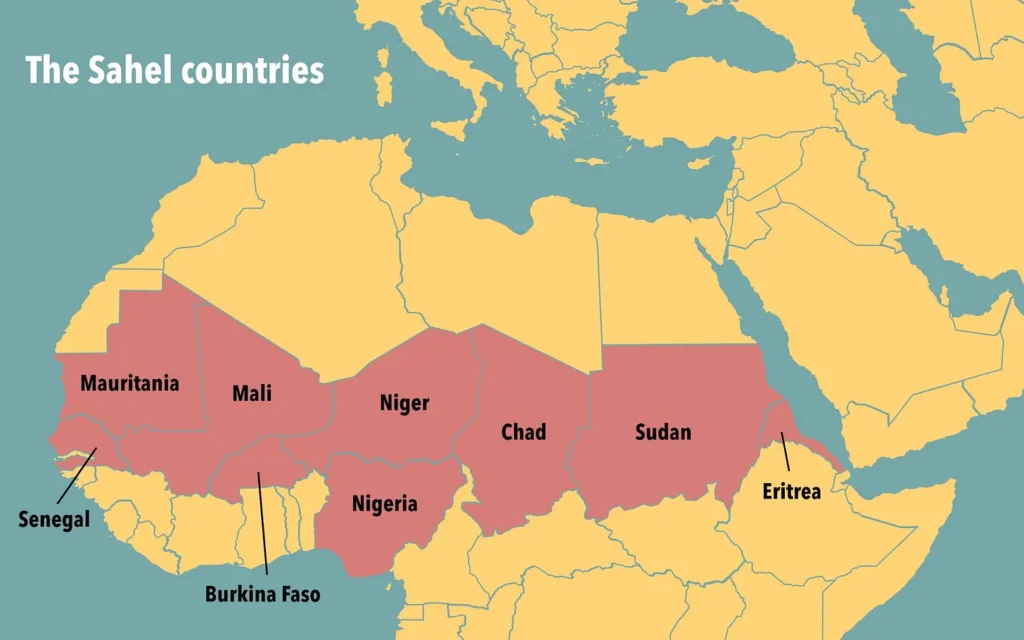
II. The Epicenter of the Fog: The Central Sahel and Regional Collapse
As previously mentioned, the recent assassination of Mali’s Minister of Defense, General Sadio Camara, and the threat of a blockade on Bamako, Mali’s capital, mark a turning point in which the State no longer faces a peripheral rebellion, but rather a siege against its vital core. This vulnerability has manifested itself with particular severity through the continuous attack on fuel supplies, a tactical maneuver by JNIM that has managed to paralyze the capital and its basic functions. By cutting the logistical arteries connecting Bamako to supply ports on the western coast of Africa, the insurgency has transformed hydrocarbon shortages into a form of psychological and economic warfare. The paralysis of public transportation, the interruption of electrical generators sustaining hospitals and administrative centers, and the exponential increase in the cost of consumer goods have generated internal social pressure that erodes the legitimacy of General Assimi Goïta, the country’s transitional president, more effectively than a direct military confrontation.
This energy crisis is not a fortuitous event, but rather the result of a systematic campaign of sabotage against fuel tanker convoys and the occupation of strategic road nodes. According to analyses by the Armed Conflict Location & Event Data Project (ACLED, 2024), this operational synergy has managed to dismantle the response capacity of the Malian army, extending instability into Burkina Faso and Niger. In these countries, the inability of civilian institutions to contain the advance of the Islamic State in the Greater Sahara (ISGS) has led to a succession of military coups that, far from pacifying the territory, have increased violence against the civilian population. The shortages in Bamako function as a mirror of what is occurring in neighboring capitals, where the control of strategic resources by non-state actors has further fragmented central authority, forcing governments to negotiate or collapse under the weight of logistical paralysis (Crisis Group, 2023).
In Nigeria, the situation takes on a dimension of critical urban vulnerability. In several documents released by Nigeria’s Department of State Security in 2024, warnings were issued regarding the infiltration of jihadist militants into the federal capital, Abuja, with the objective of attacking high-level infrastructure. This movement represents the transition from rural warfare to asymmetric urban warfare, in which the State loses the ability to protect even its administrative centers of power, a pattern reflecting structural fragility in the face of corruption and the co-optation of security institutions.
III. The Powder Keg of the Great Lakes and the Horn of Africa
Instability extends southward and eastward across the continent, where the conflict dynamics in the Democratic Republic of the Congo (DRC) illustrate the persistence of proxy wars. The reactivation of the M23 group in eastern DRC has exacerbated tensions with Rwanda, a country accused of providing logistical support to insurgents, leading us to identify similar phenomena associated with the porous borders exploited by armed groups in Colombia to evade justice. The United Nations Group of Experts on the DRC (United Nations, 2023) has documented how this violence is fueled by the illegal exploitation of minerals, creating a war economy that sustains insurgency above any political aspiration.
This amalgamation of interests can also be observed in Uganda and its struggle against the Allied Democratic Forces (ADF). What began as a local insurgency has evolved into a more hybrid form, with global terrorism networks following its pledge of allegiance to the Islamic State, expanding its operational reach into Congolese territory and complicating regional security (Congo Research Group, 2024). Meanwhile, in Burundi, internal political repression and institutional fragility keep the country in a state of latent conflict, and in South Sudan, the Sudd Institute (SUDD, 2024) warns that the persistence of personal militias prevents the consolidation of a functional State, leaving the country trapped in a cycle of fratricidal violence that nullifies the social contract.
IV. The Haze in Latin America: The Colombian Mirror
While Africa confronts religious extremism, Colombia is experiencing a secular version of this state erosion that has expanded into a transnational criminal ecosystem. The intensification of attacks prior to the May 31 elections reflects a strategy of criminal governance in which FARC dissident groups and the ELN have ceased to be purely local actors. These groups have consolidated a strategic corridor that uses Venezuela as a sanctuary and logistical platform. According to reports by InSight Crime (InSight Crime, 2024), the ELN’s presence in more than twelve Venezuelan states occurs with the acquiescence of the local government, allowing the group to manage illegal mining and drug trafficking with an operational depth that effectively erases the binational border.
This expansion is similarly manifested in Ecuador, which has transitioned from a transit country into a logistics operations hub. FARC dissident factions, particularly the Óliver Sinisterra Front, have managed to penetrate Ecuadorian security structures in order to facilitate cocaine exports through the ports of Guayaquil and Esmeraldas, triggering a security crisis in the Andean nation (Fundación Paz & Reconciliación, 2024).
The complexity of this “haze” is aggravated by the convergence of extra-regional interests. Intelligence reports and studies by the Center for a Secure Free Society (SFS, 2024) have pointed to the persistent influence of Iran and its operational arm, Hezbollah, in Venezuela’s mining arc and border areas with Colombia. Hezbollah’s network exploits illicit economic structures for money laundering, establishing a nexus between Middle Eastern extremism and Latin American insurgencies. This Iranian presence is not limited to the financial sphere; the exchange of tactical technology and advisory support in asymmetric intelligence operations strengthens the capacity of dissident groups and the ELN to challenge state sovereignty, creating a bridge of instability that connects Sahelian tactics with the South American reality.
V. Comparative Analysis and Tactical Convergences
The comparison between Africa’s belt of instability and the Colombian case reveals patterns of deterioration that transcend geographic borders. One of the most notable convergences is the “weaponization of hunger,” in which blockades of capitals in Mali find their equivalent in the confinement of entire communities in departments such as Chocó. Likewise, the exploitation of natural resources (gold in the Sahel and the DRC, cocaine and other minerals in Colombia) serves as the primary financial fuel for the persistence of war.
Technology has also played an equalizing role in these hybrid insurgencies. The use of commercial drones for surveillance and asymmetric attacks is now a reality for both jihadist groups in Nigeria and criminal organizations in the Andes. This democratization of lethality, combined with institutional infiltration, suggests that the State is no longer fighting only an external enemy, but rather a metastasis that uses the tools of modernity to dismantle sovereignty.
VI. Conclusion
The transition from African “fog” to Latin American “haze” demonstrates that contemporary social deterioration is a process of systemic fragmentation. The fall of key figures in Mali, the siege of Abuja, and electoral violence in Colombia are symptoms of a global shift in which the traditional nation-state is losing the battle for territorial control. To reverse this trend, it is imperative that security responses not be limited to military action, but instead focus on restoring institutional legitimacy and protecting democratic processes. If the haze continues to thicken, the imminent risk is not only the loss of territory but the potential extinction of social peace as an attainable concept in the twenty-first century.
Recommendation
The expansion of hybrid insurgencies and transnational illicit economies demands responses that combine security, institutional strengthening, and regional cooperation. Beyond military action, States must restore an effective presence in vulnerable territories, strengthen intelligence capabilities, and protect democratic processes against armed coercion and criminal infiltration.
Likewise, Latin America must draw lessons from the Sahel: the gradual erosion of state authority, if not contained in time, can transform localized crises into long-term systemic threats. A coordinated strategy centered on governance, territorial control, and institutional resilience is essential to prevent the consolidation of spaces of fragmented sovereignty.
Author
Rear Admiral (Ret.) Leonardo Quijarro Santibáñez is a naval strategist and defense logistics expert with more than 38 years of service in the Chilean Navy. A Naval Electronics Engineer and General Staff Specialist, he held senior leadership roles including Deputy Chief of the General Staff of the Navy, Director of Naval Engineering and Systems, Director General of Naval Logistics, and Chairman of the Board of the Navy Shipyards and Workshops (ASMAR).
He holds a Master’s degree in Naval and Maritime Sciences and postgraduate diplomas in Industrial Engineering and Business Management, Antarctic Affairs, and Senior Executive Leadership. He currently serves as a Resident Professor at the Chilean Naval War College, teaching logistics, defense economics, force development, and operational planning, and as a Research Fellow at the Center for Naval and Maritime Studies. He is a co-author of Emerging Technologies and Their Impact on Naval Warfare (2023).
References
ACLED (2024). Report on the Central Sahel: The Advance of JNIM and the Withdrawal of the State from Rural Areas of Mali and Burkina Faso.
Center for a Secure Free Society (2024). Iran’s Latin American Strategy: Leveraging Asymmetric Warfare to Project Conflict into the Western Hemisphere.
Congo Research Group (2024). The ADF and the Expansion of the Islamic State in Central Africa: A Perspective from Uganda and the DRC.
Crisis Group (2023). Niger: The Risks of the Military Transition Following the Coup.
Fundación Paz & Reconciliación – Pares (2024). The Expansion of the Colombian Conflict into Ecuador and Venezuela.
Human Rights Watch (2023). Burundi: Annual Report on Political Repression and Border Security.
InSight Crime (2024). The ELN and Dissident Groups: The Evolution of Binational Armies Along the Border Corridor.
Indepaz (2024). Report on Armed Violence and Territorial Control in Colombia Ahead of the Elections.
United Nations – Group of Experts on the DRC (2023). Report on External Support to M23 and the Illegal Exploitation of Minerals in Eastern Congo.
Sudd Institute (2024). The Peace Deadlock in South Sudan: Between Militias and the Transitional Government.
The opinions expressed in this article are those of the author and do not necessarily reflect the views of the Miami Strategic Intelligence Institute (MSI²).
Publication Details
Abstract
This Major SIG examines converging patterns of state erosion across the African Sahel, the Great Lakes region, and the Andean arc. It explores how armed groups, illicit economies, territorial fragmentation, institutional weakness, and cross-border networks can produce forms of hybrid insurgency that challenge conventional distinctions between terrorism, organized crime, and political violence. The analysis compares developments in Mali, Nigeria, the Democratic Republic of the Congo, Uganda, and Colombia, highlighting the importance of governance, territorial control, intelligence, regional cooperation, and institutional resilience in responding to contemporary security challenges.
Citation
RAdm Chilean Navy (Ret.) Leonardo Quijarro Santibáñez. “From Africa’s Fog to Latin America’s Haze: Convergences of Hybrid Insurgency and State Erosion.” Miami Strategic Intelligence Institute (MSI²). May 19, 2026.