
01 Jan SITREP – Justice Mission 2025: China Conducts Live-Fire Drills in Taiwan While the World Remains Silent
By,
Verioska Velasco, Senior Fellow, MSI²
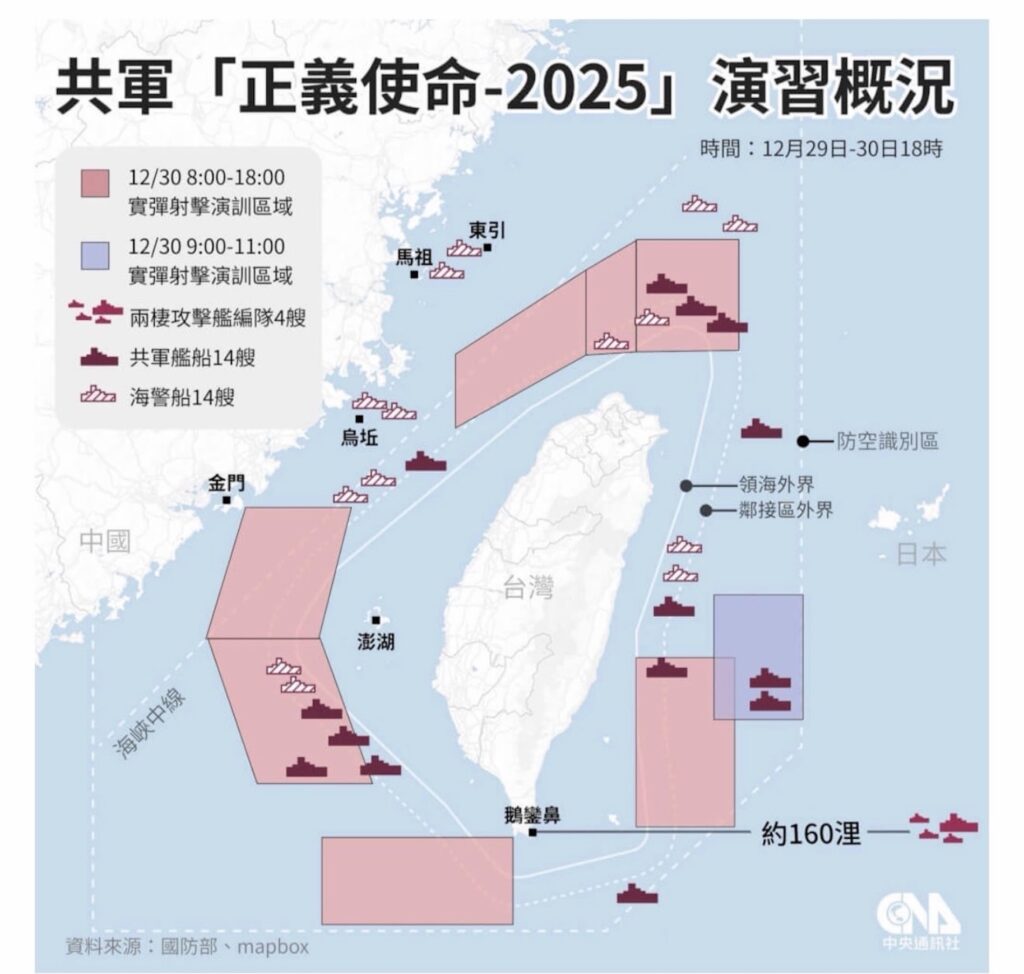
The recent activation of the Chinese operation Justice Mission 2025 marks a new point of military pressure on Taiwan. These are military exercises that include live-fire maneuvers and the designation of five zones around the island, subject to maritime and airspace restrictions for a period of ten hours. The deployment coordinated joint actions by the army, navy, air force, and missile force, configuring a comprehensive and highly intimidating exercise that goes beyond a routine demonstration of capabilities (Reuters, 2025; Ministry of National Defense of the Republic of China (Taiwan), 2025).
These maneuvers took place just three days after China’s Ministry of Foreign Affairs announced sanctions in response to U.S. arms sales to Taiwan. In its official statement, Beijing declared that “China has decided to take countermeasures in accordance with the Law of the People’s Republic of China on Countering Foreign Sanctions against 20 companies related to the U.S. military industry and 10 senior executives who have participated in the supply of weapons to Taiwan in recent years” (Ministry of Foreign Affairs of the People’s Republic of China, 2025).
For mainland China, the Taiwan issue constitutes “the first red line that must not be crossed in China–United States relations,” reinforcing the view that Justice Mission 2025 is not an isolated event, but rather part of a graduated coercive strategy (Reuters, 2025).
One of the most persistent errors in the global debate is treating the Taiwan contingency as a purely bilateral issue. In reality, the Taiwan Strait is a vital artery of global trade: more than 50% of global maritime transport transits through routes whose stability depends on it.
Added to this is an even more sensitive factor: Taiwan produces more than 90% of high-end semiconductors and more than 60% of conventional semiconductors, critical inputs for the global technology, military, automotive, and energy industries (Center for Strategic and International Studies, 2024; International Institute for Strategic Studies, 2024). Any scenario of military escalation would have immediate and systemic impacts, affecting supply chains, inflation, technological security, and financial stability in regions far removed from the Indo-Pacific.
Pressure on the island is part of a broader geopolitical strategy that includes control of the First Island Chain, power projection in the South China Sea, and direct competition with the United States for global primacy. Taiwan is a central piece not only because of its geostrategic location, but also because its survival as a functional democracy challenges the Chinese Communist Party’s narrative on governance, legitimacy, and political control (United States Department of Defense, 2024).
Alongside military coercion, China continues to advance a legal and discursive offensive based on UN General Assembly Resolution 2758 and the so-called One China principle. The interpretation promoted by Beijing does not derive from the text of the resolution, which is limited to resolving the issue of China’s representation at the United Nations. Passively accepting this narrative reduces the political costs of a potential military action and weakens the margins of international deterrence (CSIS, 2024).
In this context, the international community must move from rhetoric to action. The lack of coordination among like-minded countries favors mainland China. Democracies should abandon isolated statements and move toward coordinated messages and actions. Likewise, peace and stability in the Taiwan Strait must be systematically reiterated in multilateral forums (IISS, 2024).
Justice Mission 2025 is not only a warning directed at Taiwan; it is a test of the international system. Supporting Taiwan in a coordinated and unambiguous manner is a strategic decision to preserve global stability, economic security, and the balance of the international order (U.S. Department of Defense, 2024).
References
Center for Strategic and International Studies. (2024). China’s coercive military activities against Taiwan. CSIS China Power Project. https://chinapower.csis.org
International Institute for Strategic Studies. (2024). The Military Balance 2024. London, United Kingdom: IISS. https://www.iiss.org
Ministry of Foreign Affairs of the People’s Republic of China. (2025). Foreign Ministry spokesperson’s remarks on U.S. arms sales to Taiwan. Government of the People’s Republic of China. https://www.fmprc.gov.cn
Ministry of National Defense of the Republic of China (Taiwan). (2025). Press releases and situation updates on PLA military activities. Government of Taiwan. https://www.mnd.gov.tw
People’s Liberation Army. (2025). Joint firepower and combat readiness drills in the Taiwan Strait. PLA Daily. http://eng.chinamil.com.cn
Reuters. (2025, December 28). China’s military conducts live-fire exercises around Taiwan. Reuters.
United States Department of Defense. (2024). Military and Security Developments Involving the People’s Republic of China. Washington, DC: Department of Defense. https://www.defense.gov
The opinions expressed in this article are those of the author and do not necessarily reflect the views of the Miami Strategic Intelligence Institute (MSI²).