
27 Jun SITREP: Who Controls the Narrative? The Uncertain Fate of Iran’s Nuclear Program
By,
Octavio Perez, Senior Fellow | MSI2
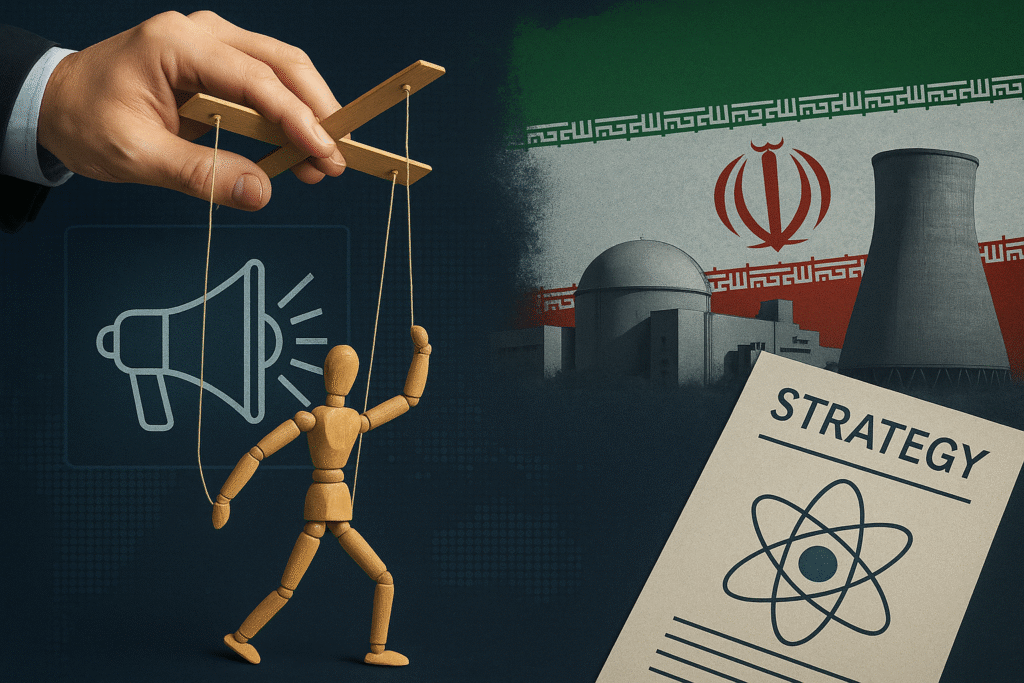
Who controls the discourse? What is the truth, and what is the intent? Was the Iranian nuclear program destroyed? Heavily damaged? Partially hit? Or will it be back in operation in two months?
Who to believe? Why would someone intentionally leak portions of a report? Technically, can you get 3-30 years in jail for doing so? Why has this been more common now than 40 years ago?
Although this could be a topic of discussion for a white paper, and how generations interpret the pursuit of truth, freedom, and national security; it is now more pervasive in our government that 40 years ago.
Under the guise of pursuing the truth and seeking headlines, the yellow press, the liberal media are quick to grasp security leaks and run with a headline based on a small piece of evidence to regain control of the discourse. If they are wrong, they will give it a political twist and turn it around.
How many times have you heard or seen an apology, a retraction, or a correction on a critical headliner gone bad? So here you have the facts and sources for you to weigh in on your own evaluation of the situation.
Start with the Jerusalem Post, as they reassure that, the regime is looking at restoring their nuclear program. And in doing so, JP quotes Mehr News as their source (making this a second source article).
The Mehr News Agency is a semi-official news agency sponsored by the government of Iran. It is headquartered in Tehran, and is owned by the Iranian Development Organization.
They go on and say what is still questionable is “whether the Fordow nuclear site was completely or partially destroyed…” JP then continues with the listing of documenting the listings of minor nuclear sites also destroyed, as well as a dozen or so nuclear scientists killed during the operation. It also states that more than 2/3 of the TELs (Mobile Transporter Erector Launchers) have also been destroyed, and includes that a large portion of the missile production factories are also gone.
So, let’s bulletize all this as we add on:
- Fordow (Partially or Completely destroyed)
- Other nuclear factories, sites, and associated gear were destroyed
- 2/3 of all MTELs (mobile transporter launchers)
- A large portion of the missile production factories
- A dozen or so nuclear scientists were killed
They continue to list the killing of 9 of the 13 primary military and intelligence chiefs during the operation and how they did this to destabilize the internal power & command structure of the IRGC and the Basij Militia.
Let’s add some more bullets:
- Death of 9 of 13 Key generals and Intelligence chiefs
- Destabilization of internal command and control (leadership) is intentional
- Over 30 generals and commanders both in the IRGC and the Intell svcs (intelligence services)
So, let’s move to another source, New York Times, where they reiterate the fact that the nuclear program consists of over 30 facilities and that the IAEA (International Atomic Energy Agency) from the UN, clearly said Israel had struck two centrifuge production facilities:
- Their initial report only said they had struck and damaged only the aboveground part of the enrichment plant
- But it later revised its assessment to confirm “direct impacts” on the underground enrichment halls
- Satellite imagery two days after the attack shows heavy machinery covering craters where the enrichment halls are believed to be
In addition to the Nuclear program, military facilities, and other key energy infrastructure sites were also hit:
- Main Gas Depot vicinity Tehran
- Central Oil Refinery (Fires visible at Shahran oil depot)
- A central Gas field, one of the largest in the country
- HQ Iran State television
- A missile base in Kermanshah (missile storage site damaged)
Bouncing around to other News sources like Axios, AP, we get this information:
A look at Iran’s remaining capabilities:
- Iran was said to have an estimated 2,500 ballistic missiles and thousands of drones when the 12-Day War started
- Around 2/3 of the missile launchers were destroyed (a 2nd confirmation of this event), and over 1,000 missiles were fired/destroyed
So, this leaves the Islamic Republic with 1,000 to 1,500 missiles and 100 launchers left. According to IDF estimates
- Over 80 Iranian Air Defense Batteries were also destroyed
- Iran could not shoot down any IDF planes, but two drones, and did have Air Superiority
- Israel carried out over 1,000 missions (sorties)
- Did over 600 aerial refueling missions
According to IDF BDA (bomb damage assessment)
- Airstrikes caused significant damage to the Natanz and Isfahan nuclear enrichment sites
- The attack on Fordo was a US mission and not assessed by the IDF
- The attacks on other sites such as the Arak Heavy Water reactor, the HQ of the SPND (where nuclear archives were kept), and several centrifuge production sites, have effectively pushed back the Nuclear program by a year
Missiles and drones
- Iran launched between some 550 ballistic missiles and around 1,000 drones at Israel during the war, according to the IDF
- The vast majority of the 1,000 drones, which are slower-moving but harder to track, failed to even make it to Israel’s borders
Even more stats on losses
- Hundreds more IRGC soldiers, including numerous members of the Basij internal security body, were killed in Israeli strikes, according to IDF assessments
So, let’s listen to what Axios has to say
- Israeli officials see “significant” damage to Iran’s nuclear facilities
- Many are perplexed by the leaked US Intel Report suggesting otherwise
- Israel has not produced a final report yet
Without an official final report from Israel and the US, it is obvious that the intended leak report has a political underwriting. The DIA report that claims it may have set them back only a few months, falls short of what could be a more concrete final report.
Trump said during a press conference at the NATO summit that the report was inconclusive and that the Israeli report would shed better light.
If you don’t understand that Israel, the Mossad may have better sources (Humint) in Iran to verify and substantiate the extent of the damage, then a report based on satellite photography only could very well be inconclusive.
Then again, if Israel which has more to lose and faces a direct threat from Iran, is largely satisfied with the early reports, why should a single agency report, pretty much based on a single source (Photint), Photographic Intelligence, only be more credible? Even when the Iranians have not issued their own internal report?
The advent of the leaked report, abrupt postponement of congressional briefings on Tuesday had also contributed to the opposition party to complain.
Steve Witkoff, on the other hand, rightfully so, said the leak is treasonous, and whoever did it should be prosecuted.
Also, within their article, they claim Israeli officials via intercepted communications suggest that Iranian military officials have been giving false SITREPs (Situation Reports) to the political leadership downplaying the actual damages… So to make it simple, Iranians themselves still don’t have their overall picture of what has happened.
AP News, Times of Israel, and Economic Times of India reach pretty much the same conclusions. Whether they all use the same source and do concede the following:
- All three sites (Natanz, Fordow, Isfahan) had significant damage
- Natanz’s above-ground enrichment facility was completely destroyed with w/signs of points to collapse of its underground infrastructure
- At Fordow, the GBU-57 did major damage to the facility, although it is not clear whether the underground facility suffered full structural collapse
- At Isfahan, the Uranium reprocessing facility was destroyed as well and the underground tunnels were damaged
- Doubtful whether these facilities will be operational immediately or near future
- Israeli officials do claim that the stockpile of 60% / 20% enriched uranium is now buried in rubble at Isfahan and Fordow
Apart from the direct damage to Iran’s Nuclear facilities, the decapitation of the military and scientific leadership, will have long-term crippling effects to the Nuclear program.
Eliminating A-list B-list nuclear scientists erases the institutional memory and actual experience in the program. Iran has transitioned through 6 types of autochthonous centrifuges which were designed by several of the dead scientists.
The fact that out of the 19,000 centrifuges in Natanz and Fordow many may be down is a tremendous factor. 16,426 of the IR 1 and IR 2m in Natanz are basically the initial low-level centrifuges that later provide the newer IR 4 IR 6 units to reach higher levels at Fordow.
So, replacing these is not an easy task, or something done in months. Add to that collateral labs and testing facilities that housed scientific equipment critical to weapons research. So if you expect a photo to be your single source and not weigh in all the other factors you are not providing an all source analysis.
On the other hand, some reports coming out of Tehran claimed that Iran relocated (nearly all its enriched uranium before the US strike. There is satellite imagery to support this claim. Now, according to Israeli sources, they do claim that Iran did manage to move 400 kg (1,016lbs) of enriched uranium at 60% from Fordow and Isfahan to an undisclosed place.
If they did move the material secretly, they transported it in construction vehicles, which do not provide the protection required to move such materials. To move adequately enriched uranium, you must have trucks with reinforced steel containers and a protective casing.
Satellite imagery could track their routes and eventual new location. So again, the question to ask is: Can Iran continue to build a nuclear weapon?
Can it rebuild its facilities at other undisclosed locations? And the answer is yes, but it will take years.
So, after you analyze all this, let’s see what the BBC, AP, NYT, and those who printed the story on the leak from DIA said…
The Intentional leak says:
- The US strikes on Iran’s nuclear facilities did not destroy the country’s nuclear program and probably only set it back by months
- The Islamic Republic’s stockpile of enriched uranium was not eliminated in Saturday’s bombings
- But sources familiar with the Pentagon’s intelligence assessment say Iran’s centrifuges are largely “intact” and the impact was limited to above-ground structures
- Entrances to two nuclear facilities were sealed off, and some infrastructure was destroyed or damaged, but much of the facilities, which are deep underground, escaped the brunt of the blasts that any resumption of its nuclear program may be based on how long it takes the country to dig out and make repairs.
The US has 18 intelligence agencies, which sometimes produce conflicting reports based on their mission and area of expertise.
The only unbiased truth in their review was that, “…it is possible future intelligence reports will include more information showing a different level of damage to the facilities”.
They did clarify that the Pentagon said it would take some time to assess the damage. The Pentagon did reiterate that the sites did sustain extremely severe damage.
The article, on the other hand, cites Hassam Abedini, from Iran’s state broadcasting, that the materials were safe and that they were taken out before the strike, but did not address the status of the facilities.
The article further states: “… He added that the administration hasn’t said whether the strikes destroyed Iran’s ability to weaponize its uranium, its uranium-enriching centrifuges or depleted its stockpile, which he said would be enough to create nine nuclear weapons…”
Another item they did address was a report in Saudi news outlet Al Hadath, citing an unnamed Israeli source, said that Israel believes most of Iran’s enriched uranium is buried under the rubble.
Somewhat balance to the leaked article, is when the cite David Albright’s comments (president of the Institute for Science and International Security and an expert on secret nuclear weapons development), who said that the damage Iran sustained by the US attacks will mean “it will take significant time, investment and energy” for it to restore its nuclear program.
And the smartest move was that the CIA and the Office of the Director of National Intelligence declined to comment on the DIA assessment.
Whenever we get an all-source report, that includes (HUMINT, SIGINT, PHOTINT) intelligence for Israel, the US, and still other foreign services, we will be able to substantiate one or the other. But there are too many loose ends to conclude that the damages would only set Iran’s program back several months.
The destruction of certain centrifuges at Natanz type IR-1 and IR-2, which pretty much start enrichment up to 20% would set back the program right there.
Keep in mind that there are cascading centrifuges and many other components that are needed to transition from one level to the other.
So, if you break the link at any level, it holds you back from achieving the next one. “…If they have 60% enriched uranium, but they don’t have the ability to enrich it to 90%, and, further, they don’t have the ability to convert that to a nuclear weapon, that is mission success…”
“And that is the obliteration of their nuclear program, which is why the president, I think, rightly is using that term,” Vance said…
Finally, if Iran launched a covert nuclear program, it would do so at a disadvantage, having lost to Israeli and American strikes vital equipment and personnel that are crucial for turning the enriched uranium into a functional nuclear weapon.
Intentional leaks often do more damage than help clarify the truth; the complexity of what happened requires time. Reclaiming the discourse is a tactic to underestimate a person or government and its accomplishments.
Read whatever you want, consider the source, but never let yourself be sold on a single-source analysis.
Footnotes
After uranium is enriched, it is typically converted back into a solid form, specifically uranium dioxide (UO2), which is then used to create nuclear fuel pellets. The enriched uranium hexafluoride (UF6) gas is heated and chemically processed to form the UO2 powder.
Approximately 42 kilograms of 60% enriched uranium is theoretically enough to produce one atomic bomb if enriched further to 90%, according to the U.N. nuclear watchdog.
References
Associated Press. (n.d.). Early US intelligence report suggests US strikes only set back Iran’s nuclear program by months. Retrieved June 26, 2025, from https://apnews.com/article/iran-nuclear-program-military-strikes-trump-f0fc085a2605e7da3e2f47ff9ac0e01d
Axios. (n.d.). Israeli officials see “significant” damage to Iran’s nuclear facilities. Retrieved June 26, 2025, from https://www.axios.com/2025/06/25/iran-nuclear-program-israel-damage-intelligence
BBC News. (n.d.). Trump pushes back after leaked report suggests Iran strikes had limited impact. Retrieved June 26, 2025, from https://www.bbc.com/news/articles/ce9x809vgrro
BBC News. (n.d.). US strikes did not destroy Iran nuclear program, says intelligence assessment. Retrieved June 26, 2025, from https://www.bbc.com/news/articles/ckglxwp5x03o
The Economic Times. (n.d.). Where is 400 kg enriched uranium? Iran claims to secretly move nuclear material to undisclosed location before US airstrikes hit nuclear sites. Here’s how uranium may have been transported secretly. Retrieved June 26, 2025, from https://economictimes.indiatimes.com/news/international/us/where-is-400-kg-enriched-uranium-iran-claims-to-secretly-move-nuclear-material-to-undisclosed-location-before-us-airstrikes-hit-nuclear-sites-heres-how-uranium-may-have-been-transported-secretly/articleshow/122028401.cms?from=mdr
The Jerusalem Post. (n.d.). Iran is looking to restore its nuclear industry, Iran’s nuclear chief says. Retrieved June 26, 2025, from https://www.jpost.com/middle-east/iran-news/article-858888
The New York Times. (n.d.). See What Strategic Infrastructure Israel Has Damaged in Iran. Retrieved June 26, 2025, from https://www.nytimes.com/interactive/2025/06/18/world/middleeast/israel-iran-strikes-facilities-map.html
Times of Israel. (n.d.). The Israel-Iran war by the numbers, after 12 days of fighting. Retrieved June 26, 2025, from https://www.timesofisrael.com/the-israel-iran-war-by-the-numbers-after-12-days-of-fighting/
The opinions expressed in this article are those of the author and do not necessarily reflect the views of the Miami Strategic Intelligence Institute (MSI²).