23 Oct Panama Is Not a Bystander: Why President Mulino’s “Bilateral” Framing Misses the Point
By,
CDR JoséAdán Gutiérrez, USN (Ret), Senior Fellow, MSI²
Gerardo Arias, Geopolitical analyst and graduate in International Studies
Abstract
During an October 2025 press conference, Panamanian President José Raúl Mulino argued that the current tensions between the United States and China are a “bilateral” dispute that should not involve Panama. While the desire for neutrality is understandable, it ignores a hard fact: Panama already sits at the crossroads of two competing world powers—digitally, economically, and strategically. The country has become the central node in China’s Digital Silk Road push in the hemisphere and a priority security concern for Washington.
This article—built on MSI²’s prior research on Huawei’s entrenchment in Panama—explains why the “bilateral” narrative undercuts Panamanian sovereignty and proposes a framework of active neutrality: one grounded in transparency, clean networks, and balanced partnerships that safeguard the Canal, ports, and national data.
What the President Said—and Why It Matters
At his weekly press conference on October 16, 2025, President José Raúl Mulino criticized perceived U.S. Embassy pressure on Panamanians with business ties to China and declared that the clash between Washington and Beijing was a “bilateral” issue in which Panama should not be entangled (AP News, 2025). He humorously added that “the best Panamanian breakfast is a Chinese breakfast.”
His remarks landed in a country already wired into both powers’ strategic circuits. While politically calibrated to display independence, they obscure a deeper reality: Panama is not a neutral observer but an operational beachhead for both powers. Its geography, ports, and digital arteries make it an inevitable intersection of influence—shaped by history yet cemented by policy.
Panama placed itself in this position when it opened its doors to the Chinese Communist Party in 2017, and China came. Then-President Juan Carlos Varela announced the change in a televised address on June 12, 2017, stating that establishing full diplomatic ties with Beijing was the “correct path for our country.”
Panama Is Already a Digital Battleground
Huawei’s footprint. Since the late 2010s, Huawei Technologies Co. Ltd. has built operations in Panama, including proposals to operate a regional “Transparency and Cybersecurity Center” and participation in national 5G rollouts (China Global South, 2025).
U.S. countermeasures. In June 2025, the U.S. Embassy in Panama announced an $8 million modernization project with the Ministry of Public Security to replace Huawei telecom equipment at thirteen critical sites (U.S. Embassy, 2025; BNamericas, 2025). The program explicitly referenced “secure network resilience” and “shared hemispheric security.”
Policy trajectory. Under President Mulino, Panama has not renewed its 2017 Belt and Road Memorandum of Understanding and has publicly reiterated that the Panama Canal remains under full national control, signaling a recalibration of ties with Beijing (Reuters, 2025).
These developments confirm that Panama’s digital and physical infrastructure has become a strategic interface—not a spectator platform—in the U.S.–China rivalry.
Why “It’s Bilateral” Undercuts Panama’s Interests
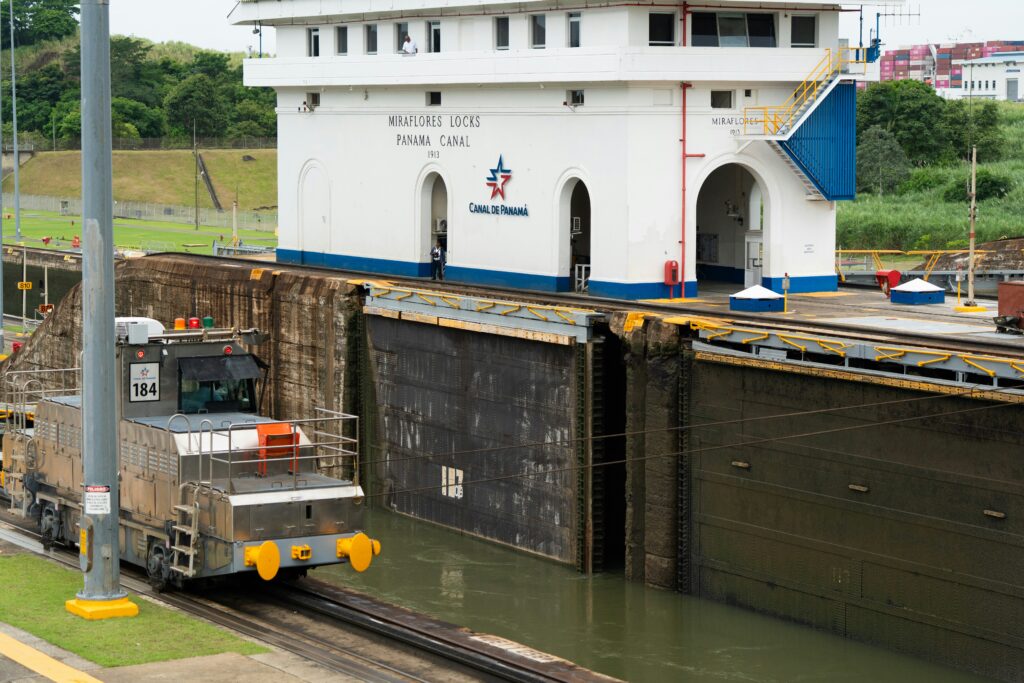
Neutrality is a moral choice only when geography and infrastructure allow disengagement. Panama’s position between two oceans and two great powers removes that luxury. The nation’s assets make it a systemic node—one whose neutrality must be actively defended, not merely declared.
1. Canal and Ports as Global Leverage. The Canal Zone and the Balboa–Cristóbal port complex are global chokepoints. Embedding high-risk foreign vendors in port operations, logistics software, or national data centers amplifies external leverage over Panama’s decision-making and crisis response.
2. Security Externalities. When law-enforcement networks or maritime sensors rely on untrusted equipment, the first victim is Panama’s sovereignty—only then Washington’s. The U.S. program to replace Huawei systems, therefore, serves both nations’ security interests (BNamericas, 2025; U.S. Embassy, 2025).
3. Regulatory Credibility. Panama’s 2023 5G security decree, which effectively excluded high-risk vendors, established a model for the region. Weakening that precedent would invite loophole-hunting by foreign-backed firms and undermine investor confidence.
The Strategic Frame Panama Actually Needs
Active neutrality is not silence; it is sovereignty through rules. MSI² proposes four actionable pillars:
1. Clean-Core Infrastructure
• Exclude high-risk vendors from 5G cores, law-enforcement networks, port and canal operational and information-technology systems, and government clouds.
• Publish an annual Trusted Vendor List and transparently complete the thirteen-site equipment-replacement program.
2. Data Sovereignty and Transparency
• Mandate data localization for critical government and infrastructure datasets.
• Create a National Cyber Transparency Registry identifying ultimate beneficial ownership and foreign-government influence, including military–civil fusion risks.
3. Canal and Port Risk Hardening
• Commission an independent Canal/Port Tech Risk Review assessing hardware, firmware, and software vulnerabilities.
• Conduct periodic cyber-resilience exercises with trusted partners to stress-test segmentation and emergency failover.
4. Balanced Diplomacy with Clear Red Lines
• Maintain trade with all partners within those guardrails.
• Codify prohibitions on foreign base rights, untrusted vendors in security networks, and exclusive control of dual-use infrastructure.
• Use financing from trusted partners (e.g., the U.S. International Development Finance Corporation, the European Union, Japan, and Taiwan) to crowd in clean alternatives—ensuring that security and affordability align.
A Direct Note to President Mulino
Mr. President, Panama should never be bullied by anyone—but sovereignty is not defended by calling the contest “bilateral” and moving on. It is defended by transparent rules that shield your canal, ports, and data from undue influence. The United States will remain engaged because these arteries sustain hemispheric stability—and hemispheric stability anchors U.S. security.
The responsible path forward is assertive neutrality with teeth: clean networks, open data, and trusted partnerships grounded in transparency and national pride.
References
AP News. (2025, October 16). Presidente de Panamá señala presuntas presiones de funcionaria de la embajada de EEUU. https://apnews.com/article/panama-china-eeuu-presiones-funcionaria-embajada-visas-82f980ff30f2954492a81b27cd3f1eac
BNamericas. (2025, June 12). US working with Panama to remove Huawei telecoms equipment. https://www.bnamericas.com/en/news/us-working-with-panama-to-remove-huawei-telecoms-equipment
Bloomberg. (2025, June 11). US replacing Huawei towers in Panama to ‘counter China’. https://www.bloomberg.com/news/articles/2025-06-11/us-replacing-huawei-towers-in-panama-to-counter-china
China Global South. (2025, July 9). Huawei out, Washington in: Panama’s 5G reset. https://chinaglobalsouth.com/analysis/panama-huawei-5g-us-china-central-america/
La Estrella de Panamá. (2025, October 17). Presidente Mulino: “Amenazar con visas no soluciona la crisis entre EE.UU. y China”. La Estrella de Panamá. https://www.laestrella.com.pa/panama/presidente-mulino-amenazar-con-visas-no-soluciona-la-crisis-entre-ee-uu-y-china-OI16784587
La Prensa. (2025, October 16). ‘Una funcionaria de la embajada, amenazando con quitar visas’: Mulino cuestiona presiones de Estados Unidos. La Prensa. https://www.prensa.com/politica/una-funcionaria-por-ahi-de-la-embajada-amenazando-con-quitar-visas-mulino-cuestiona-presiones-de-estados-unidos/
Reuters. (2025, February 2). Presidente de Panamá descarta debate sobre canal pero ofrece ayuda en migración. https://www.reuters.com/latam/negocio/FCEOW5UCTZO2BFHRODFPPN6AEQ-2025-02-02/
U.S. Embassy Panama. (2025, June 11). U.S. Embassy and Ministry of Security build telecommunications towers and install secure technology. https://pa.usembassy.gov/u-s-embassy-and-ministry-of-security-build-telecommunications-towers-and-install-secure-technology/
Author’s Note
This article builds on the MSI² study Panama as China’s Digital Bridgehead in the Western Hemisphere, (2025), aligning its conclusions with the 2025 U.S. National Defense Strategy’s homeland-first framework.
The opinions expressed in this article are those of the author and do not necessarily reflect the views of the Miami Strategic Intelligence Institute (MSI²).